10.1 Timeline of Events
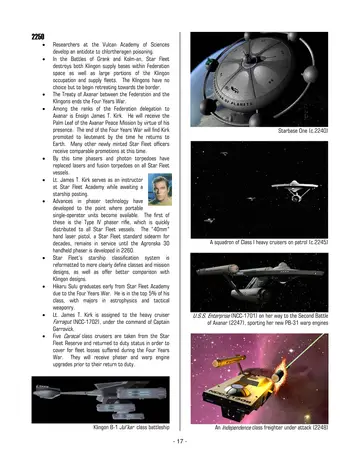
A year-by-year timeline from 2221 to 2250 records the authorization and entry into service of the Class I and Class II starship classes, the births of future Star Fleet luminaries (Scott, Spock, Kirk, Sulu, Uhura, Chekov, Decker), the Scandal of Archimedes and the Babel Conference of 2230, the launch and early career of the Enterprise under Captains April and Pike, the breakthroughs in phaser and PB-series warp engine technology, and the campaigns of the Four Years War from the First Battle of Axanar to the Treaty of Axanar.
2221
- Kel Titiac of Cochrane Warp Dynamics develops the PB-30 circumferential warp engine. Externally, it appears almost identical to the PB-20, yet it sports a number of power and system improvements over its predecessor.
- The Hermes class scout is authorized for construction.
- The Saladin class destroyer is authorized for construction.
- The Ptolemy class transport/tug and its transport container system are authorized for construction.
- The Carolina class frigate is refused authorization due to concerns about its unorthodox design. This will open the door for acceptance of the Surya and Loknar.
- The last of the Stellarford class spaceliners are decommissioned. They will make a comeback of sorts as troop transports during the Four Years War.
2222
- The U.S.S. Constitution (NCC-1700), the first official Class I starship and the first of the Class I heavy cruisers, is launched from the San Francisco Navy Yards Orbital Complex at Terra on 16 March. She is officially commissioned into the fleet on 3 May. NOTE: The launch of the Constitution marks the official beginning of Star Fleet’s Class I starship program.
- Robert April, age 34, is personally selected by Commodore William van Anling, head of the Class I Program, to be the first captain of the heavy cruiser Enterprise. Over the next year he will work with lead engineer Franz Joseph IV in familiarizing himself with his new command while it undergoes final free-space assembly in orbit at the San Francisco Navy Yards at Terra. April’s pre-command familiarization will become something of a tradition among future Enterprise commanders.
- Montgomery Edward Scott, destined to become one of the greatest starship engineers of his era, is born on 3 March in Aberdeen, Scotland, on Terra.
- The Lowell class scouts are withdrawn from service.
2223
- The Provider class space tugs are retired from service.
- The heavy cruiser Enterprise is launched on 4 July amid great fanfare and a personal appearance by Federation President Samuel Solomon Qasr.
- Captain April takes the Enterprise directly into fleet service without the traditional shakedown cruise. This will become something of an unspoken tradition among Enterprise commanders in the years to come.
- Four more Constitution class heavy cruisers are laid down and construction proceeds simultaneously. Construction on all ship classes in Star Fleet’s new Class I Program begins in earnest. In particular, the Constitution class will proceed at the rate of 3-4 ships built every year until the initial order of 12 ships is completed. The final task of the Constitution first build program will be to upgrade the prototypes Republic and Constellation to something approaching class production specifications.
- The Caracal class cruiser Audace (NCC-757) disappears without a trace near the Klingon border. It is believed to be the first Star Fleet vessel ever to fall victim to a Klingon attack.
2224
- The Saladin class destroyer enters service.
- The Hermes class scout enters service.
- The Ptolemy class transport/tug enters service.
- The Hunter class corvettes are retired from service.
- The Mann class survey cruisers are retired from service.
- PB-30 warp engines are refitted to all Detroyat class heavy destroyers. A number of small yet significant quirks that come to light during their use will lead to the development of the improved PB-31 a few years later. The PB-31 will quickly replace the PB-30 for use with all Baton Rouge era upgrade programs.
- The Scandal of Archimedes is exposed, renewing the political power of the Terra Return League.
- A revitalized Cosmadyne Corporation becomes one of the major bidders in Star Fleet’s Class I Program.
2225
- Spock, son of Sarek, one of the few Vulcan-Human hybrids to survive birth and destined to become one of the greatest Star Fleet officers in history, is born in the city of ShiKahr on Vulcan.
2226
- Arbing and Lidde renews its bid to build a dreadnought. Their revised proposal is based on the new Class I Program and uses standard Class I components. As before, with its initial Baton Rouge era submission, the design is set aside due to high projected cost and lack of apparent need.
- Yet another civil war begins within the Klingon Empire. Five contenders for the Chancellorship will be assassinated within the year. There will also be a significant reduction in the number of Houses seated on the High Council before all is said and done.
- The Kzinti test Federation resolve in the Slavin Incident. The end result is five Kzinti ships destroyed and a sixth captured.
2227
- Growing dissention within the Federation saps its economic strength and threatens its defensive window of capability. The Klingons perceive an opportunity to wage war against their newest foe and begin making preparations.
- The Ceti Alpha system is first surveyed by an unmanned probe.
- The PB-31 circumferential warp engine is developed. It is little more than a slightly improved PB-30 with its problems fixed.
- Kelvar Garth, from the planet Izar, graduates at the top of the Star Fleet Academy class of 2227. He earns dual majors in tactics and military history.
2228
- The Marklin class destroyers enter service.
- Dilithium deposits are discovered on Rigel XII, causing a mining boom in the local economy of the Rigel system. The Orion pirates will sell dilithium crystals from Rigel to both the Federation and the Klingons.
- An Orion slave ship is captured and impounded by an Andorian police ship. From its databanks come the only Federation star charts known for the far side of Tholian space.
- End of the Klingon civil war. Chancellor Kar’harmer becomes the new ruler of the Empire. He openly endorses an all-out war with the Federation.
- The USS Kresta (NCC-1712), the last ship in the Class I heavy cruiser program, is cancelled. Funds allocated for its construction are instead used to convert both Class I Program prototypes, the USS Constellation (NCC-1017) and the USS Republic (NCC-1371) to full Class I specifications.
- Captain Robert April completes his first five-year mission aboard the starship Enterprise and is reassigned.
2229
- The Independence class cargo transports enter service. They are the first of Star Fleet’s new Class II support vessels, designed to supplement the new Class I fleet.
- Birth of James Tiberius Kirk, the greatest starship commander in Federation history. He is born 22 March on Terra at the Kirk family farm in Riverside, Iowa. He is the second son of Star Fleet officer George Kirk.
- Chancellor Kar’harmer authorizes the Imperial Klingon fleet to begin a massive shipbuilding program in order to fuel his planned war with the Federation.
2230
- The Klingons send their first ambassador, Captain Krenn (sutaiRustazh) to the Federation. He arrives with great flourish in the IKV Serpant, a disarmed D-5 Dupat class cruiser that has been granted special permission to serve him in Federation space. It is Star Fleet’s first look at a “modern” Klingon battlecruiser. Krenn’s first task is to attend this year’s Babel Conference as a non-voting visiting dignitary.
- The Second Babel Conference is disrupted by members of the Terra Return League, who advocate the dissolution of the Federation. After a moving speech by philanthropist Carter Winston a vote on the resolution fails to pass. The Terra Return League dissolves shortly thereafter, breaking up into splinter groups such as the Independent Systems Movement. Such movements prove to be of great interest to Captain Krenn for their intelligence gathering potential.
- The obsolete Caracal class cruisers are decommissioned, starting with the U.S.S. Caracal itself (NCC-750). It is donated to the Federation Air and Space Museum for preservation, while the rest of the class is placed in the Star Fleet Reserve.
- Both single-hull and double-hull Class II “container ships” enter service.
- Hikaru Itaka Sulu, one of the great Star Fleet commanders of the present era, is born 24 June at San Francisco General Hospital on Terra.
2231
- The Hale class scouts are retired from service.
- Photon grenades are developed for use as heavy weapons for the Star Fleet Marines and starship landing parties facing hostile situations.
- A major breakthrough is made in weapons development involving the creation of a pulse phase laser beam more powerful than an ordinary laser. This will become known as the phaser. Over a decade will pass before phaser technology becomes refined enough for mass production.
2232
- Star Fleet begins refitting many of its older class starships with PB-31 warp engines. The aging light cruiser USS Texas (NCC-900) is the first to receive them.
- Birth of Williard Decker, son of Star Fleet officer Matthew Decker. He will be remembered as the only Star Fleet starship captain never to command a starship “in the field,” due largely to the events surrounding the Vejur Crisis and his untimely death in 2267.
2233
- The Kzinti make their presence known again in the Monaba Incident.
- Cochrane Warp Dynamics buys out Kloratis Drive Systems in a friendly takeover bid. The reorganized Kloratis Systems Division of Cochrane will specialize in impulse engines and non-dilithium moderated, reduced-size warp engines for long-range shuttlecraft and small starships.
- Nyota Upenda Uhura is born on 19 January on Terra in the Kitui Province of Kenya.
2234
- A Star Fleet study calls for a new class of starship, based on components of the Class I Program, which can relieve the Class I heavy cruisers of border patrol and perimeter action duties. The term “perimeter action” sticks and the new starship class is termed a perimeter action ship. Two very different proposals are submitted to Star Fleet at this time for approval. One of these will become the troubled Akula class. The other, the Kiaga class, will become a legend in its own time.
- Star Fleet becomes aware of a 70% drop in Klingon border activity within the space of a few months. Only later is it learned that this corresponds to the Demon War on the backside of the Klingon Empire. This will delay Klingon plans to assault the Federation by a full decade.
- Arbing and Lidde finally gets the go-ahead to build its Baton Rouge era Invincible class dreadnought as a demonstrator of the dreadnought concept.
- The science ship SS Columbia disappears while on a deep space survey mission. It is eventually listed as missing, presumed lost.
2235
- The Sherman class cargo drone enters service. These will become the most ubiquitous Class II starships of their time.
- The planet Holberg 917G is purchased by businessman Micah Brack for his personal use.
- Star Fleet authorizes the construction of a single prototype for the Akula class perimeter action vessel. It will experience numerous delays in construction and testing due to its unique over/under warp engine configuration.
- All remaining Baton Rouge generation starships under construction are cancelled save for the two closest to completion. These are the Baton Rouge class cruisers Liberty and Chauncey. The remainder will be scrapped in their slips and their components scavenged for use with existing Baton Rouge generation hulls. Star Fleet needs the extra yard space for additional Class I starship construction. Among the list of cancellations is Arbing and Lidde’s dreadnought prototype. NOTE: The year 2235 marks the official end of the Baton Rouge era of starships.
2236
- The USS Liberty (NCC-1373) and USS Chauncey (NCC-1374) join the fleet as the last two Baton Rouge era starships.
- The Alexis class cargo drones enters service. These will later be uprated to Sherman class specifications.
- As an experiment, Star Fleet converts four of its old Texas class light cruisers into “commando cruisers.” These are for the exclusive use of the Star Fleet Marines in support of assault operations. Lessons learned from the conversion and subsequent operations will be incorporated into the future Miranda class starship program.
- The Deodryat class heavy destroyer USS Resolution (NCC-1101) is pulled from service to be converted to a new Class I “second wave” starship design. It will serve as the prototype for the Surya class frigates.
- The largest space rescue in history occurs when the USS Deerslayer rescues the 600+ passengers and crew of the disabled SS Juliana.
- At the request of the UESPA Foundation the retired Marshall class destroyer UES Hannibal (NAR-D246) is donated to the Federation Air and Space Museum. It undergoes an extensive, privately funded restoration over the next three years. The restored Hannibal will become the centerpiece of the museum’s Romulan War exhibit.
- The Federation begins experimenting with zero-point energy devices for use as a tactical singularity weapon. This research will not bear fruit for decades; however, it will eventually result in the concept of the quantum torpedo by the turn of the century.
- The Federation Council approves Star Fleet’s request for a “second wave” of Class I starships to supplement its existing Class I Program vessels. Out of this new series will come the Larson class destroyer, the Nelson class scout, the Pompey class heavy destroyer, and the Loknar class frigate.
- The Wolf 359 Combined Fleet Exercise is the largest war games operation conducted by Star Fleet to date. It is also the first in which Class I starships take part in significant numbers.
2237
- A young starship engineer named Montgomery Edward Scott begins making a name for himself in the Federation Merchant Marine.
2238
- The Surya class frigate program is formally authorized.
- Montgomery Scott is recommended for the Star Fleet Academy based on his excellent record in his year of service with the Federation Merchant Marine.
- Wrigley’s Pleasure Planet is founded by a private business consortium “for the pleasure and entertainment of all space travelers and passers-by.” The many vices it offers will make it a legend among Federation starship crews.
- The starship USS Republic (NCC-1371) is reassigned as the official training ship of the Class I Program on 30 May. It will operate in conjunction with both regular Star Fleet forces (retraining) and the Star Fleet Academy Training Command (midshipman training) on Terra. In time it will become the Academy’s official training starship.
2239
- The Federation outpost on Caleb IV is attacked without provocation by a Klingon battle group testing a prototype cloaking system. The test fails to go as planned and the Klingons are quickly routed by Federation forces. This incident marks the return of the Klingons in force to the Federation border.
- The Battle of Donatu V (results inconclusive).
- One of the side benefits of the duotronics breakthrough is the development of the universal translator. This will be quickly adopted for use by Star Fleet vessels and landing parties.
- The Aurelians become the first intelligent avian race to join the Federation.
2240
- The Larson class destroyer enters service.
- The Nelson class scout enters service.
- The Frobisher class cutter enters service.
- Star Fleet cancels the remainder of its order for 100 Fraternity class (modified Independence class) transports even though only 14 have been delivered. At this time it feels it has more than enough transports to fulfill Federation needs. Star Fleet will regret this decision in the years to come.
2241
- The Star Fleet White Paper for this year notes the initial success of the early Class I program starships, most notably the Constitution class heavy cruisers. It calls for a “third wave” of Class I starships to be built as soon as possible due to the Klingon threat. It also notes that due to budget and yard constraints the first of these new classes cannot enter service until 2244 at the earliest, assuming construction begins immediately.
- In light of the growing hostilities with the Klingon Empire the Federation Council gives Star Fleet a blank check for its Class I starship program. At least a half-dozen new Class I designs are authorized for immediate construction, with more under serious consideration for future building. Among the new classes authorized are the Akula and Kiaga class perimeter action ships, as well as the Kearsarge class light cruiser.
- The Eagle class civilian starliner enters service.
- The Tarsus IV Massacre. The Merchant Marine freighter SS Dierdre is the first on the scene with relief supplies, albeit too late to save the 4000 colonists that Governor Kodos has already murdered. Kodos disappears in the ensuing riot. Eventually, a body burned beyond recognition is found and claimed to be his. Among the survivors are two boys, James Kirk and Kevin Riley, who were visiting relatives on the colony prior to the imposition of martial law.
- Star Fleet Intelligence begins receiving reports of a new battlecruiser in Klingon service. These initial reports mislead analysts to believe that the new class is no more effective than the current D-5 Dupat class.
- The size of the Surya class is reduced to a more reasonable 28 hulls on order. 11 more will be re-authorized two months before construction begins on the first.
- Unknown to the Federation, Chancellor Kar’harmer of the Klingon Empire has given his blessing for an all-out war. The Klingons begin massing forces along their shared border with the Federation.
- Pavel Andreievich Chekov is born 19 September on Terra in Pushkino, Russia.
2242
- The Cochrane class colonial transport enters service.
- The Loknar class frigate enters service. This class as a whole will see more action than any other Federation starship class during the Four Years War. It is based on the NX-cruiser design study of the 2150s. It will also prove to be a favorite with Star Fleet’s Andorian contingent (aka “the Blue Fleet”). More Andorians will serve on Loknar class frigates than any other given Class I starship design to date.
- Montgomery Scott is commissioned as an officer in Star Fleet upon graduation from Star Fleet Academy.
- The survey cruiser Wells inexplicably travels through time, completing a three-year mission in only 33 days.
2243
- Dr. Lawrence Marvick is one of the principal designers of the PB-32 circumferential warp engine. This is the first to allow sustained cruising speeds in excess of the “time barrier” of Warp 6. These will not enter Star Fleet service until the start of the Bonhomme Richard heavy cruiser program.
- DD495 series drydocks are phased out of service.
2244
- The Pompey class heavy destroyer enters service.
- The Surya class frigate enters service.
- The Canopus class research ship enters service.
- All Deodryat class heavy destroyers are reclassified as heavy scouts following the introduction of the Pompey class starships.
- Spock of Vulcan enrolls in Star Fleet Academy against his father’s wishes. He is the first Vulcan to join in Star Fleet in the normal “human” manner. His father, Ambassador Sarek of Vulcan, is outraged by Spock’s choice. The two will not speak to each other again for the next two decades. NOTE: All previous Vulcans serving in Star Fleet were either pre-Charter naval transfers or exchanges arranged by the Vulcan Academy of Sciences.
- “Space bag” protective gear becomes standard on all Star Fleet vessels.
- Dr. Leonard Horatio McCoy enlists in Star Fleet after his wife walks out on him, having been caught in an adulterous affair and taking their daughter Joanna with her.
- Captain Robert April, who has replaced the infirmed William van Anling as officer in charge of the Class I Program, is promoted to commodore and accepts an appointment as Federation ambassador-at-large. As an honor for the program’s success, Star Fleet Command lets Commodore April pick the next captain of his former command, the starship Enterprise.
- Commodore April picks Commander Christopher R. Pike, the new executive officer of the destroyer Darius, as the new captain of the Enterprise. At age 33, this will make Pike the youngest starship captain in Star Fleet history at the time.
- A Klingon sneak attack at Tassem-Loki III is ample proof of the Empire’s new intentions toward the Federation. Star Fleet begins staging additional forces along the border in anticipation of a full-bore Klingon attack.
- The Arcanis IV Massacre almost triggers the Four Years War two years early.
- In light of increasing hostilities with the Klingon Empire, Star Fleet’s Starship Design Bureau requests Arbing and Lidde to present an updated version of its dreadnought proposal. The intent is to begin construction as soon as Federation Council approval is granted. The outbreak of the Four Years War will prevent this from happening.
- The Brass Ring Incident takes place on the Federation-Romulan border.
- The USS Lovell manages to salvage a crashed Klingon scout ship. Much is gleaned from the wreckage concerning the Klingon’s S-Graph FTL engine technology.
2245
- A second block of Class I heavy cruisers is authorized for construction. This will become the Bonhomme Richard class.
- The Kearsarge class light cruiser enters service.
- PXK pergium fission reactors are phased out of use in the Federation around this time.
- Auroral plague strikes Dramia II. A Star Fleet medical mission lead by Lt. Leonard McCoy is unsuccessful in determining the cause of the plague. Only a handful of the population survives.
- The heavy cruiser Enterprise is laid up at San Francisco Navy Yards at Terra for her first ESLP overhaul. It is expected to take eleven months to complete. It is at this time that Pike formally receives his assignment orders from Commodore April transferring him to the Enterprise. April then gives Pike a personal tour of his new command.
- Among those involved with the Enterprise’s overhaul is Lt. Montgomery Scott. This will be his first encounter with the Enterprise, but by no means his last.
- Future Star Fleet captain James T. Kirk gets his first exposure to life in space as a cargo hauler aboard an industrial freighter. His father, Commander George Kirk, was instrumental in arranging the job for him.
- Star Fleet notices a massive buildup of Klingon forces around the Axanar star system. They correctly interpret this as setting the stage for the long-expected war between the two interstellar powers.
2246–2250 — The Four Years War
NOTE: For the Klingon perspective on the Four Years War, please consult the Federation Spaceflight Chronology Supplement A: The Klingon Empire.
2246
- The Akula class perimeter action ship enters service.
- James T. Kirk is admitted to the Star Fleet Academy. He is sponsored by Commodore Robert April, an old family friend.
- The Federation scout vessel Gulliver is destroyed by a Klingon task force staging at Axanar. This event marks the opening act of the Four Years War.
- Captain Kelvar Garth, commander of the Marklin class heavy destroyer Xenophon and overall commander of a hastily assembled squadron of Star Fleet vessels, makes a name for himself at the First Battle of Axanar. His brilliant battle tactics in the face of overwhelmingly superior Klingon forces results in an undisputed Federation victory. It also prevents the Klingons from mounting a devastating “first strike” against Federation border forces. For this Garth will be decorated and receive a battlefield promotion to the rank of fleet captain. Garth’s victory at Axanar will be studied at the Star Fleet Academy for decades to come.
- The Federation formally declares war with the Klingons due to the situation in the Axanar star system.
- All four starships of the Santee class are hurriedly assembled from off-the-shelf Class I and Class II starship components. They will comprise Star Fleet’s first dedicated shuttlecarriers since the building of the Illustrious. Experience gained in their construction and operation will lead to the development of the Coronado class through-deck cruiser.
- The planned overhaul of the Enterprise is cut short due to the war. The ship is hurriedly put back together for action against the Klingons. The refit has proceeded long enough, though, for the Enterprise to be fitted with new PB-31 warp engines prior to reassembly and departure from spacedock.
- Among those assigned to the Enterprise before it ships out is Lt. Montgomery Scott, by his own request. He is assigned as junior assistant engineer under Chief Engineer Caitlin Barry.
- Phaser technology (PHASed Energy Rectification) is perfected. It will take another two years to develop the necessary support systems so Star Fleet vessels can be upgraded with this new weapons system. That will not stop Star Fleet from developing a prototype weapon known as the phaser cannon. Its one and only deployment will be the new Kiaga class perimeter action ship already under construction.
2247
- The Second Battle of Axanar also results in a Federation victory. This is Captain Pike’s first action as a starship commander and earns him a commendation from Captain Garth. Klingon forces have penetrated elsewhere along the border, though, and continue to make significant inroads into Federation space.
- The Federation suffers heavy losses at the Battles of GR-1 and Nozseca VIII.
- The Battle of Revonet, also known as the Attack on Convoy Y-162, ends in a Federation victory. It also marks the end of all major Klingon advances into Federation space for the time being.
- Star Fleet establishes the Zone of Transport Escort over a large region of Federation space along the border. This restricts the movement of civilian shipping within the war zone as well as providing for armed escorts for all Federation shipping operating within the Zone. This act not only saves the Federation’s transport capability but also significantly cuts down on the number of pirate attacks and unexplained starship disappearances. The Zone of Transport Escort will remain in effect for the rest of the Four Years War.
- All contact is lost with the old UESPA deep space probe Friendship One.
- The Klingons suffer their worst defeat yet in the Nostveg Engagement. Star Fleet losses are minimal in comparison. The presence of the newly deployed Kiaga class perimeter action ship, with its prototype phaser cannon, is the deciding factor in the battle.
- By this time enough dedicated Class I military designs have entered service for Star Fleet to withdraw the Constitution class heavy cruisers from the front lines. They are returned to survey and exploration duties.
- Dr. Leonard McCoy sees action during the Four Years War as a surgeon aboard the USS Hood (NCC-1707).
- A young Lieutenant Spock is assigned to the Enterprise as part of Captain Pike’s first official five-year mission.
- Starbase 25 begins operations. It is the unofficial “quarter-century” mark in Star Fleet’s ongoing and oft-delayed starbase construction program.
- The Coventry class frigate enters service.
2248
- The Battle of Sinbad IV includes the first major ground action of the Four Years War, with Star Fleet Marines taking on an occupation force of 30,000 Klingons led by a crack Imperial Guard battalion. The fight to liberate the planet eventually ends in a Federation victory, with Klingon forces fighting to the last man. The events of this hard-fought action will become the stuff of legend among the Star Fleet Marines, ranking in the same pantheon of stories as the campaign to liberate Alpha Centauri during the Earth-Kzin Wars.
- Meanwhile, up in orbit above Delgon-R, the major moon of Sinbad IV, a nine-ship Klingon task force charged with defending the planet is attacked head-on by the Federation Sixth Fleet. In the space of 30 minutes all but three of the Klingon ships are destroyed, with the badly mauled survivors limping away as fast as they can. Star Fleet losses are three starships destroyed, two crippled, and the rest of the fleet receiving light to moderate damage.
- The Battle of Sinbad IV marks the turning point of the Four Years War. The Klingon Imperial Navy has penetrated as deep as 15 parsecs into the Federation in some places; however, its supply lines are strained and its resources are overtaxed.
- The Miranda class cruiser enters service.
- The Bonhomme Richard class heavy cruiser enters service.
- The Agilis class perimeter attack ship enters service.
- Star Fleet General Order 7 is enacted, prohibiting contact with the natives of Talos IV on pain of death. This almost immediately follows a volatile encounter between the Talosians and Captain Christopher Pike of the starship Enterprise.
- The Klingons use chlortheragen nerve gas for the first time in action at Rudgur III.
- Hikaru Sulu is accepted to Star Fleet Academy.
- The Aakenn class freighter enters service.
2249
- Phaser weapon upgrades begin in earnest on all Star Fleet vessels, with priority given to those on the war front and to new builds. This technology automatically makes a Star Fleet vessel more powerful in battle than its Klingon counterpart. It will have a telling effect on the outcome of the war.
- New phaser-equipped starships are the key to the Federation victory at the Battle of Thranstor. The attacking Klingon fleets are thoroughly routed attempting their deepest penetration ever of Federation space. Star Fleet goes on the offensive.
- James T. Kirk becomes the first Star Fleet Academy midshipman to beat its infamous Kobayashi Maru training simulation. His unorthodox solution had the virtue of having never been tried. It earns him his first-ever Star Fleet commendation — for original thinking.
- Wartime conditions have caused, among other things, the reduction of the Star Fleet Academy officer training program from four years to just two. James T. Kirk earns an early commission as a Star Fleet ensign this year due to the Four Years War.
- Disagreements with the chief surgeon of the Hood cause Dr. Leonard McCoy to request and be granted a transfer to the Star Fleet Surgeon General’s office. He will undertake numerous planetary medical missions, write several books, and earn a second doctorate (in pathology) during this time.
- Ensign James T. Kirk earns his second Star Fleet commendation by preventing a near-fatal explosion and saving the lives of 10 crewmen aboard the training starship Republic (NCC-1371). The officer-in-charge, Commander Benjamin Finney, is reprimanded and reduced in rank.
- Project Citadel is enacted. This program is designed to develop a starship class suited for fleet command ship operations. It will eventually result in the development of the Balsom and Citadel class starships, as well as the later uprated Nordenskjold auxiliary command cruiser program.
- The Chariot class civilian cargo hauler enters service.
- The Federation gets a major intelligence break due to the defection of Admiral Komex, one of the leading Klingon commanders on the war front. Among the data Komex shares are the locations of both major Klingon supply bases in the war zone.
2250
- Researchers at the Vulcan Academy of Sciences develop an antidote to chlortheragen poisoning.
- In the Battles of Grank and Kolm-an, Star Fleet destroys both Klingon supply bases within Federation space as well as large portions of the Klingon occupation and supply fleets. The Klingons have no choice but to begin retreating towards the border.
- The Treaty of Axanar between the Federation and the Klingons ends the Four Years War.
- Among the ranks of the Federation delegation to Axanar is Ensign James T. Kirk. He will receive the Palm Leaf of the Axanar Peace Mission by virtue of his presence. The end of the Four Years War will find Kirk promoted to lieutenant by the time he returns to Earth. Many other newly minted Star Fleet officers receive comparable promotions at this time.
- By this time phasers and photon torpedoes have replaced lasers and fusion torpedoes on all Star Fleet vessels.
- Lt. James T. Kirk serves as an instructor at Star Fleet Academy while awaiting a starship posting.
- Advances in phaser technology have developed to the point where portable single-operator units become available. The first of these is the Type IV phaser rifle, which is quickly distributed to all Star Fleet vessels. The “40mm” hand laser pistol, a Star Fleet standard sidearm for decades, remains in service until the Agronska 30 handheld phaser is developed in 2260.
- Star Fleet’s starship classification system is reformatted to more clearly define classes and mission designs, as well as offer better comparison with Klingon designs.
- Hikaru Sulu graduates early from Star Fleet Academy due to the Four Years War. He is in the top 5% of his class, with majors in astrophysics and tactical weaponry.
- Lt. James T. Kirk is assigned to the heavy cruiser Farragut (NCC-1702), under the command of Captain Garrovick.
- Five Caracal class cruisers are taken from the Star Fleet Reserve and returned to duty status in order to cover for fleet losses suffered during the Four Years War. They will receive phaser and warp engine upgrades prior to their return to duty.