1.9 Terran Explorations: Luna (Sol IIIb)
A survey of Terra's moon Luna, covering its likely origin, lifeless airless surface, the nine early manned landings, planetary specifications, and major surface features.
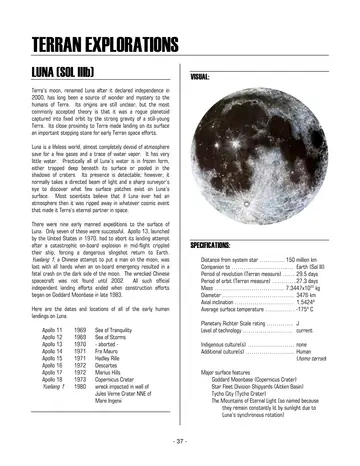
Terra's moon, renamed Luna after it declared independence in 2000, has long been a source of wonder and mystery to the humans of Terra. Its origins are still unclear, but the most commonly accepted theory is that it was a rogue planetoid captured into fixed orbit by the strong gravity of a still-young Terra. Its close proximity to Terra made landing on its surface an important stepping stone for early Terran space efforts.
Luna is a lifeless world, almost completely devoid of atmosphere save for a few gases and a trace of water vapor. It has very little water. Practically all of Luna's water is in frozen form, either trapped deep beneath its surface or pooled in the shadows of craters. Its presence is detectable; however, it normally takes a directed beam of light and a sharp surveyor's eye to discover what few surface patches exist on Luna's surface. Most scientists believe that if Luna ever had an atmosphere then it was ripped away in whatever cosmic event that made it Terra's eternal partner in space.
There were nine early manned expeditions to the surface of Luna. Only seven of these were successful. Apollo 13, launched by the United States in 1970, had to abort its landing attempt after a catastrophic on-board explosion in mid-flight crippled their ship, forcing a dangerous slingshot return to Earth. Yueliang 1, a Chinese attempt to put a man on the moon, was lost with all hands when an on-board emergency resulted in a fatal crash on the dark side of the moon. The wrecked Chinese spacecraft was not found until 2002. All such official independent landing efforts ended when construction efforts began on Goddard Moonbase in late 1983.
Here are the dates and locations of all of the early human landings on Luna:
- Apollo 11 — 1969 — Sea of Tranquility
- Apollo 12 — 1969 — Sea of Storms
- Apollo 13 — 1970 — aborted
- Apollo 14 — 1971 — Fra Mauro
- Apollo 15 — 1971 — Hadley Rille
- Apollo 16 — 1972 — Descartes
- Apollo 17 — 1972 — Marius Hills
- Apollo 18 — 1973 — Copernicus Crater
- Yueliang 1 — 1980 — wreck impacted in wall of Jules Verne Crater NNE of Mare Ingenii
Specifications: Distance from system star 150 million km; Companion to Earth (Sol III); Period of revolution (Terran measure) 29.5 days; Period of orbit (Terran measure) 27.3 days; Mass 7.3447x10²² kg; Diameter 3476 km; Axial inclination 1.5424°; Average surface temperature -175° C; Planetary Richter Scale rating J; Level of technology current; Indigenous culture(s) none; Additional culture(s) Human (homo terran).
Major surface features include Goddard Moonbase (Copernicus Crater), the Star Fleet Division Shipyards (Aitken Basin), Tycho City (Tycho Crater), and the Mountains of Eternal Light (so named because they remain constantly lit by sunlight due to Luna's synchronous rotation).