5.1 Timeline of Events
A year-by-year timeline of the 2065-2100 era covers the end of the Earth-Kzin Wars, first contacts with the Vulcans, Kaferians, Tellarites, Andorians, Orions and Deltans, the loss of the survey cruisers Valiant and Defiant, the establishment of subspace radio and the space lane network, the founding of the Coalition of Planets, and the War with the Vegan Tyranny.
2065 • The Treaty of Sirius ends the Earth-Kzin Wars. • Sirius IX, site of the signing of the Treaty of Sirius, is colonized. This is mankind’s first official space colony outside of his own interstellar sphere of influence. • A disabled Vulcan starship is chanced upon by the Terran survey cruiser Amity. Its crew is rescued and brought back to the Sol System to recuperate before being returned to their homeworld of Vulcan. This is humanity’s first official contact with the Vulcans. • In a parallel first contact event a Franklin series probe comes across a Vulcan colony world. The Vulcan colonists send the probe back with a message inviting humanity to visit both them and their homeworld. • The starship Cochrane is the first human vessel ever to visit the planet Vulcan. • Humanity’s behavior during the Earth-Kzin Wars has convinced the Vulcans that they are a noble species, despite their emotionalism, and worthy of their benevolence. They will become the greatest allies of humanity during this time, helping introduce it to the other major Local Group cultures and disarming any potential conflicts that may arise. One of the first technological exchanges between humanity and the Vulcans results in improved warp drive engines. • The starship Bonaventure leaves the Sol System on its first real interstellar voyage. What was to be a five-year mission exploring the outer Local Group star systems turns instead into a nine-year mission of discovery. It is the first of many exploration ships that will follow in its wake. • The galactic survey cruiser Valiant leaves the Local Group on a mission “to the edge of the galaxy,” attempting to determine the ultimate fate of the missing spaceship Courageous and its crew. It departs upward from the plane of the ecliptic, following the last known course of the Courageous before all contact was lost. • The galactic survey cruiser Defiant leaves the Local Group in like manner as its sister ship Valiant. In the case of the Defiant it is headed downward from the plane of the ecliptic. • The nickname “torpedoes” becomes common for starship missiles around this time.
2066 • The planet of Kaferia (Tau Ceti system) is the first of the Vulcan-suggested worlds in the Local Group visited by humanity. It is also the first with insect-derived intelligent life. First contact goes better than expected and the Kaferians eventually invite humanity to establish a colony on their world. • The postwar Cold Peace falls on Terra, inhibiting moves towards a one-world government. • The Defiant is destroyed by a previously unknown alien power. It will take over two decades for its distress call to reach the nearest Local Group star system.
2067 • The UESPA advanced space probe Friendship One is launched. • The first of fifteen Terra series space arks is built and launched. This marks the beginning of Terra’s Second Great Space Rush (2067-2088). A large number of Terran colonization efforts are directed towards the Ficus Sector and other regions of space deemed potentially compatible with human life forms. • The Valiant is caught in a spatial fold within an ion storm that hurtles it millions of light-years within seconds. It re-emerges only two years away from the galactic rim, well beyond the range of communications with the Local Group.
2068 • Formal diplomatic relations are established between humanity and the Vulcans. • The Vulcans are the first to suggest a major interstellar alliance among the major powers of the Local Group. Mankind, with the memories of the Earth-Kzin Wars still fresh in its mind, is eager to take up the suggestion. Nothing comes of this at the time because humanity is not yet ready for such an alliance. It will have to stabilize its government, then meet and become friendly with the other major powers before this can happen. The Vulcans offer their support in this effort.
2069 • The 100th anniversary of the first manned landing on Luna is celebrated. • The Valiant is lost “at the edge of the galaxy.” • The massive Martian Colonies Spaceyards and Orbital Complex are formally reorganized and renamed as the Utopia Planitia Shipyards.
2070 • As a direct result of the encounter with the Kaferians, the authors of UESPA’s Xenobiological Probability Study are laughed out of the organization. • No trace is found of the Botany Bay by UESPA ships along the route to Tau Ceti. The common theory is that it was hit by a rogue meteor and knocked off course. The odds of finding Khan and his escaped Eugenics War supermen now make the proposition a practical impossibility. • The first attempt to build a working transporter is deemed a failure. Its inventor, Colin Blakeney, is lost under mysterious circumstances. His disappearance sets back research into transporter technology for decades to come.
2071 • The first working subspace radio transmitter, based on Vulcan research and technology, is built. This will free mankind’s reliance on geon holes as a means of communications, although geon hole technology is retained as a fallback measure. The domain of geon hole communications will eventually pass to the civilian sector (hobbyists in particular) as subspace radio becomes more powerful and reliable. • The galactic survey cruiser Valiant is officially declared “missing, presumed lost” by UESPA. • An interstellar trade pact is signed by representatives of the Sol System (Terra), Alpha Centauri (Toliman), and 40 Eridani (Vulcan), and includes their respective space colonies as well. Some historians see this as the first real step on the long road leading to the founding of the Federation. • One of the immediate outcomes of this trade agreement is the initial definition of major space lanes and trading routes. This will form a series of trade corridors that in time becomes the backbone of the Federation’s own space lane network. Almost all of these early space lanes and trade routes remain in use today. • The Terran interstellar MultiDock enters service. 115 of these will eventually be built with the support of Terra’s new allies. They will be placed along major space routes and at strategic points within the Local Group. This is the forerunner of the Federation’s Starbase and Deep Space Station networks. • Terra sends its first manned expedition to Europa since the loss of the Nautilus. • The Wanderer, a former L-5 space city, becomes mankind’s largest-ever spacecraft after it is modified with fusion drives by its inhabitants and rockets out of the Sol System.
2072 • The last of Terra series space arks is launched. • The Merchant class explorers enter service. • Terra abandons Intersat code for interstellar communications.
2073 • The space buoy marker system comes into being. They are deployed to mark the first commercial spacelane network (as defined by the 2071 treaty). • The first subspace relays are deployed. • First contact is made with the Tellarites. • The last of the Glenn class space buses is retired. • The planet Hera is colonized by the last known survivors from the losing side of the Eugenics Wars.
2074 • The Cochrane Interstellar Express (CIE-07) starships enter service. These are the first starships designed for use by the civilian sector and the last ever built by Cochrane Warp Dynamics. After this the company abandons starship design to focus more on warp drive development and production. • The first test of the new Local Group subspace radio network is successful, with messages being relayed at 64 times the speed of light. • The Bonaventure arrives at Alpha Centauri, having successfully completed its first interstellar voyage. It brings back a wealth of information on worlds within the Local Group. A second voyage is commissioned as soon as the ship is refurbished and upgraded. This process will take almost six years to complete due to rapid advances in starship technology since the Bonaventure’s was first launched.
2075 • The Franklin class scout enters service (not to be confused with the Franklin automated probe). • Around this time, many Terran pre-warp interstellar starships are either converted to warp drive or retired from service as more warp-based designs become available. The starship Icarus, the lone survivor of its class, is retired rather than converted. Its unique design makes it a poor candidate for a full warp drive conversion. Most of these retired pre-warp starships eventually find their way to the civilian sector, where they will labor on for decades (and centuries) to come. • First contact with the Andorians almost ends in disaster when they attack the UESPA vessel visiting their world.
2076 • The Aquarius class automated bulk transports enter service. They will become a familiar sight on the Local Group’s space lane network, transporting raw materials and bulk goods from one star system to another.
2077 • The Vulcans intervene to prevent a new interstellar war between Terra and Andor. Their logic to the Andorians is that Terra was the power behind the defeat of the Kzinti Empire. They are a species worth knowing, not fighting, and Andor would better be served as their ally instead of their enemy. Andor and Terra will eventually become strong allies despite this initial rocky start, just as the Vulcans have predicted. • The Parr class transports are retired.
2078 • The Messier class cruisers enter service. This is the last major Terran starship class and the last whose components are manufactured exclusively within the Sol System. • Birth of Harmon Axelrod, first president of the Federation. • As of this date there are 33 self-sufficient human colonies on 10 extraterrestrial worlds. • The Wayne class scouts are decommissioned. • Growing xenophobia against “alien influences” in certain parts of the world disrupts the increasingly impotent New United Nations. The warlords of the devastated zones in Asia and Europe begin to fight among themselves, bringing about the Warlord War.
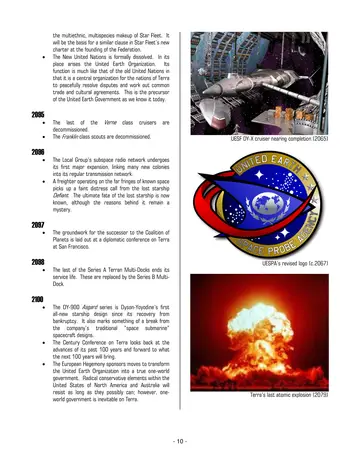
2079 • As the rest of Terra watches in horror, atomic weapons are employed as the last remaining factions from the Post Atomic Horror effectively exterminate each other in the short-lived Warlord War. This marks the last use of atomic weapons on Earth. • The surviving elements of the United States, Canada, Mexico, and the Carribean islands band together to form the United States of North America. • The Pacific League of States is formed around this time. • Humanity visits the Rigel system for the first time after hearing of their existence from the Tellarites. The starship Marco Polo, a visiting Terran vessel, also has mankind’s its first encounter with Rigel’s Orion colonies. Their trade goods and technology are discovered to be far in advance of anything that the system currently has to offer in exchange. Nonetheless, Orion merchants plan to “invade” this new market as soon as possible, offering their system’s plentiful raw materials in exchange for Local Group merchandise. • A temporary hiatus, lasting only a few years, occurs in Terran interstellar exploration. This is partly due to government reluctance and partly due to the culture shock resulting from the encounter with the Orion colonies, where slavery of Orion females is not only permitted but officially endorsed by the government. • The WP174 work pods enter service. • All save the class ship of the Magellan class spaceliners are withdrawn from service.
2080 • The Companion class cruisers are decommissioned save for the Fisher. It is converted to a diplomatic cruiser for use by diplomats and officials of the New United Nations. • Zephram Cochrane leaves Alpha Centauri and relocates to Terra, where he works at Princeton-Pennsylvania as a professor for a time. • The European Hegemony forms around this time. • The surviving African nations band together to form the United States of Africa. • The Russian Federation forms around this time. • The newly refurbished and rechristened starship Bonaventure leaves Alpha Centauri on its second major interstellar voyage. This time its mission is to the systems in former Kzinti space beyond the Local Group. • By this point humanity has a number of thriving space colonies both within the Local Group and beyond. Far many more colonization attempts have failed or disappeared without a trace.
2081 • The first of the Quantum (aka Milky Way) series of deep space probes, jointly developed by humans and Vulcans, is launched.
2082 • Now that the major powers of the Local Group are finally acquainted and at peace with each other, the Vulcans once again raise the idea of a formal interstellar alliance. They sponsor a conference on the subject. The move fails to receive popular support because its primary goals and policies are not adequately defined. The Vulcans resolve to try again at a later date. In the meantime the attending diplomats agree to work together to better define the roles and responsibilities of the new government. • The Cosmos class survey ships enter service. • The first major incident with the Kzinti since the end of the Earth-Kzin Wars takes place. They attempt to capture the Bonaventure in order to gain the secrets of warp drive. Star Fleet comes to the rescue; however, the Bonaventure is so heavily damaged in the encounter that its second voyage comes to a premature end. It is subsequently towed back to the Sol System and repaired sufficiently for public display as man’s first true starship. It will remain a museum ship for almost a century. • Problems encountered in towing the Bonaventure back to the Local Group will result in the production of the Assist class starships.
2083 • The UESF cruiser Pollux becomes the first Terran starship with an alien crewmember. Its communications officer is a Vulcan. • The last of the war-era Keller class space ambulances are decommissioned. • The Andorians are the next of the major Local Group powers to achieve faster-than-light travel. The other powers within the Local Group have only minimal input in this effort per the wishes of the Andorians. Their cultural pride dictates that they be recognized for their own accomplishments rather than accept the charity of others.
2084 • The Ceres Expedition, an early colonization effort to the Ceres Sector, is lost. Their descendants will be rediscovered decades later on Capella IV. • The lone ship of the DY-1000 series, also known as the Edison class, enters service. It is a colossal failure due to inadequate shielding and sub-par warp performance. Dyson-Yoyodyne goes bankrupt and passes into receivership as a result of this debacle, marking the end of an era in Terran spacecraft design.
2085 • A previously unknown disease contracted from an unscrupulous Orion trader wipes out the entire staff of the Pluto Research Base. The trader flees for his life and escapes back to the Orion colonies, where he escapes prosecution by Terran authorities. This unpleasant incident sets the tone for future Terran-Orion relations. • The Assist class starships enter service. These are “space tugs” designed to tow damaged or disabled starships at warp speed back to the nearest base or planet for repair.
2086 • The first Andorian starships with warp drive begin operating within the Local Group. • The Verne class starship Fletcher explodes in near-Earth orbit after a catastrophic warp drive failure within Earth’s gravity well. The subsequent investigation determines that its unusual warp field created by its triple-engine arrangement was probably responsible for the failure. This is the first hard evidence of the difficulties in maintaining a stable warp field with an odd number of engine nacelles, given the limitations in starship technology at the time. It is the only black mark in the otherwise excellent service record of the Verne class. • The loss of the Fletcher marks the beginning of the rise of the fortunes of Cochrane Warp Dynamics, as its warp engine technology has proven to be more stable than current Terran designs. Most Terran warp drive manufacturers will go bust or change business venues by the end of the century.
2087 • Vulcan sponsors the first of the Babel Interplanetary Conferences is held. These will become annual events, designed to allow the Local Group systems to peacefully resolve their disputes without resorting to warfare. • The Coalition of Planets is founded as a loose alliance among the major and allied systems of the Local Group during this year’s Babel Conference. This is the forerunner of the Federation as we know it today. • All members of the Coalition of Planets consent to Terra taking on the lion’s share of Coalition space exploration and defense. Terra’s United Earth Star Fleet is named as the Coalition’s official space defense agency. UESPA is named as its official science and exploration agency. Coalition members begin coordinating many of their own space defense and exploration efforts through Star Fleet and UESPA after this point.
NOTE: From this point on the term Star Fleet will be used in place of the acronym UESF in light of its new role with the Coalition of Planets.
2089-2094 • The War with the Vegan Tyranny.
2089 • Another Vegan ship is encountered, the first since the end of the Earth-Kzin Wars. It fires on a Terran ship and the Terran ship returns fire, disabling it. The Vegan ship self-destructs before it can be seized. This marks the beginning of the War with the Vegan Tyranny. • The War with the Vegan Tyranny marks Star Fleet’s first real test as the defensive arm of the Coalition. • The decisive actions of the Star Fleet starships Krushchev and Cochrane prevent the War with the Vegan Tyranny from escalating into a major interstellar conflict. • The British royal family surrenders Buckingham Palace and many of their other royal estates to a public trust and move into more modest lodgings. They still continue in their ceremonial roles per the wishes of their subjects, however. Buckingham Palace is eventually turned into a museum.
2090 • A joint Star Fleet/Tellarite/Andorian operation defeats the Vegans in one of the major battles of the War with the Vegan Tyranny. • The first of Vega’s slave planets is freed by Star Fleet. • The Monticello class transports are decommissioned. • A second Kzinti “incident” is nipped in the bud when their ships run afoul of a squadron of Messier class cruisers engaged in battle with Vegan craft. Both sides break off the engagement to destroy their mutual enemy, the Kzinti. The two sides then leave the field of battle and conflict with the Vegans ends for a brief time. This will be the last Kzinti attempt to break the confines of the Treaty of Sirius in this century. The incident is considered a victory by Star Fleet and helps increase their prestige with the public.
2092 • A trade corridor is established between Rigel and the Local Group. Soon, Orion traders and merchants will be a common sight among Local Group systems. The practice of selling Orion’s “green animal women” as slaves will be forbidden by local laws, although many such purchases will be made in secret. • A new DY-245 “revival series” is launched by what remains of the Dyson-Yoyodyne consortium, which is still recovering from bankruptcy. A slight reworking of the classic DY-245 design with modern technology, these reproductions are the most affordable DY-series to date. Their low-cost jump drives makes the revival DY-245s the fastest DY-series ships of their time. Brisk sales among the denizens of the Terran asteroid belt help Dyson-Yoyodyne emerge from receivership within a few years. As a result of this success the new Dyson-Yoyodyne will limit future development of new ships types, focusing its efforts instead on the rapidly growing “classic starships” market.
2093 • Star Fleet learns that the Vegans are suffering from an extremely virulent disease, vegan choriomeningitis, which they call “the Green Death” and which will kill what few of them are left in short order. • The Vegans refuse Star Fleet’s offer to help them overcome the “Green Death” afflicting them. The xenophobic Vegans opt for racial suicide instead. The War with the Vegan Tyranny ends the following year with the deaths of the last Vegans. • The last of the Liberty class cruisers are decommissioned.
2094 • First contact with the Deltans at their new colony on Vega IX. • Star Fleet’s attempt to seize Vega IX (and any Vegan technological secrets it might hold) “for the safety of the Coalition” so outrages its members that a Babel Conference has to be called to resolve the situation. • One of the clauses of the Treaty of Vega IX, enacted during the emergency Babel Conference, guarantees the multiethnic, multispecies makeup of Star Fleet. It will be the basis for a similar clause in Star Fleet’s new charter at the founding of the Federation. • The New United Nations is formally dissolved. In its place arises the United Earth Organization. Its function is much like that of the old United Nations in that it is a central organization for the nations of Terra to peacefully resolve disputes and work out common trade and cultural agreements. This is the precursor of the United Earth Government as we know it today.
2095 • The last of the Verne class cruisers are decommissioned. • The Franklin class scouts are decommissioned.
2096 • The Local Group’s subspace radio network undergoes its first major expansion, linking many new colonies into its regular transmission network. • A freighter operating on the far fringes of known space picks up a faint distress call from the lost starship Defiant. The ultimate fate of the lost starship is now known, although the reasons behind it remain a mystery.
2097 • The groundwork for the successor to the Coalition of Planets is laid out at a diplomatic conference on Terra at San Francisco.
2098 • The last of the Series A Terran Multi-Docks ends its service life. These are replaced by the Series B MultiDock.
2100 • The DY-900 Asgard series is Dyson-Yoyodyne’s first all-new starship design since its recovery from bankruptcy. It also marks something of a break from the company’s traditional “space submarine” spacecraft designs. • The Century Conference on Terra looks back at the advances of its past 100 years and forward to what the next 100 years will bring. • The European Hegemony sponsors moves to transform the United Earth Organization into a true one-world government. Radical conservative elements within the United States of North America and Australia will resist as long as they possibly can; however, one-world government is inevitable on Terra.