8.22 Terran Explorations: Pyrimis A and B
Pyrimis A and B were a unique shared-orbit binary planetary pair whose decaying orbits doomed them to collide; their spacefaring inhabitants refused Federation evacuation on religious grounds, and fewer than a thousand dissenters escaped to resettle on Agleb III before the 2175 collision destroyed both worlds.
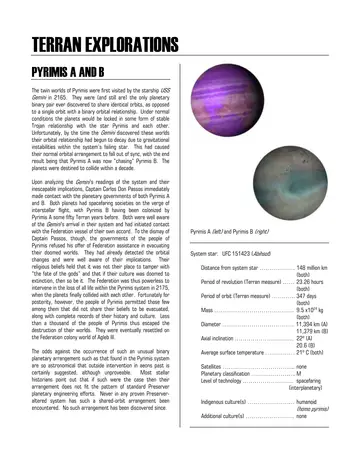
The twin worlds of Pyrimis were first visited by the starship USS Gemini in 2165. They were (and still are) the only planetary binary pair ever discovered to share identical orbits, as opposed to a single orbit with a binary orbital relationship. Under normal conditions the planets would be locked in some form of stable Trojan relationship with the star Pyrimis and each other. Unfortunately, by the time the Gemini discovered these worlds their orbital relationship had begun to decay due to gravitational instabilities within the system’s failing star. This had caused their normal orbital arrangement to fall out of sync, with the end result being that Pyrimis A was now “chasing” Pyrimis B. The planets were destined to collide within a decade.
Upon analyzing the Gemini’s readings of the system and their inescapable implications, Captain Carlos Don Passos immediately made contact with the planetary governments of both Pyrimis A and B. Both planets had spacefaring societies on the verge of interstellar flight, with Pyrimis B having been colonized by Pyrimis A some fifty Terran years before. Both were well aware of the Gemini’s arrival in their system and had initiated contact with the Federation vessel of their own accord. To the dismay of Captain Passos, though, the governments of the people of Pyrimis refused his offer of Federation assistance in evacuating their doomed worlds. They had already detected the orbital changes and were well aware of their implications. Their religious beliefs held that it was not their place to tamper with “the fate of the gods” and that if their culture was doomed to extinction, then so be it. The Federation was thus powerless to intervene in the loss of all life within the Pyrimis system in 2175, when the planets finally collided with each other. Fortunately for posterity, however, the people of Pyrimis permitted those few among them that did not share their beliefs to be evacuated, along with complete records of their history and culture. Less than a thousand of the people of Pyrimis thus escaped the destruction of their worlds. They were eventually resettled on the Federation colony world of Agleb III.
The odds against the occurrence of such an unusual binary planetary arrangement such as that found in the Pyrimis system are so astronomical that outside intervention in aeons past is certainly suggested, although unprovable. Most stellar historians point out that if such were the case then their arrangement does not fit the pattern of standard Preserver planetary engineering efforts. Never in any proven Preserver-altered system has such a shared-orbit arrangement been encountered. No such arrangement has been discovered since.
System star: UFC 151423 (Abihsot)
- Distance from system star: 148 million km (both)
- Period of revolution (Terran measure): 23.26 hours (both)
- Period of orbit (Terran measure): 347 days (both)
- Mass: 9.5 x 1024 kg (both)
- Diameter: 11,394 km (A), 11,379 km (B)
- Axial inclination: 22° (A), 20.6° (B)
- Average surface temperature: 21° C (both)
- Satellites: none
- Planetary classification: M
- Level of technology: spacefaring (interplanetary)
- Indigenous culture(s): humanoid (homo pyrimis)
- Additional culture(s): none