2.2 Lindbergh Class Space Ferry
Profiles of the chemical-powered Lindbergh class Space Ferry (Space Ferry II) and the AI-equipped Stellar series space probe, including their histories and specifications.
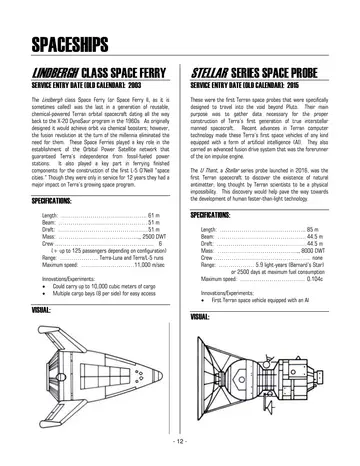
Lindbergh Class Space Ferry
Service entry date (old calendar): 2003
The Lindbergh class Space Ferry (or Space Ferry II, as it is sometimes called) was the last in a generation of reusable, chemical-powered Terran orbital spacecraft dating all the way back to the X-20 DynoSaur program in the 1960s. As originally designed it would achieve orbit via chemical boosters; however, the fusion revolution at the turn of the millennia eliminated the need for them. These Space Ferries played a key role in the establishment of the Orbital Power Satellite network that guaranteed Terra’s independence from fossil-fueled power stations. It also played a key part in ferrying finished components for the construction of the first L-5 O’Neill “space cities.” Though they were only in service for 12 years they had a major impact on Terra’s growing space program.
Specifications:
- Length: 61 m
- Beam: 51 m
- Draft: 51 m
- Mass: 2500 DWT
- Crew: 6 (+ up to 125 passengers depending on configuration)
- Range: Terra-Luna and Terra/L-5 runs
- Maximum speed: 11,000 m/sec
Innovations/Experiments:
- Could carry up to 10,000 cubic meters of cargo
- Multiple cargo bays (8 per side) for easy access
Stellar Series Space Probe
Service entry date (old calendar): 2015
These were the first Terran space probes that were specifically designed to travel into the void beyond Pluto. Their main purpose was to gather data necessary for the proper construction of Terra’s first generation of true interstellar manned spacecraft. Recent advances in Terran computer technology made these Terra’s first space vehicles of any kind equipped with a form of artificial intelligence (AI). They also carried an advanced fusion drive system that was the forerunner of the ion impulse engine.
The U Thant, a Stellar series probe launched in 2016, was the first Terran spacecraft to discover the existence of natural antimatter, long thought by Terran scientists to be a physical impossibility. This discovery would help pave the way towards the development of human faster-than-light technology.
Specifications:
- Length: 85 m
- Beam: 44.5 m
- Draft: 44.5 m
- Mass: 8000 DWT
- Crew: none
- Range: 5.9 light-years (Barnard’s Star) or 2500 days at maximum fuel consumption
- Maximum speed: 0.104c
Innovations/Experiments:
- First Terran space vehicle equipped with an AI