11.0 Overview
2251-2275: The Linear Warp Revolution I remember the first time I saw the Enterprise after she was rebuilt. We were rushed, we had a deadlin
2251-2275: The Linear Warp Revolution
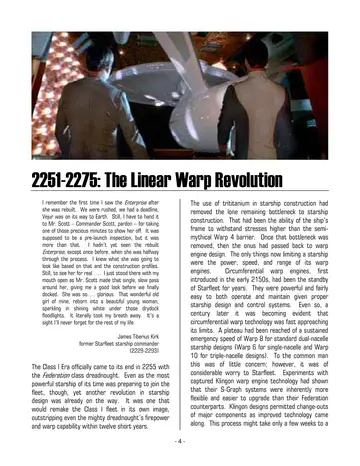
I remember the first time I saw the Enterprise after she was rebuilt. We were rushed, we had a deadline, Vejur was on its way to Earth. Still, I have to hand it to Mr. Scott – Commander Scott, pardon – for taking one of those precious minutes to show her off. It was supposed to be a pre-launch inspection, but it was more than that. I hadn’t yet seen the rebuilt Enterprise, except once before, when she was halfway through the process. I knew what she was going to look like based on that and the construction profiles. Still, to see her for real …. I just stood there with my mouth open as Mr. Scott made that single, slow pass around her, giving me a good look before we finally docked. She was so … glorious. That wonderful old girl of mine, reborn into a beautiful young woman, sparkling in shining white under those drydock floodlights. It literally took my breath away. It’s a sight I’ll never forget for the rest of my life.
James Tiberius Kirk former Starfleet starship commander (2229-2293)
The Class I Era officially came to its end in 2255 with the Federation class dreadnought. Even as the most powerful starship of its time was preparing to join the fleet, though, yet another revolution in starship design was already on the way. It was one that would remake the Class I fleet in its own image, outstripping even the mighty dreadnought’s firepower and warp capability within twelve short years. The use of trititanium in starship construction had removed the lone remaining bottleneck to starship construction. That had been the ability of the ship’s frame to withstand stresses higher than the semimythical Warp 4 barrier. Once that bottleneck was removed, then the onus had passed back to warp engine design. The only things now limiting a starship were the power, speed, and range of its warp engines. Circumferential warp engines, first introduced in the early 2150s, had been the standby of Starfleet for years. They were powerful and fairly easy to both operate and maintain given proper starship design and control systems. Even so, a century later it was becoming evident that circumferential warp technology was fast approaching its limits. A plateau had been reached of a sustained emergency speed of Warp 8 for standard dual-nacelle starship designs (Warp 6 for single-nacelle and Warp 10 for triple-nacelle designs). To the common man this was of little concern; however, it was of considerable worry to Starfleet. Experiments with captured Klingon warp engine technology had shown that their S-Graph systems were inherently more flexible and easier to upgrade than their Federation counterparts. Klingon designs permitted change-outs of major components as improved technology came along. This process might take only a few weeks to a
- 4 -
few months. Common Starfleet practice was to change out the entire engine and its associated control programs. This required a space dock or freespace reassembly area and was a process that took months to complete. If the Klingons made any major advances in their warp technology within the decade (and all intelligence pointed to them doing just that) then their newly refitted starships would probably outclass their current Starfleet counterparts. To prevent this, Starfleet would have to adopt a new warp engine design and do it now, while they still had time to put a fleet-wide upgrade plan into effect.
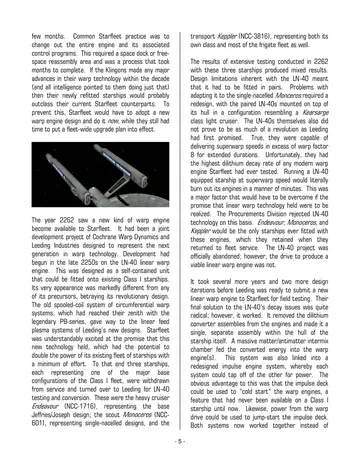
The year 2262 saw a new kind of warp engine become available to Starfleet. It had been a joint development project of Cochrane Warp Dynamics and Leeding Industries designed to represent the next generation in warp technology. Development had begun in the late 2250s on the LN-40 linear warp engine. This was designed as a self-contained unit that could be fitted onto existing Class I starships. Its very appearance was markedly different from any of its precursors, betraying its revolutionary design. The old spooled-coil system of circumferential warp systems, which had reached their zenith with the legendary PB-series, gave way to the linear feed plasma systems of Leeding’s new designs. Starfleet was understandably excited at the promise that this new technology held, which had the potential to double the power of its existing fleet of starships with a minimum of effort. To that end three starships, each representing one of the major base configurations of the Class I fleet, were withdrawn from service and turned over to Leeding for LN-40 testing and conversion. These were the heavy cruiser Endeavour (NCC-1716), representing the base Jeffries/Joseph design; the scout Monoceros (NCC601), representing single-nacelled designs, and the transport Keppler (NCC-3816), representing both its own class and most of the frigate fleet as well.
The results of extensive testing conducted in 2262 with these three starships produced mixed results. Design limitations inherent with the LN-40 meant that it had to be fitted in pairs. Problems with adapting it to the single-nacelled Monceros required a redesign, with the paired LN-40s mounted on top of its hull in a configuration resembling a Kearsarge class light cruiser. The LN-40s themselves also did not prove to be as much of a revolution as Leeding had first promised. True, they were capable of delivering superwarp speeds in excess of warp factor 8 for extended durations. Unfortunately, they had the highest dilithium decay rate of any modern warp engine Starfleet had ever tested. Running a LN-40 equipped starship at superwarp speed would literally burn out its engines in a manner of minutes. This was a major factor that would have to be overcome if the promise that linear warp technology held were to be realized. The Procurements Division rejected LN-40 technology on this basis. Endeavour, Monoceros, and Keppler would be the only starships ever fitted with these engines, which they retained when they returned to fleet service. The LN-40 project was officially abandoned; however, the drive to produce a viable linear warp engine was not.
It took several more years and two more design iterations before Leeding was ready to submit a new linear warp engine to Starfleet for field testing. Their final solution to the LN-40’s decay issues was quite radical; however, it worked. It removed the dilithium converter assemblies from the engines and made it a single, separate assembly within the hull of the starship itself. A massive matter/antimatter intermix chamber fed the converted energy into the warp engine(s). This system was also linked into a redesigned impulse engine system, whereby each system could tap off of the other for power. The obvious advantage to this was that the impulse deck could be used to “cold start” the warp engines, a feature that had never been available on a Class I starship until now. Likewise, power from the warp drive could be used to jump-start the impulse deck. Both systems now worked together instead of
- 5 -
separately, and both could be operated from each other’s control systems. Making the impulse deck part of the warp power assembly also had an added benefit, one that was vital to Leeding’s new warp engine design. In the past, impulse power was not normally used during faster-than-light travel. The impulse engines were allowed to idle or power auxiliary systems in order to keep their reactors running. This was necessary but ultimately wasteful. Leeding’s new design used this excess impulse power to reinforce the flux capacitors in the new unified dilithium converter assembly. This prevented the rapid dilithium decay of the LN-40 design by repeatedly reversing the polarity of the neutron flow, setting up a constant interference field to prevent decay from ever starting in the first place. It was an engineering kludge, admittedly, but it worked, and that was all that mattered. The final form of this design was termed the Leeding LN-64 linear warp engine. It would go on to become the namesake of a whole new generation of Federation starships.
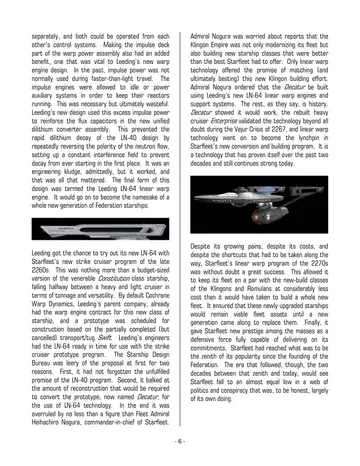
Leeding got the chance to try out its new LN-64 with Starfleet’s new strike cruiser program of the late 2260s. This was nothing more than a budget-sized version of the venerable Constitution class starship, falling halfway between a heavy and light cruiser in terms of tonnage and versatility. By default Cochrane Warp Dynamics, Leeding’s parent company, already had the warp engine contract for this new class of starship, and a prototype was scheduled for construction based on the partially completed (but cancelled) transport/tug Swift. Leeding’s engineers had the LN-64 ready in time for use with the strike cruiser prototype program. The Starship Design Bureau was leery of the proposal at first for two reasons. First, it had not forgotten the unfulfilled promise of the LN-40 program. Second, it balked at the amount of reconstruction that would be required to convert the prototype, now named Decatur, for the use of LN-64 technology. In the end it was overruled by no less than a figure than Fleet Admiral Heihachiro Nogura, commander-in-chief of Starfleet. Admiral Nogura was worried about reports that the Klingon Empire was not only modernizing its fleet but also building new starship classes that were better than the best Starfleet had to offer. Only linear warp technology offered the promise of matching (and ultimately besting) this new Klingon building effort. Admiral Nogura ordered that the Decatur be built using Leeding’s new LN-64 linear warp engines and support systems. The rest, as they say, is history. Decatur showed it would work, the rebuilt heavy cruiser Enterprise validated the technology beyond all doubt during the Vejur Crisis of 2267, and linear warp technology went on to become the lynchpin in Starfleet’s new conversion and building program. It is a technology that has proven itself over the past two decades and still continues strong today.
Despite its growing pains, despite its costs, and despite the shortcuts that had to be taken along the way, Starfleet’s linear warp program of the 2270s was without doubt a great success. This allowed it to keep its fleet on a par with the new-build classes of the Klingons and Romulans at considerably less cost than it would have taken to build a whole new fleet. It ensured that these newly upgraded starships would remain viable fleet assets until a new generation came along to replace them. Finally, it gave Starfleet new prestige among the masses as a defensive force fully capable of delivering on its commitments. Starfleet had reached what was to be the zenith of its popularity since the founding of the Federation. The era that followed, though, the two decades between that zenith and today, would see Starfleet fall to an almost equal low in a web of politics and conspiracy that was, to be honest, largely of its own doing.
- 6 -