12.2 Starships: The Dreadnought Program (Part 2)
STARSHIPS THE DREADNOUGHT PROGRAM (Pt. 2) SERVICE ENTRY DATES (OLD CALENDAR): ASCENSION CLASS: 2278 KOMSOMLSK CLASS: CANCELLED KIROV CLASS:
STARSHIPS THE DREADNOUGHT PROGRAM (Pt. 2) SERVICE ENTRY DATES (OLD CALENDAR): ASCENSION CLASS: 2278 KOMSOMLSK CLASS: CANCELLED KIROV CLASS: 2287 YAMATO CLASS: 2290
Starfleet began conversion of its Federation class dreadnoughts along with other ship classes during the fleetwide linear warp upgrade programs of the 2270s. Federation had been made obsolete overnight by this development, and the old design’s limits had been dramatically illustrated by the vain attempt of the dreadnought Entente (NCC-2120) to catch V’Ger before it could reach Earthspace. It would not do for one of Starfleet’s newest pre-linear Class I starships to be already obsolete, one that was supposed to be the fastest and most powerful of that same fleet. For this reason the Federation refit program began.
Unfortunately, Federation proved more costly and troublesome to convert to linear warp technology than any other other Class I starship. The specialized primary and secondary hulls were largely to blame for this, as was the need to keep the unique three-nacelle configuration in order to preserve its warp geometry. Delays and cost overruns continued to compound until, in the end, the Admiralty ordered that a simplified design be employed similar to that of the Enterprise refit. The custom primary and secondary hulls were discarded in favor of fleetstandard, linear warp era ones (save for dual docking ports on the bridge module) and a considerably simplified engine pylon system was adopted. The new arrangement employed a routinedetachable arrangement for the warp support pylons on the primary hull inspired by the one used on Belknap. The combined keel mount could not be copied for conversion reasons, so a modified version was used instead using parallel pylons at the top of the secondary hull instead of the old angled arrangement. All but three of the Federation class were successfully converted to the new uprated Federation standard, with the first reentering service in 2276. These last three would eventually received the Star League “total conversion” that had first been proposed, but not until long after the Federation upgrade program had ended and the days of the dreadnoughts themselves were numbered.
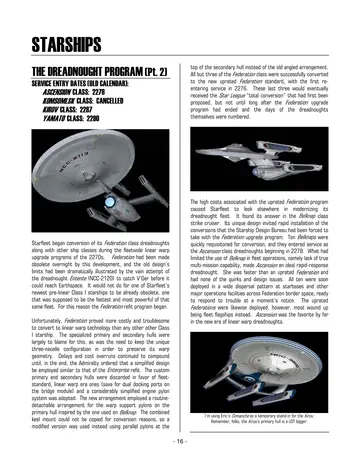
The high costs associated with the uprated Federation program caused Starfleet to look elsewhere in modernizing its dreadnought fleet. It found its answer in the Belknap class strike cruiser. Its unique design invited rapid installation of the conversions that the Starship Desgin Bureau had been forced to take with the Federation upgrade program. Ten Belknaps were quickly requisitoned for conversion, and they entered service as the Ascension class dreadnoughts beginning in 2278. What had limited the use of Belknap in fleet operations, namely lack of true multi-mission capability, made Ascension an ideal rapid-response dreadnought. She was faster than an uprated Federation and had none of the quirks and design issues. All ten were soon deployed in a wide dispersal pattern at starbases and other major operations facilities across Federation border space, ready to respond to trouble at a moment’s notice. The uprated Federations were likewise deployed; however, most wound up being fleet flagships instead. Ascension was the favorite by far in the new era of linear warp dreadnoughts.
I’m using Eric’s Comanche as a temporary stand-in for the Kirov. Remember, folks, the Kirov’s primary hull is a LOT bigger.
- 16 -
The competition to develop the space control ship program (Excelsior) in the 2280s also had its effect on dreadnought development. The Komsomlsk and Kirov classes were spun out of this effort, based on the Chiokis-designed expanded primary hull for the Ariel class shuttlecarrier. Komsomlsk was authorized in 2280 but never built. The Starship Desgin Bureau could never agree on a configuration for its secondary hull. By the time they made up their collective mind Starfleet Command had already decided to cancel the program and use the appropriated funds for the Yamato program instead. Kirov was a one-shot battlecruiser design intended to test the possibilities of building an upsized “Miranda dreadnought.” The program was abruptly terminated in 2289 after only five ships, once Starfleet Command decided in favor of Yamato.
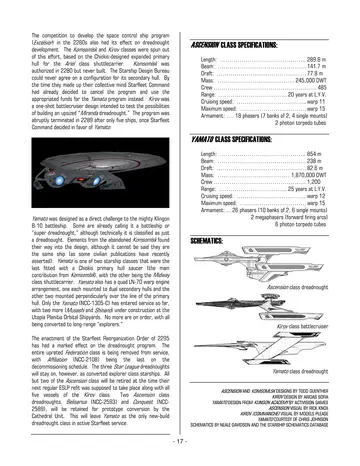
Yamato was designed as a direct challenge to the mighty Klingon B-10 battleship. Some are already calling it a battleship or “super dreadnought,” although technically it is classified as just a dreadnought. Elements from the abandoned Komsomlsk found their way into the design, although it cannot be said they are the same ship (as some civilian publications have recently asserted). Yamato is one of two starship classes that were the last fitted with a Chiokis primary hull saucer (the main contribution from Komsomlsk), with the other being the Midway class shuttlecarrier. Yamato also has a quad LN-70 warp engine arrangement, one each mounted to dual secondary hulls and the other two mounted perpendicularly over the line of the primary hull. Only the Yamato (NCC-1305-C) has entered service so far, with two more (Musashi and Shinano) under construction at the Utopia Planitia Orbital Shipyards. No more are on order, with all being converted to long-range “explorers.”
The enactment of the Starfleet Reorganization Order of 2295 has had a marked effect on the dreadnought program. The entire uprated Federation class is being removed from service, with Affiliation (NCC-2108) being the last on the decommissioning schedule. The three Star League dreadnoughts will stay on, however, as converted explorer class starships. All but two of the Ascension class will be retired at the time their next regular ESLP refit was supposed to take place along with all five vessels of the Kirov class. Two Ascension class dreadnoughts, Belisarius (NCC-2593) and Conquest (NCC2589), will be retained for prototype conversion by the Cathedral Unit. This will leave Yamato as the only new-build dreadnought class in active Starfleet service. ASCENSION CLASS SPECIFICATIONS:
Length: …………………………………….. 289.8 m Beam: ……………………………………… 141.7 m Draft: …………………….………………… 77.8 m Mass: ………………….……………... 245,000 DWT Crew …………………………………………….. 485 Range: ……………………….……. 20 years at L.Y.V. Cruising speed: ………………….………….. warp 11 Maximum speed: ………………….………… warp 15 Armament: …. 18 phasers (7 banks of 2, 4 single mounts) 2 photon torpedo tubes
YAMATO CLASS SPECIFICATIONS:
Length: …………………………………….. 854 m Beam: ……………………………………… 238 m Draft: …………………….………………… 82.6 m Mass: ………………….…………… 1,870,000 DWT Crew ………………………………………... 1,200 Range: ……………………….……. 25 years at L.Y.V. Cruising speed: ………………….………….. warp 12 Maximum speed: ………………….………… warp 15 Armament: ... 26 phasers (10 banks of 2, 6 single mounts) 2 megaphasers (forward firing arcs) 6 photon torpedo tubes
SCHEMATICS:
Ascension class dreadnought
Kirov class battlecruiser
Yamato class dreadnought
L ASCENSION AND KOMSOM SK DESIGNS BY TODD GUENTHER KIROV DESIGN BY ARIDAS SOFIA YAMATO DESIGN FROM KLINGON ACADEMY BY ACTIVISION GAMES ASCENSION VISUAL BY RICK KNOX KIROV (COMMANCHE) VISUAL BY MODELS PLEASE YAMATO COURTESY OF CHRIS JOHNSON SCHEMATICS BY NEALE DAVIDSON AND THE STARSHIP SCHEMATICS DATABASE
- 17 -