7.9 Terran Explorations: Eden, Romulus and Remus
Eden was a once-mythical paradise named by shipwrecked survivors of the USS Achilles, rediscovered in 2263 inside the Neutral Zone only to be found poisoned by a Romulan-introduced retrovirus; Romulus and Remus are the binary homeworlds of the Vulcan exiles who rejected Surak's reforms, their unusual configuration suggesting Preserver stellar engineering.
Eden
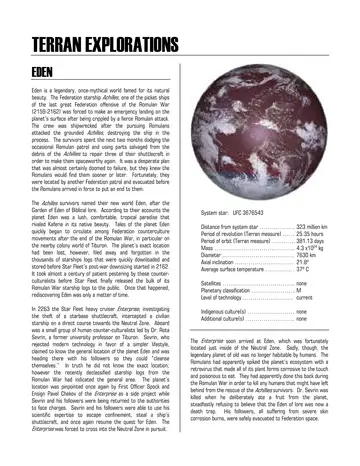
Eden is a legendary, once-mythical world famed for its natural beauty. The Federation starship Achilles, one of the picket ships of the last great Federation offensive of the Romulan War (2159-2162) was forced to make an emergency landing on the planet's surface after being crippled by a fierce Romulan attack. The crew was shipwrecked after the pursuing Romulans attacked the grounded Achilles, destroying the ship in the process. The survivors spent the next two months dodging the occasional Romulan patrol and using parts salvaged from the debris of the Achilles to repair three of their shuttlecraft in order to make them spaceworthy again. It was a desperate plan that was almost certainly doomed to failure, but they knew the Romulans would find them sooner or later. Fortunately, they were located by another Federation patrol and evacuated before the Romulans arrived in force to put an end to them.
The Achilles survivors named their new world Eden, after the Garden of Eden of Biblical lore. According to their accounts the planet Eden was a lush, comfortable, tropical paradise that rivaled Kaferia in its native beauty. Tales of the planet Eden quickly began to circulate among Federation counterculture movements after the end of the Romulan War, in particular on the nearby colony world of Tiburon. The planet's exact location had been lost, however, filed away and forgotten in the thousands of starships logs that were quickly downloaded and stored before Star Fleet's post-war downsizing started in 2162. It took almost a century of patient pestering by these counterculturalists before Star Fleet finally released the bulk of its Romulan War starship logs to the public. Once that happened, rediscovering Eden was only a matter of time.
In 2263 the Star Fleet heavy cruiser Enterprise, investigating the theft of a starbase shuttlecraft, intercepted a civilian starship on a direct course towards the Neutral Zone. Aboard was a small group of human counter-culturalists led by Dr. Rota Sevrin, a former university professor on Tiburon. Sevrin, who rejected modern technology in favor of a simpler lifestyle, claimed to know the general location of the planet Eden and was heading there with his followers so they could "cleanse themselves." In truth he did not know the exact location; however the recently declassified starship logs from the Romulan War had indicated the general area. The planet's location was pinpointed once again by First Officer Spock and Ensign Pavel Chekov of the Enterprise as a side project while Sevrin and his followers were being returned to the authorities to face charges. Sevrin and his followers were able to use his scientific expertise to escape confinement, steal a ship's shuttlecraft, and once again resume the quest for Eden. The Enterprise was forced to cross into the Neutral Zone in pursuit.
The Enterprise soon arrived at Eden, which was fortunately located just inside of the Neutral Zone. Sadly, though, the legendary planet of old was no longer habitable by humans. The Romulans had apparently spiked the planet's ecosystem with a retrovirus that made all of its plant forms corrosive to the touch and poisonous to eat. They had apparently done this back during the Romulan War in order to kill any humans that might have been left behind from the rescue of the Achilles survivors. Dr. Sevrin was killed when he deliberately ate a fruit from the planet, steadfastly refusing to believe that the Eden of lore was now a death trap. His followers, all suffering from severe skin corrosion burns, were safely evacuated to Federation space.
Eden — System star: UFC 3676543. Distance from system star: 323 million km. Period of revolution (Terran measure): 25.35 hours. Period of orbit (Terran measure): 381.13 days. Mass: 4.3 x 1024 kg. Diameter: 7630 km. Axial inclination: 21.8°. Average surface temperature: 37° C. Satellites: none. Planetary classification: M. Level of technology: current. Indigenous culture(s): none. Additional culture(s): none.
Romulus and Remus
Romulus (ch'Rihan, Ket-cheleb III) is the home planet of the Romulans. They are a distant offshoot of the Vulcans whose ancestors rejected the reforms of Surak and left to find a world to claim as their own. They eventually found the worlds of the Romulus star system in c. 400 CE after decades of travel. Six planets greeted their sensors, of which planets three and four were a binary pair with two small moons well within habitable Vulcan parameters. Habitable binary planet pairs are rare; those with moons even more rare. It was taken as a sign by the Vulcan exiles and they immediately set course for it. Their long journey was over, for they had found their new home.
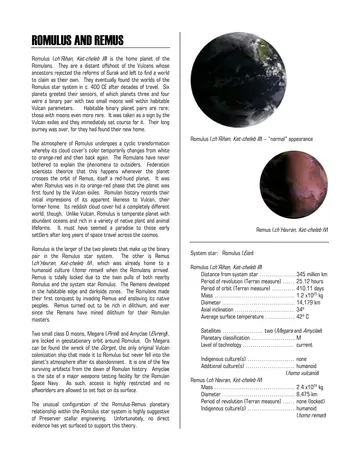
The atmosphere of Romulus undergoes a cyclic transformation whereby its cloud cover's color temporarily changes from white to orange-red and then back again. The Romulans have never bothered to explain the phenomena to outsiders. Federation scientists theorize that this happens whenever the planet crosses the orbit of Remus, itself a red-hued planet. It was when Romulus was in its orange-red phase that the planet was first found by the Vulcan exiles. Romulan history records their initial impressions of its apparent likeness to Vulcan, their former home. Its reddish cloud cover hid a completely different world, though. Unlike Vulcan, Romulus is a temperate planet with abundant oceans and rich in a variety of native plant and animal lifeforms. It must have seemed a paradise to those early settlers after long years of space travel across the cosmos.
Romulus is the larger of the two planets that make up the binary pair in the Romulus star system. The other is Remus (ch'Havran, Ket-cheleb IV), which was already home to a humanoid culture (homo reman) when the Romulans arrived. Remus is tidally locked due to the twin pulls of both nearby Romulus and the system star Romulus. The Remans developed in the habitable edge and darkside zones. The Romulans made their first conquest by invading Remus and enslaving its native peoples. Remus turned out to be rich in dilithium, and ever since the Remans have mined dilithium for their Romulan masters.
Two small class D moons, Megara (Pirek) and Amyclae (Elvreng), are locked in geostationary orbit around Romulus. On Megara can be found the wreck of the Gorget, the only original Vulcan colonization ship that made it to Romulus but never fell into the planet's atmosphere after its abandonment. It is one of the few surviving artifacts from the dawn of Romulan history. Amyclae is the site of a major weapons testing facility for the Romulan Space Navy. As such, access is highly restricted and no offworlders are allowed to set foot on its surface.
The unusual configuration of the Romulus-Remus planetary relationship within the Romulus star system is highly suggestive of Preserver stellar engineering. Unfortunately, no direct evidence has yet surfaced to support this theory.
System star: Romulus (Eisn). Romulus (ch'Rihan, Ket-cheleb III): Distance from system star: 345 million km. Period of revolution (Terran measure): 25.12 hours. Period of orbit (Terran measure): 410.11 days. Mass: 1.2 x 1025 kg. Diameter: 14,179 km. Axial inclination: 34°. Average surface temperature: 42° C. Satellites: two (Megara and Amyclae). Planetary classification: M. Level of technology: current. Indigenous culture(s): none. Additional culture(s): humanoid (homo vulcanis). Remus (ch'Havran, Ket-cheleb IV): Mass: 2.4 x 1024 kg. Diameter: 8,475 km. Period of revolution (Terran measure): none (locked). Indigenous culture(s): humanoid (homo reman).