10.6 Historical Articles
A collection of in-universe articles recounts the 2223 launch of the Enterprise under Captain Robert April (extracted from Alan Dean Foster's Star Trek Log Ten), the largest space rescue in history when the starliner Juliana was hurled out of known space, the time-travel of the U.S.S. Wells, the destruction of the scout Ajax revealed by a comet, Spock's enrollment at Star Fleet Academy, Captain Garth's victory at Axanar, the Klingons suing for peace at the end of the Four Years War, and the return of the old Caracal class cruisers to active duty.
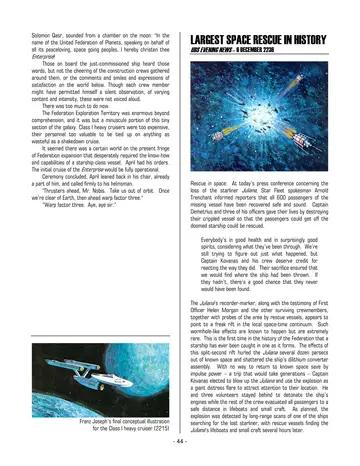
The Launching of the Enterprise
4 July 2223. An abridged and edited extract from Star Trek Log Ten by Alan Dean Foster (New York: Ballantine Books).
Several thousand strong, the construction crews began to assemble around the finished ship. Individuals in work-quits drifted in, as did crews of two or three manning engineering lighters and early “work bee” utility craft. Several hundred looked on from the orbital assembly stations that boxed in the shipyard. All were watching as the first crew finally took official possession of their ship. Their starship. The engineering crew alone did not proceed at once to assigned quarters. Starship engineers seldom used their onboard personal cabins. They lived in Jeffries tubes and cramped accessways and the free spaces in between computer housing.
Captain Robert Townsend April barely had time to stow his gear and check the glistening chronometer in his quarters. Sarah would see to the rest. Luxuriating in the comparative spaciousness of the captain’s cabin would have to wait. He had a ship to command. It was a short turbolift ride to the bridge. His first shift officers awaited him there. Slowly, appraisingly, he looked them over one at a time. Were they all as nervous as he was, he wondered? Some had more time in Star Fleet than he, albeit in non-commissioned ratings. Did any of them feel the same overpowering mix of fear and exultation, of terror and expectancy, that had been building in him since the day Commodore van Anling had shown him this ship, at that time only a smattering of diagrams spread on an office wall in the San Francisco Navy Yards? To April’s relief, it was First Officer Sundresh who broke the silence. “Ready to get underway, captain.” “Very well, Mr. Sundresh. All hands, stand by.” Suddenly his fear was gone, replaced by a strange calmness. It all seemed so natural somehow, as if he had been doing this for years. Walking forward, he strode to the command con and took his seat. His seat. His body melted easily into the deceptively blunt contours. The con was comforting beyond imagination in a way that bordered almost on the erotic. Leaning over, April keyed the intercom and spoke with a reassurance that sprang from just-tapped regions. “Engineering?” “Chief Engineer Kursley, sir,” the thick voice filtered back. “Standing by for orders.” “Activate warp-drive engines, Chief.” “Activating warp-drive, Captain.” Kursley turned to the prime engineering board. She eyed her subordinates, then uttered a silent liturgy. It might have been a prayer, might have been something else. She engaged the energies of a sun.
Hitherto quiescent monitors awoke on the bridge. Blank circlets winked on, needles sprinted ahead, bayed bands ascended in gauges, and a tiny shock ran through every member of the bridge crew. “All systems,” April ordered firmly, “final checkout. Report.” Response came from around the bridge, from speakers at the freshly painted communications station, and finally from Navigation. “Visual contact, sir. Object approaching on collision course, bearing dead ahead.” “Acknowledged, Lieutenant Po.” April addressed the general intercom. “All hands, stand by.” Other, distant hands were standing by in a small room beneath the lunar surface. Other eyes checked chronometers and predictors as they watched the distant Earth-ball, fighting to find a minute speck outlined against that brilliant blue-white globe. The drama begun on a small stage several weeks before was approaching the final curtain. “Contact in thirty seconds, Captain,” Lieutenant Po reported, with an irrepressible shiver of excitement. “Thank you, Lieutenant.” In ships and stations, thousands of men and women of several races watched their fully formed offspring and waited expectantly. “Four . . . three . . .” the navigator counted off intensely, “two . . . one . . . mark!” Head-on, the tiny projectile struck the completed cruiser, exploded, and burst into a small but rapidly expanding ball of brilliance. Tiny reflective fragments caught the morning sunlight and turned the diffusing globe into a spray of diamonds. Thousands of watching eyes saw the distant explosion and reacted. From electronic pickups set strategically around the assembly area, billions more on Earth and on other globes also saw it and all reacted. On billions of speakers, the aged but enormously respected voice of the Federation president, Samuel Solomon Qasr, sounded from a chamber on the moon: “In the name of the United Federation of Planets, speaking on behalf of all its peaceloving, space going peoples, I hereby christen thee Enterprise!”
Those on board the just-commissioned ship heard those words, but not the cheering of the construction crews gathered around them, or the comments and smiles and expressions of satisfaction on the world below. Though each crew member might have permitted himself a silent observation, of varying content and intensity, these were not voiced aloud. There was too much to do now. The Federation Exploration Territory was enormous beyond comprehension, and it was but a minuscule portion of this tiny section of the galaxy. Class I heavy cruisers were too expensive, their personnel too valuable to be tied up on anything as wasteful as a shakedown cruise. It seemed there was a certain world on the present fringe of Federation expansion that desperately required the know-how and capabilities of a starship-class vessel. April had his orders. The initial cruise of the Enterprise would be fully operational. Ceremony concluded, April leaned back in his chair, already a part of him, and called firmly to his helmsman. “Thrusters ahead, Mr. Nobis. Take us out of orbit. Once we’re clear of Earth, then ahead warp factor three.” “Warp factor three. Aye, aye sir.”
Largest Space Rescue in History
UBS Evening News — 6 December 2236
Rescue in space: At today’s press conference concerning the loss of the starliner Juliana, Star Fleet spokesman Arnold Trenchant informed reporters that all 600 passengers of the missing vessel have been recovered safe and sound. Captain Demetrius and three of his officers gave their lives by destroying their crippled vessel so that the passengers of the doomed starship could be rescued.
Everybody’s in good health and in surprisingly good spirits, considering what they’ve been through. We’re still trying to figure out just what happened, but Captain Kovanas and his crew deserve credit for reacting the way they did. Their sacrifice ensured that we would find where the ship had been thrown. If they hadn’t, there’s a good chance that they never would have been found.
The Juliana’s recorder-marker, along with the testimony of First Officer Helen Morgan and the other surviving crewmembers, together with probes of the area by rescue vessels, appears to point to a freak rift in the local space-time continuum. Such wormhole-like effects are known to happen but are extremely rare. This is the first time in the history of the Federation that a starship has ever been caught in one as it forms. The effects of this split-second rift hurled the Juliana several dozen parsecs out of known space and shattered the ship’s dilithium converter assembly. With no way to return to known space save by impulse power — a trip that would take generations — Captain Kovanas elected to blow up the Juliana and use the explosion as a giant distress flare to attract attention to their location. He and three volunteers stayed behind to detonate the ship’s engines while the rest of the crew evacuated all passengers to a safe distance in lifeboats and small craft. As planned, the explosion was detected by long-range scans of one of the ships searching for the lost starliner, with rescue vessels finding the Juliana’s lifeboats and small craft several hours later.
Starship Travels Through Time
Starbase 12 Log — Commodore Gregory Tree, commanding. 12 May 2242
The U.S.S. Wells embarked from Starbase 20 thirty-three solar days ago on a five-year exploratory mission to chart several sectors of unknown space. Yesterday, it returned — limping on impulse power, its warp engines seriously damaged and the rest of the ship in equally bad shape. When Captain Perry reported to me, however, he stated that the Wells had been gone for three years. This is impossible; yet it apparently happened.
The crew swears to it. The ship’s logs confirm it. Hull testing shows stress, fatigue, and signs of deterioration consistent with their tale of three years of sublight interstellar travel. Clearly, the Wells somehow traveled back in time — an event that almost destroyed them.
Neil is certain exactly when his ship made its time-jump. His recollection is confirmed by the ship’s logs. The Wells was traveling through an apparently empty sector of space when the ship began to be buffeted by what Science Officer Filby described as “ripples in time.” They were emanating from a particular point in space several sectors ahead of them. When they tried to approach it, however, the time waves increased in intensity until it was too much for the ship’s engines to handle. They were caught by one and thrown like the crack of a whip. Once they stopped, they found they had been thrown back in time just over three years. The ship was so badly damaged by the event that they had to return on impulse power at space normal speed. No warp power, no subspace communications, just impulse engines and what stores they had on board. There’s been no other ship in that part of space except the Wells for at least a decade. That’s why it took them three years to get back. We didn’t know they were out there.
There’s no way Neil Perry and his crew are faking this. I’m not about to let any other starships into that sector until Star Fleet sends me one powerful enough to deal with it. In the meantime, I’m declaring it a navigational hazard and off-limits to all non-authorized starships save by direct order of Star Fleet Command.
Comet Created by Starship Explosion
UFP InfoNet — 20 July 2245
The mystery behind the sudden disappearance of the starship Ajax has been solved. Debris identified as coming from the lost Star Fleet scout has been found in the form of a comet orbiting the star UFC 514263 near the Klingon border. The U.S.S. Brahe, a Canopus class research cruiser under the command of Captain Peter Sullivan, discovered the comet while on a routine survey of previously unmapped interstellar phenomena. Captain Sullivan was able to recover the recorder-marker of the Ajax from the comet debris. Preliminary analysis of the data suggests the Ajax was destroyed by an explosion resulting from a catastrophic failure of its dilithium energy converter assembly. No survivors were found and there does not appear to have been time for any of the crew to escape based on the recorder-marker data. All relatives of Ajax personnel are being notified of the final fate of their loved ones. In the meantime, Star Fleet has set up a board of inquiry to determine if the possibility of a similar catastrophic converter failure might occur in other starships with dilithium moderated warp engines.
Vulcan Enrolls at Star Fleet Academy
UBS Newsline — “From the Fleet” feature — 29 April 2244
Something of a stir is taking place within the ranks of Federation military and diplomatic circles. Spock, son of Sarek, has applied for and been admitted to the Terran branch of Star Fleet Academy. He will be entering the Academy as part of this year’s midshipman class.
Spock is the first Vulcan in history to attempt to aspire to the ranks of the Star Fleet officer corps like any other Federation citizen. All Vulcans currently serving in Star Fleet are either special attached duty personnel arranged through the Vulcan Academy of Sciences or interservice transfers made after the disbanding of Local Group system fleets in 2184. Up until now Vulcans have refrained from a more active role in Star Fleet due to what they assert are its overly militaristic overtones. No reason was given as to the young Spock’s decision. It has apparently caused considerable contention within the ranks of Vulcan’s diplomatic corps on Earth. Spock’s father Sarek is the Vulcan ambassador to Terra and, according to one report, is so upset with his son’s decision that he is no longer speaking to him. Only time will tell if this family rift, if true, is ever healed.
Academy officials refused to comment on Spock’s admission to the freshman class of 2242. Speaking off the record, though, Academy insiders say that Spock will receive no special treatment despite his unique status. He will be expected to prove himself and pull his weight just like any human, Andorian, Tellarite, or other Federation citizen who is attempting to join the Star Fleet officer corps. Should the young Spock pass this gauntlet, then he can look forward to what will certainly be a groundbreaking career in Star Fleet.
Victory at Axanar
UFP InfoNet — 29 August 2246
Star Fleet has won its first major victory against the Klingon Empire in the war that has broken out between the Klingons and the Federation. A Star Fleet task force led by Captain Kelvar Garth, commanding the heavy destroyer Xenophon, has routed a Klingon invasion fleet staging at the Axanar star system. According to Star Fleet forces the Klingons were planning a deep-strike invasion of the kind that the Romulans so successfully pulled off at the start of the Romulan War. Star Fleet Intelligence got wind of the operation, and Captain Garth’s fleet was sent to stop the invasion before it could happen. Despite odds of four-to-one the battle was won by Captain Garth’s tactical wizardry. His slash-and-attack tactics, utilizing the fearsome firepower of the Marklin class destroyers at his disposal, wreaked havoc with Klingon forces as they unsuccessfully attempted to corner and destroy his small fleet. They were themselves routed instead, losing over two-thirds of their ships and the rest fleeing back towards Klingon space. Captain Garth is already being hailed as Star Fleet’s first hero of the war and has been placed in overall command of all Star Fleet forces in and around the Axanar system.
Despite their loss at Axanar, however, the Klingons have proven more successful elsewhere along the border. Five of Star Fleet’s eleven new deep space stations have either been destroyed or captured by Klingon forces, and they have managed to succeed in the Andromeda sector where they failed at Axanar. Star Fleet’s biggest problems seem to be with the sheer number of Klingon ships as well as a new “battleship” that has more firepower than any Star Fleet ship in the field. Star Fleet is also experience problems in moving enough supplies and reinforcements up to the front due to lack of transport capability. Civilian and Merchant Marine craft of all kinds and sizes are being pressed into emergency service. This includes four of the legendary Stellarford class starliners, which are now being used as troop transports to reinforce beleaguered planetary defense forces.
Klingons Sue for Peace
UFP InfoNet — 26 April 2250
Today, under a sign of truce, a Klingon escort was permitted into Federation space bearing a diplomatic envoy from the Klingon High Council. According to a Star Fleet spokesman, the Klingons are suing for peace on Federation terms. They have admitted that they can no longer sustain the war that they so cold-bloodedly provoked with the Federation almost four years ago.
The Battle of Kolm-an was one of the largest battles yet fought between Star Fleet and Imperial Klingon forces. This two-pronged assault against the last remaining Klingon supply base in captured Federation space was an all-day affair, with both Federation starships and carrier groups taking part in the fight. Star Fleet casualties were lighter than expected; even so, some 11 starships were destroyed and 17 damaged. Klingon forces were far heavier, with not only the loss of their base but almost every ship that was defending it. Only seven badly damaged Klingon starships managed to escape Star Fleet forces, and the hunt is on to find them before they can find safe shelter or make it back over the border.
The Return of the Caracals
UFP InfoNet — 3 December 2250
Veterans of Star Fleet in days past will soon see a familiar looking starship in the post-war skies. Five of Star Fleet’s old Caracal class cruisers, built before the modern starship era, are being returned to active duty service this week. They have been reactivated along with several other older reserve starships to help cover for losses that Star Fleet suffered during the Four Years War.
“Well, it’s like coming back to an old friend that you haven’t seen in a while,” said Senior Chief Petty Officer Patrick O’Brien. He and several other retired Star Fleet veterans were offered the chance to return to service due to their prior experiences aboard a Caracal class cruiser. “As soon as I set foot inside the main hatch and felt that old deck under my feet, well, I was right at home again. It felt good to be back.”
O’Brien worked as a junior engineering assistant aboard the cruiser Palomar during the last years of its original service life. Now he’s returning as a consulting engineer, working with ship’s chief engineer Commander Hrondal of Tellar. The two seemed to hit it off almost at once, and their friendly arguing over how best to keep the ship in good running order is welcome music to Captain Jake Peterson’s ears.
“That’s just Hrondal’s way of saying how glad he is to have Chief O’Brien with us,” Captain Peterson said when interviewed. “They may have put new warp engines on the Palomar and replaced her lasers with phasers, but the rest of the ship is still pretty much the way she was when she was decommissioned back in 2232. Vets like Chief O’Brien know best how to deal with those old systems, and Hrondal knows that. Personally, I think he’s learned a thing or two from the chief and some of our other special guests.”
The Caracals are part of a program to replace newer Star Fleet vessels in Local Group fleet duties for the next two years. The ships they replace will be freed for duty along the still-sensitive Klingon border. Each Caracal will have, in addition to its regular crew, a team of two dozen volunteer veterans returned to duty status. They will do their best to ensure that this last tour of duty for these old warhorses ranks among their finest.