12.12 Class I Transport/Tugs of the Linear Warp Era
CLASS I TRANSPORT/TUGS OF THE LINEAR WARP ERA SERVICE ENTRY DATE (OLD CALENDAR): 2276 The building and upgrading of Starfleet’s Class I tran
CLASS I TRANSPORT/TUGS OF THE LINEAR WARP ERA SERVICE ENTRY DATE (OLD CALENDAR): 2276
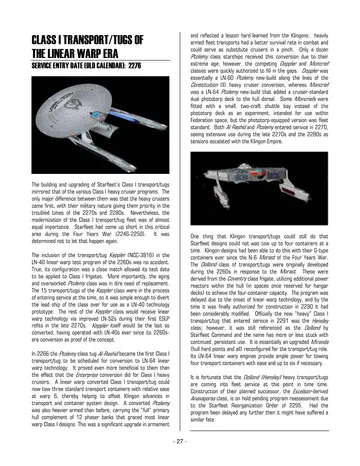
The building and upgrading of Starfleet’s Class I transport/tugs mirrored that of the various Class I heavy cruiser programs. The only major difference between them was that the heavy cruisers came first, with their military nature giving them priority in the troubled times of the 2270s and 2280s. Nevertheless, the modernization of the Class I transport/tug fleet was of almost equal importance. Starfleet had come up short in this critical area during the Four Years War (2246-2250). It was determined not to let that happen again.
The inclusion of the transport/tug Keppler (NCC-3816) in the LN-40 linear warp test program of the 2260s was no accident. True, its configuration was a close match allowed its test data to be applied to Class I frigates. More importantly, the aging and overworked Ptolemy class was in dire need of replacement. The 15 transport/tugs of the Keppler class were in the process of entering service at the time, so it was simple enough to divert the lead ship of the class over for use as a LN-40 technology prototype. The rest of the Keppler class would receive linear warp technology via improved LN-52s during their first ESLP refits in the late 2270s. Keppler itself would be the last so converted, having operated with LN-40s ever since its 2260sera conversion as proof of the concept.
In 2266 the Ptolemy class tug Al-Rashid became the first Class I transport/tug to be scheduled for conversion to LN-64 linear warp technology. It proved even more beneficial to them than the effect that the Enterprise conversion did for Class I heavy cruisers. A linear warp converted Class I transport/tug could now tow three standard transport containers with relative ease at warp 6, thereby helping to offset Klingon advances in transport and container system design. A converted Ptolemy was also heavier armed than before, carrying the “full” primary hull complement of 12 phaser banks that graced most linear warp Class I designs. This was a significant upgrade in armament and reflected a lesson hard-learned from the Klingons: heavily armed fleet transports had a better survival rate in combat and could serve as substitute cruisers in a pinch. Only a dozen Ptolemy class starships received this conversion due to their extreme age; however, the competing Doppler and Moncrief classes were quickly authorized to fill in the gaps. Doppler was essentially a LN-60 Ptolemy new-build along the lines of the Constitui ion (II) heavy cruiser conversion, whereas Moncrief t was a LN-64 Ptolemy new-build that added a cruiser-standard dual phototorp deck to the hull dorsal. Some Moncriefs were fitted with a small, two-craft shuttle bay instead of the phototorp deck as an experiment, intended for use within Federation space, but the phototorp-equipped version was fleet standard. Both Al Rashid and Ptolemy entered service in 2270, seeing extensive use during the late 2270s and the 2280s as tensions escalated with the Klingon Empire.
One thing that Klingon transport/tugs could still do that Starfleet designs could not was tow up to four containers at a time. Klingon designs had been able to do this with their G-type containers ever since the N-6 Morast of the Four Years War. The Dollond class of transport/tugs were originally developed during the 2260s in response to the Morast. These were derived from the Coventry class frigate, utilizing additional power reactors within the hull (in spaces once reserved for hangar decks) to achieve the four-container capacity. The program was delayed due to the onset of linear warp technology, and by the time it was finally authorized for construction in 2290 it had been considerably modified. Officially the new “heavy” Class I transport/tug that entered service in 2291 was the Hensley class; however, it was still referenced as the Dollond by Starfleet Command and the name has more or less stuck with continued, persistent use. It is essentially an upgraded Miranda (hull hard points and all) reconfigured for the transport/tug role. Its LN-64 linear warp engines provide ample power for towing four transport containers with ease and up to six if necessary.
It is fortunate that the Dollond (Hensley) heavy transport/tugs are coming into fleet service at this point in time time. Construction of their planned successor, the Excelsior-derived Anaxagoras class, is on hold pending program reassessment due to the Starfleet Reorganization Order of 2295. Had the program been delayed any further then it might have suffered a similar fate.
- 27 -
SPECIFICATIONS (UPGRADED KEPPLER ):
Length: …………………………………….. 222.0 m Beam: ……………………………………… 124.3 m Draft: …………………….………………… 67.4 m Mass: ………………………………… 133,500 DWT Crew ………………………………………... 320 Range: ……………………….… 5 light-years at L.Y.V. Cruising speed: ………………….………….. warp 7 Maximum speed: ………………….………… warp 9 Armament: ……… 4 phasers (1 bank of 2, 2 single banks)
SPECIFICATIONS (AL-RASHID, MONCRIEF )
Length: …………………………………….. 247.1 m Beam: ……………………………………… 141.7 m Draft: …………………….………………… 64.0 m Mass: ………………………………… 146,000 DWT Crew …………………………………………….. 339 Range: ………………………… 16 light-years at L.Y.V. Cruising speed: ………………….………….. warp 7 Maximum speed: ………………….………… warp 12 Armament: ………………..… 12 phasers (6 banks of 2) 2 photon torpedo tubes (Moncrief only)
SPECIFICATIONS (DOLLOND/HENSLEY ):
Length: …………………………………….. 234.7 m Beam: ……………………………………… 141.7 m Draft: …………………….………………… 63.6 m Mass: ………………………………… 205,750 DWT Crew …………………………………………….. 490 Range: ………………………… 16 light-years at L.Y.V. Cruising speed: ………………….………….. warp 7 Maximum speed: ………………….………… warp 12 Armament: …… 14 phasers (6 banks of 2, 2 single banks) 2 photon torpedo tubes (modified roll bar option)
NOTE: A special version of the Hensley (Dollond), known as the Brownwood class “assault transport,” is being produced for the Starfleet Marines. This is a Hensley fitted with the standard Miranda/Avenger roll bar weapons package and interior spaces reconfigured to better accommodate Marine operations. These will be replacing all Miranda class starships currently on loan from Starfleet on a one-for-one basis as they are built. Authorization for additional Brownwood class starships is on hold pending program review under the Starfleet Reorganization Order of 2295. SCHEMATICS:
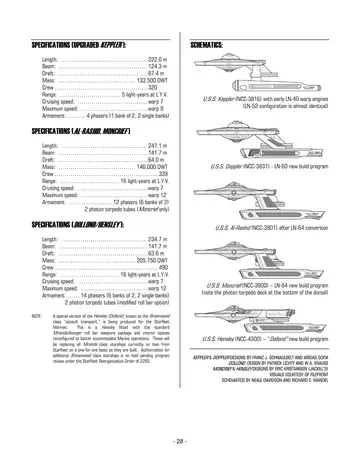
U.S.S. Keppler (NCC-3816) with early LN-40 warp engines (LN-52 configuration is almost identical)
U.S.S. Doppler (NCC-3831) - LN-60 new build program
U.S.S. Al-Rashid (NCC-3801) after LN-64 conversion
U.S.S. Moncrief (NCC-3800) – LN-64 new build program (note the photon torpedo deck at the bottom of the dorsal)
U.S.S. Hensley (NCC-4300) – “Dollond” new build program
KEPPLER & DOPPLER DESIGNS BY FRANZ J. SCHNAULBELT AND ARIDAS SOFIA DOLLOND DESIGN BY PATRICK LICHTY AND W.A. KRAUSE MONCRIEF & HENSLEY DESIGNS BY ERIC KRISTIANSEN (JACKILL’S) VISUALS COURTESY OF FILEFRONT SCHEMATICS BY NEALE DAVIDSON AND RICHARD E. MANDEL
- 28 -