2.4 Cyclops Class Explorer
The story of the ill-fated Cyclops, mankind's first manned interstellar craft and a casualty of the TAU Program, alongside the in-space-built Aventeur class explorer of the Saturn-Titan probe.
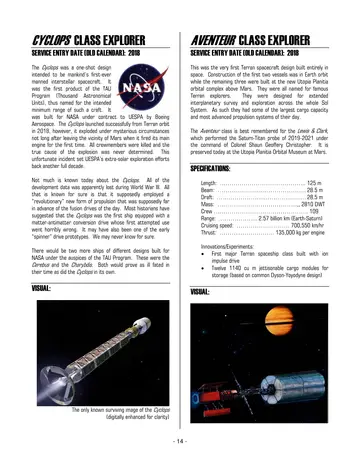
Cyclops Class Explorer
Service entry date (old calendar): 2018
The Cyclops was a one-shot design intended to be mankind’s first-ever manned interstellar spacecraft. It was the first product of the TAU Program (Thousand Astronomical Units), thus named for the intended minimum range of such a craft. It was built for NASA under contract to UESPA by Boeing Aerospace. The Cyclops launched successfully from Terran orbit in 2018, however, it exploded under mysterious circumstances not long after leaving the vicinity of Mars when it fired its main engine for the first time. All crewmembers were killed and the true cause of the explosion was never determined. This unfortunate incident set UESPA’s extra-solar exploration efforts back another full decade.
Not much is known today about the Cyclops. All of the development data was apparently lost during World War III. All that is known for sure is that it supposedly employed a “revolutionary” new form of propulsion that was supposedly far in advance of the fusion drives of the day. Most historians have suggested that the Cyclops was the first ship equipped with a matter-antimatter conversion drive whose first attempted use went horribly wrong. It may have also been one of the early “spinner” drive prototypes. We may never know for sure.
There would be two more ships of different designs built for NASA under the auspices of the TAU Program. These were the Cerebus and the Charybdis. Both would prove as ill fated in their time as did the Cyclops in its own.
Aventeur Class Explorer
Service entry date (old calendar): 2018
This was the very first Terran spacecraft design built entirely in space. Construction of the first two vessels was in Earth orbit while the remaining three were built at the new Utopia Planitia orbital complex above Mars. They were all named for famous Terran explorers. They were designed for extended interplanetary survey and exploration across the whole Sol System. As such they had some of the largest cargo capacity and most advanced propulsion systems of their day.
The Aventeur class is best remembered for the Lewis & Clark, which performed the Saturn-Titan probe of 2019-2021 under the command of Colonel Shaun Geoffery Christopher. It is preserved today at the Utopia Planitia Orbital Museum at Mars.
Specifications:
- Length: 125 m
- Beam: 28.5 m
- Draft: 28.5 m
- Mass: 2810 DWT
- Crew: 109
- Range: 2.57 billion km (Earth-Saturn)
- Cruising speed: 700,550 km/hr
- Thrust: 135,000 kg per engine
Innovations/Experiments:
- First major Terran spaceship class built with ion impulse drive
- Twelve 1140 cu m jettisonable cargo modules for storage (based on common Dyson-Yoyodyne design)