3.0 The Road to the Stars: Overview
An overview of the 2026-2050 era recounts Terra’s devastating Third World War and Day of Fire, the rapid expansion of the colonies and Utopia Planitia shipyards, asteroid mining and the Venus terraforming project, and the three pivotal events of the period: the concealed Vulcan crash, first contact with Alpha Centauri, and the disastrous Kzinti encounter.
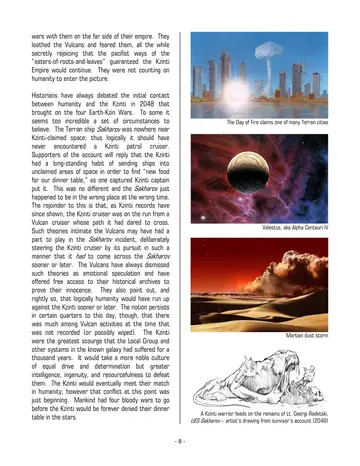
No discussion of this period in the history of Terran spaceflight can avoid the mention of World War III. It rolled across the surface of the planet in waves for some twenty-three years, leaving no country untouched and no family without its war dead. It all but stymied Terran advances in space exploration on the planet as it turned inward and turned its technology against itself. Killer satellites, orbital missile and laser platforms, quick-launch attack craft, sub-orbital assault ships – the list goes on and on. What started out as simple spat over the obsolete concepts of nationalism and territorial rights quickly devolved into a war that pitted alliance against alliance, nation against nation, and brother against brother. As soon as the conflict in one part of the world would die down another would already be flaring. War in one form or another raged nonstop on Terra until the end, when the surviving major nations finally unleashed their nuclear arsenals in the worldwide rain of death that the more noble among mankind had for so long hoped to avoid. In the space of twenty minutes one-third of Terra’s inhabited surface was laid waste, incinerated under a combined ground and orbital bombardment in an horrific maelstrom that was forever after remembered as the Day of Fire. Over 600 million of the planet’s humans died in those terrible twenty minutes and almost as many would die during the Post Atomic Horror that followed. Perhaps it was inevitable, given man’s nature. Oftentimes he has to destroy in order to create. In this case the old axiom was correct. The Terran culture that finally emerged from the Post Atomic Horror was radically different from the one before. Gone were the nationalism, religious bickering, and petty political spats. Most of the reasons for them simply no longer existed, incinerated along with most of man’s past and burned away by the simple need to survive, no matter how or what the cost. The few humans left on Terra who managed to survive the Post Atomic Horror vowed to build a new society, free from its ills of old. In this they were helped by their former space colonies, who had long ago shed such burdens for the promise that the New Frontier offered them. Terra would be rebuilt and many of its cultural and historic icons restored; however, gone forever would be the societal idiosyncrasies that had led to the Day of Fire.
The wartime burden carried by its parent government didn’t stop NASA from trying to fulfill its obligations to UESPA under the TAU Program to build a true interstellar spacecraft. This was one of the few spacecraft programs that managed to proceed in spite of the war. NASA had failed once before with Cyclops. Their next attempt, Cerebus, used the new and still largely experimental “spinner” drive for its main engine. Everything seemed to be going as planned, and the engine appeared to be working according to design, when the ship’s telemetry was lost just after it cleared Neptune. A UESF military recon mission eventually found the drifting derelict, its engines shattered and its atmosphere vented into space. All aboard were dead; whatever calamity had struck them had not left them enough time to get to the escape pods. This second failure might have seemed an ominous sign of which NASA should have taken heed; however, its decades-long reputation for excellence was on the line. “Third time’s the charm,” its contractors grimly said as the last of the TAU Program ships was built. This was the Charybdis, as ill fated as its two predecessors, and it would simply vanish without a trace in 2037. What data was available pointed to a catastrophic failure of its spinner drive, similar to what had happed with the failed fusion drives of the UES Courageous back in 2022. The TAU Program would be NASA’s last, with all funding being cut for future spacecraft development. The agency itself would be absorbed into the ISA shortly thereafter. In the meantime, though, Utopia Planitia was already succeeding for UESPA where NASA was failing with the first “ringships” ever to enter Terran service.
While most of the humans on Terra were busily trying to exterminate themselves the humans of Terra’s space colonies were rapidly leaping ahead on the road to the Sea of Stars. The first major phase of expansion at the Utopia Planitia shipyards at Mars was completed in 2029. While ship classes had already been building at Utopia Planitia before this, the availability of the new, larger facilities saw a rapid boom in the size and number of Terran vessels. Utopia Plantia would not see such a large expansion again in its shipbuilding capacities until the Earth-Kzin Wars (2048-2065). In the meantime, however, it would produce some of the best and most renowned Terran spacecraft of its time. These included the Columbus class explorer, ISA’s most famous vessel and the first true starship; the Companion class scout, which was the UESF’s first true spacegoing ship-of-the-line; and the elegant Declaration class starliners, widely regarded as the most beautiful Terran spacecraft of their day.
Certainly the most talked-about effort of Terran colonists during this time (and lied-about, depending on the taleteller) was the mining of the Sol System’s inner asteroid belt. It was the American Wild West all over again, with spaceships and early lasers instead of horses and six-shooters. There were no “space Indians” to contend with (yet); however, there were territorial wars aplenty as miners and homesteaders fought over claims – and not always with words, either. The local UESF garrisons were kept busy breaking up one mining war after another or rescuing swindled homesteaders from the claims of unscrupulous mining companies. Eventually, though, as the region stabilized somewhat and its population boomed, large quantities of nickel and iron were shipped back to Terra and Mars. These would be sent either in raw form via mass driver or in refined form via transport ship. It saw the mining town of Asterpolis grow from a regional space capital to one of the most important colonial settlements in the Sol System. This gave the asteroid miners a newfound place of importance among their peers in the early Terran colonies. Even today the people of Asterpolis take pride in their mining heritage. Daily and weekly tours are conducted of the most important mining sites. The important role that Asterpolis and the asteroid miners played in the Earth-Kzin Wars is not given short shrift, either, with a fully reconstructed UESF asteroid laser defensive base available for public inspection as part of the tour.
The biggest project by far that UESPA undertook during this time was the terraforming of Venus. Billions of blue-green cyandium caldarium algae had been seeded into its atmosphere in late 2025. These “ate” carbon dioxide and produced oxygen in the process. Within two years large quantities of oxygen were detected in the harsh atmosphere of Venus. At the same time its atmosphere began to condense natural water, which rained onto the surface and filled its previously dry canyons and gullies. This in turn lowered the planet’s notoriously high atmospheric pressure. By 2047 enough of a transformation had taken place for the establishment of the first manned base on Venus. The planet still had a long way to go before it could ever be properly colonized; however, these early results were certainly promising.
Such a large expansion of the Terran colonies required an infrastructure to match. Huge space farms were built to grow food under otherwise hostile conditions. A new generation of space transports were built to supply these rapidly growing populations. Dyson-Yoyodine lost its former monopoly on civilian space travel as better and roomier designs from competing companies gained public acceptance. It still had its military contracts, however, and in these it would continue the historic heritage of the legendary DY-series spacecraft design.
Three events near the end of this era would forever change the destiny of man on the eternal Sea of Stars. The first was the concealed crash of a Vulcan survey ship on Earth in 2045. The second was first contact with the humans of Alpha Centauri in 2048. The third was the attack on the scout ship Sakharov, also in 2048, which led directly to the First Earth-Kzin War in 2049-2050.
The Vulcans were the oldest of all cultures currently populating the worlds of the Local Group. Alone of all they had faster-than-light drive, which by default also made them the most powerful. The fact that they chose not to exercise that power spoke much of both their culture and their situation. Vulcan had interstellar colonies, yes, but it did not have an empire and did not want one. Thousands of years ago Surak the Reformer had brought the philosophy of logic to his people, changing them from a warlike to a benevolent race. The more emotional among the Vulcans, refusing to accept Surak’s way, had left long ago, never to return.
The Vulcans had been aware of humanity for centuries, monitoring its steady progress as it strove to set foot on the Sea of Stars. Of all the newly risen cultures in the Local Group that they had surveyed over the years they found humanity the most promising. They seemed to be the living embodiment of their own philosophy of IDIC: infinite diversity in infinite combinations. Mankind had many diverse cultures and even more sub-permutations on those, yet in times of great crisis they almost always banded together for the common good. Most importantly, though, they had in droves the cultural drive that the Vulcans now lacked. Logic and technical superiority had their down sides as well. Vulcan was in danger of becoming a stagnant culture. Logic dictated that given enough time a new power would arise that would surpass Vulcan dominance in the stars, possibly destroying them in the process. Logic also dictated that Vulcan was better served allied with such a culture than fighting an eventually losing war against it. That, among other things, is why once humanity achieved practical spaceflight they began to watch then quite keenly. The crash of one of their Terran survey ships in 2045, followed by the safe return of its crew by the Terrans themselves, taking care not to reveal the true identity and nature of their “guests,” spoke a lot of these beings of whom the Vulcans were already beginning to hold in some regard. Still, they waited for a more tangible sign that humanity was ready to join the Local Group not only as a friend but also as an equal and ally. They would get that sign within their own lifetimes.
Humanity’s first contact with a non-terrestrial culture turned out, surprisingly, to be an encounter with itself. The inhabitants of Alpha Centauri VII, the first “alien” culture ever encountered by Terrans, were in fact Terrans themselves – Greeks transplanted from the 3rd century BCE by the Preservers and left to develop on their artificially created, Earth-like world. Not surprisingly their civilization developed in parallel to their distant brothers back in the Sol System (an event which would lead Centaurean scientist Zacmar Hodgkins to posit his Law of Parallel Planet Development). Of course, they put their own unique spin on their path to the stars. By 2002 they had mastered the science of interplanetary travel; however, their primary method for such journeys was the solar sail (a technology that the Terrans had largely bypassed). By 2020 it had found a peaceful means of coexisting with its fledgling space colonies via the Alpha Centauri Concordium of Planets, thus sparing the system from events such as the Sol System’s Martian Rebellion. They were not without their faults, as the failure of their colony on Alpha Centauri IV subsequently showed; however, they were as quick to adapt to a given situation and make the best of it as were their brothers on Terra.
The Centarueans had become aware of life in the Sol System about the same time that the Sol System had become aware of life at Alpha Centauri. Their own interstellar program was already well underway by the time the UES Icarus arrived from Terra. They welcomed the ship’s crew with open arms – partly overjoyed at seeing they were dealing with other humans, but also because the Terrans had saved them the trouble and expense of the trip. At least one Centaurean scientist was not pleased by this development, however, and he shared his concerns privately with Icarus commander Captain Roger Tauber. As Captain Tauber listened to his translator (a native-born Greek on his own crew) relay the scientist’s description of his new drive system he realized that here was a true genius worth more than a few words of social courtesy. He put him in touch with his ship’s science officer Frank Jocasta, and the two (along with translator in tow) left the reception. Tauber wouldn’t see Jocasta in person again for another week, but when he did, Jocasta would have news that would forever change the future of mankind on the Sea of Stars.
The last culture that needed to be humanity’s first contact with a truly alien species would turn out to be its first. The ferocious, catlike Kzinti were the undisputed masters of one of the greatest interstellar empires at that time in the galaxy. It roughly comprised what is today known as the coreward sectors of the Federation’s Alpha and Beta Quadrants. They had conquered the Tellarites and forever planted nightmare visions of “the Great Claw-Swipe” in their culture. They knew the Andorians and, while failing to conquer them, nevertheless had made their independence a dearly bought victory that required constant vigil. They respected the Klingons and had fought several bloody wars with them on the far side of their empire. They loathed the Vulcans and feared them, all the while secretly rejoicing that the pacifist ways of the “eaters-of-roots-and-leaves” guaranteed the Kzinti Empire would continue. They were not counting on humanity to enter the picture.
Historians have always debated the initial contact between humanity and the Kzinti in 2048 that brought on the four Earth-Kzin Wars. To some it seems too incredible a set of circumstances to believe. The Terran ship Sakharov was nowhere near Kzinti-claimed space; thus logically it should have never encountered a Kzinti patrol cruiser. Supporters of the account will reply that the Kzinti had a long-standing habit of sending ships into unclaimed areas of space in order to find “new food for our dinner table,” as one captured Kzinti captain put it. This was no different and the Sakharov just happened to be in the wrong place at the wrong time. The rejoinder to this is that, as Kzinti records have since shown, the Kzinti cruiser was on the run from a Vulcan cruiser whose path it had dared to cross. Such theories intimate the Vulcans may have had a part to play in the Sakharov incident, deliberately steering the Kzinti cruiser by its pursuit in such a manner that it had to come across the Sakharov sooner or later. The Vulcans have always dismissed such theories as emotional speculation and have offered free access to their historical archives to prove their innocence. They also point out, and rightly so, that logically humanity would have run up against the Kzinti sooner or later. The notion persists in certain quarters to this day, though, that there was much among Vulcan activities at the time that was not recorded (or possibly wiped). The Kzinti were the greatest scourge that the Local Group and other systems in the known galaxy had suffered for a thousand years. It would take a more noble culture of equal drive and determination but greater intelligence, ingenuity, and resourcefulness to defeat them. The Kzinti would eventually meet their match in humanity; however that conflict at this point was just beginning. Mankind had four bloody wars to go before the Kzinti would be forever denied their dinner table in the stars.