2.3 Sol System Explorations: The Moon
A survey of the Moon as the sole Sol-system destination of the twentieth century, listing the first manned Moon missions of Apollo and tracing lunar exploration from the early American landings through the international cooperation that built the Goddard Moonbase.
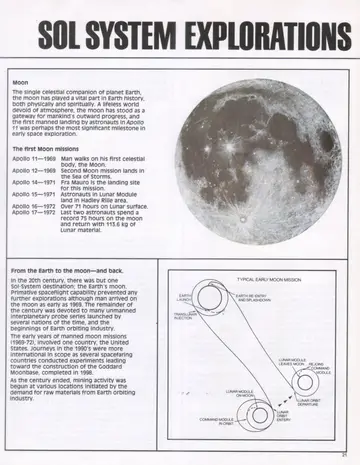
Moon
The single celestial companion of planet Earth, the moon has played a vital part in Earth history, both physically and spiritually. A lifeless world devoid of atmosphere, the moon has stood as a gateway for mankind's outward progress, and the first manned landing by astronauts in Apollo 11 was perhaps the most significant milestone in early space exploration.
The First Moon Missions
- Apollo 11—1969 Man walks on his first celestial body, the Moon.
- Apollo 12—1969 Second Moon mission lands in the Sea of Storms.
- Apollo 14—1971 Fra Mauro is the landing site for this mission.
- Apollo 15—1971 Astronauts in Lunar Module land in Hadley Rille area.
- Apollo 16—1972 Over 71 hours on Lunar surface.
- Apollo 17—1972 Last two astronauts spend a record 75 hours on the moon and return with 113.6 kg of Lunar material.
From the Earth to the Moon—and Back
In the 20th century, there was but one Sol-System destination; the Earth's moon. Primitive spaceflight capability prevented any further explorations although man arrived on the moon as early as 1969. The remainder of the century was devoted to many unmanned interplanetary probe series launched by several nations of the time, and the beginnings of Earth orbiting industry.
The early years of manned moon missions (1969-72), involved one country, the United States. Journeys in the 1990's were more international in scope as several spacefaring countries conducted experiments leading toward the construction of the Goddard Moonbase, completed in 1998.
As the century ended, mining activity was begun at various locations initiated by the demand for raw materials from Earth orbiting industry.