8.0 Astrogation Map #2 — The Federation in the X-Z Plane, Sol Region, Vessels and Buoys
Chart B presents Astrogation Map Two, a side-view (X-Z plane) cross-section of the Federation showing the galactic core, energy barrier and four quadrants, accompanied by inset maps, a roster of Federation member systems, and illustrated catalogues of Federation and alien spacecraft, navigational buoys, and other space objects.
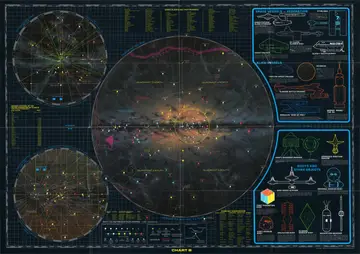
Space Vessels — Federation
Constitution / Class Starship
The U.S.S. Enterprise was the second Starship of fourteen commissioned, and recently completed its tenth five-year tour of duty on the Federation frontier. Several modifications, including the installation of new engine assemblies, were subsequently made and are illustrated here. The Enterprise is 269 meters long and has a crew complement of 430.
Space Cruiser
Space cruisers like the S.S. Aurora have been in use for over a century, and are based on a Vulcan design originally used for interplanetary travel. Essentially a 21-meter-long space yacht, space cruisers have a range of several dozen parsecs and can carry provisions for up to six passengers and crew.
DY Class Sleeper Ship
Although the DY series was not intended as an interstellar craft, some 80 or 90 eugenic "supermen," refugees of World War III, made their escape from earth by pirating the S.S. Botany Bay. More recently, DY-500 class vessels like the Woden (at 112 meters, slightly larger than the DY-100 class) have been converted for use as automated freighters.
Starliner
Starliners, Earth's first attempts at manned interstellar probes, were launched during the 2050's at various target stars within fifteen light-years of Sol. Only one, the UESP Enterprise, reached its destination — the sunlike binary pair of Alpha Centauri — before they were overtaken by the new faster-than-light spacecraft. The 120-meter-long Starliners had a crew complement of 35.
Class F Shuttlecraft
This 7-meter-long general utility craft can transport seven passengers over limited interstellar distances, or land on terrestrial worlds and return to orbit on a single fueling. The Class F shuttle is carried aboard Starships, along with a number of more specialized types, and is used as a short-range transport by Star Bases and permanent installations.
Alien Vessels
Tholian Space Cruiser
Although contact with the Tholians has been minimal, the basic design of their only known type of space vessel is believed to be a modified Federation space cruiser. Two Tholian vessels have the unique capability of producing an energy filament that can be woven into a immobilizing tractor web.
Klingon Battle Cruiser
The "Klolode" Class Battle Cruiser is the Klingon equivalent of the Federation Starship, and although smaller (215 meters), it boasts a crew complement of 454 and weaponry at least as sophisticated as Federation phasers and photon torpedoes. Due to a recent alliance, Romulans are equipped with Klingon-made battle cruisers, and some Klingon vessels now employ the Romulan cloaking device.
Fesarius
The flagship of the First Federation, the Fesarius is one of the largest starships on record and certainly one of the most unusual, designed to patrol a largely uninhabited frontier and can respond at multi-warp speeds to an M-ray signal from unmanned defense buoys. Although completely automated, the Fesarius carries a detacheable pilot vessel with a crew complement of one, and may be away from its home port for years at a time.
Buoys and Other Objects
Ship's Recorder-Marker
This early model Recorder-Marker was used by the Galactic Survey Cruiser S.S. Valiant, one of a series of exploratory starships launched in the late 21st Century, and was recovered by the U.S.S. Enterprise in 2060. It is now on permanent exhibit at the Federation Air and Space Museum.
Approach Position Beacon
Six approach beacons, generally located in the cometary halo, control all ingoing and outgoing traffic in a major star system, and provide reference points for locating planets within the system. Intra-system maneuvering is normally computer-controlled, and continues until the vessel enters a standard planetary orbit.
Deep Space Station
A total of seventeen K-Class Deep Space Stations are scattered around the periphery of Federation space, and serve as drydocks and resupply centers in areas where there are no inhabited star systems. The station's facilities include luxury accommodations, a shopping mall, sports arena, theatres, casino, restaurants, and a park complex.
Regional Marker Buoy
These beacons are located at the corners of Federation sectors, and broadcast the sector identification code in six directions. The transmitters are located in the spherical section, and the power source and drift correction rockets are contained in the hexagonal boron.
First Federation Buoy
First encountered on stardate 1512.2, this outpost buoy was resistant to sensor probes and had no detectable power source, yet possessed a sophisticated propulsion system as well as a defensive mechanism that broadcasts lethal radiation.
Kzinti Marker Buoy
The Treaty of Sirius confines the Kzinti Patriarchy to a spherical volume 50 light-years in diameter; buoys like this one are located at strategic points on the perimeter, and broadcast a warning message in the Kzinti language or "Hero's Tongue."
Melkotian Buoy
These translucent cylinders define the territorial space of the Melkot, and employ the Melkotian technique of broadcast telepathy: messages transmitted by the buoy are perceived in the listener's native tongue. They can also produce holographic images of remarkable detail and fidelity.
Klingon Marker Buoy
These buoys, located on the Klingon frontier, serve the same function as Federation regional markers, but are also remote surveillance satellites or "spy eyes": they continually monitor the Federation border, and when necessary can summon support vessels via sub-space radio.
Navigation Beacons
Space lane marker beacons (left) are located along major space lanes, and are standard reference points for interstellar travel. The antenna cluster on top broadcasts the beacon's identification code. Danger beacons (right) are used to identify dangerous regions and objects (such as black holes and areas of intense radiation), and broadcast a warning signal over a wide frequency band.
Member Systems of the United Federation of Planets
Listed in Order of Admittance, with year of admission (Terran Old Calendar):
- Sol — May 8, 2127
- Vulcan
- Tellar
- Andor
- Alpha Centauri
- Alpha — 2129
- Vega — 2132
- Deneb — 2149
- Marcos — 2152
- Izar — 2157
- Rigel — 2166
- Cait — 2172
- Antos — 2175
- Catulla — 2176
- Tiburon — 2181
- Edos — 2185
- Merak — 2193
- Aldebaran — 2207
- Ardana — 2215
- Argelius — 2221
- Daran — 2230
- Beta Ophiuchi — 2234
- Aurelia — 2239
- Cygnet — 2242
- Mantilles — 2248
- Axanar — 2249
- Medusa — 2259
- Coridan — 2264
- Delta — 2267