5.1 Ships: UNSS Bonaventure, UNSS Amity, Space Bus, Space Ark
The era's vessels are profiled through a year-by-year illustrated spaceflight chronology and detailed specification plates for the warp-pioneering UNSS Bonaventure, the popular UNSS Amity, the surface-to-orbit Space Bus, and the colony-ship Space Ark.
A Concise Look at Ships and Events: Spaceflight Chronology
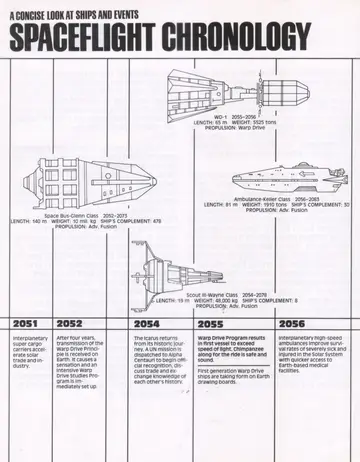
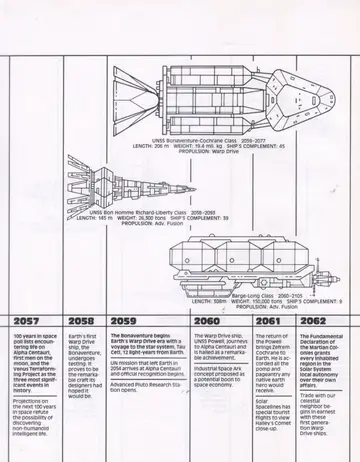
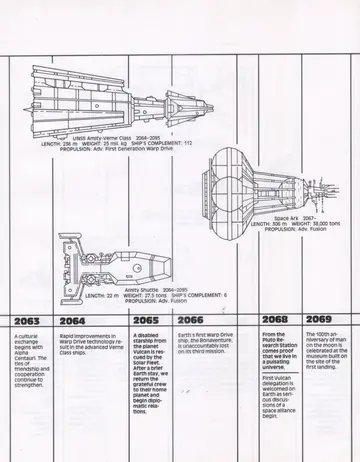
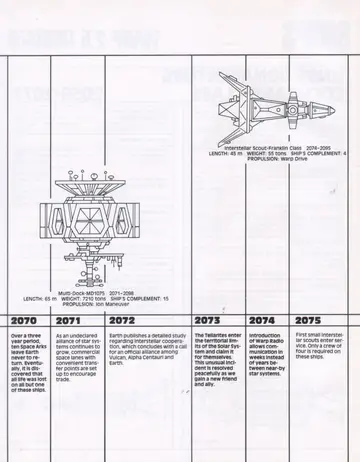
The following year-by-year chronology (2051-2075) charts the ships and events of the Warp Drive Era, illustrated with cutaway profiles of each notable vessel.
- 2051: Interplanetary super cargo carriers accelerate solar trade and industry.
- 2052: After four years, transmission of the Warp Drive Principle is received on Earth. It causes a sensation and an intensive Warp Drive Studies Program is immediately set up.
- 2054: The Icarus returns from its historic journey. A UN mission is dispatched to Alpha Centauri to begin official recognition, discuss trade and exchange knowledge of each other's history.
- 2055: Warp Drive Program results in first vessel to exceed speed of light. Chimpanzee along for the ride is safe and sound. First generation Warp Drive ships are taking form on Earth drawing boards.
- 2056: Interplanetary high-speed ambulances improve survival rates of severely sick and injured in the Solar System with quicker access to Earth-based medical facilities.
- 2057: 100 years in space poll lists encountering life on Alpha Centauri, first men on the moon, and the Venus Terraforming Project as the three most significant events in history. Projections on the next 100 years in space refute the possibility of discovering non-humanoid intelligent life.
- 2058: Earth's first Warp Drive ship, the Bonaventure, undergoes testing. It proves to be the remarkable craft its designers had hoped it would be.
- 2059: The Bonaventure begins Earth's Warp Drive era with a voyage to the star system, Tau Ceti, 12 light-years from Earth. UN mission that left Earth in 2054 arrives at Alpha Centauri and official recognition begins. Advanced Pluto Research Station opens.
- 2060: The Warp Drive ship, UNSS Powell, journeys to Alpha Centauri and is hailed as a remarkable achievement. Industrial Space Ark concept proposed as a potential boon to space economy.
- 2061: The return of the Powell brings Zefrem Cochrane to Earth. He is accorded all the pomp and pageantry any native earth hero would receive. Solar Spacelines has special tourist flights to view Halley's Comet close-up.
- 2062: The Fundamental Declaration of the Martian Colonies grants every inhabited region in the Solar System local autonomy over their own affairs. Trade with our celestial neighbor begins in earnest with these first generation Warp Drive ships.
- 2063: A cultural exchange begins with Alpha Centauri. The ties of friendship and cooperation continue to strengthen.
- 2064: Rapid improvements in Warp Drive technology result in the advanced Verne Class ships.
- 2065: A disabled starship from the planet Vulcan is rescued by the Solar Fleet. After a brief Earth stay, we return the grateful crew to their home planet and begin diplomatic relations.
- 2066: Earth's first Warp Drive ship, the Bonaventure, is unaccountably lost on its third mission.
- 2068: From the Pluto Research Station comes proof that we live in a pulsating universe. First Vulcan delegation is welcomed on Earth as serious discussions of a space alliance begin.
- 2069: The 100th anniversary of man on the moon is celebrated at the museum built on the site of the first landing.
- 2070: Over a three year period, ten Space Arks leave Earth never to return. Eventually, it is discovered that all life was lost on all but one of these ships.
- 2071: As an undeclared alliance of star systems continues to grow, commercial space lanes with convenient transfer points are set up to encourage trade.
- 2072: Earth publishes a detailed study regarding interstellar cooperation, which concludes with a call for an official alliance among Vulcan, Alpha Centauri and Earth.
- 2073: The Tellarites enter the territorial limits of the Solar System and claim it for themselves. This unusual incident is resolved peacefully as we gain a new friend and ally.
- 2074: Introduction of Warp Radio allows communication in weeks instead of years between near-by star systems.
- 2075: First small interstellar scouts enter service. Only a crew of four is required on these ships.
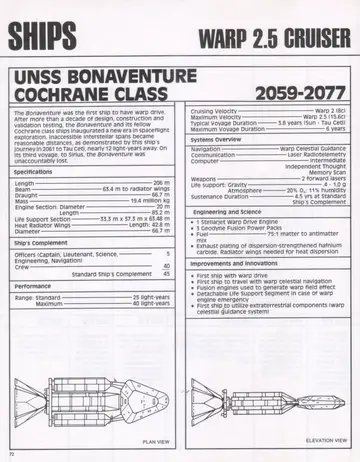
UNSS Bonaventure — Cochrane Class (2059-2077)
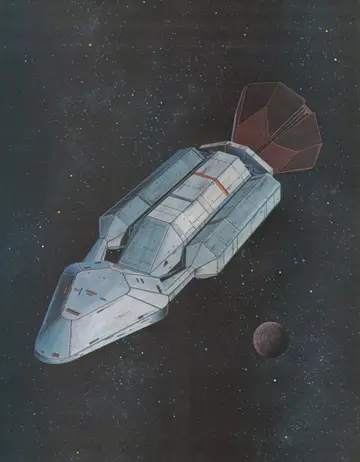
The Bonaventure was the first ship to have warp drive. After more than a decade of design, construction and validation testing, the Bonaventure and its fellow Cochrane class ships inaugurated a new era in spaceflight exploration. Inaccessible interstellar spans became reasonable distances, as demonstrated by this ship's journey in 2061 to Tau Ceti, nearly 12 light-years away. On its third voyage, to Sirius, the Bonaventure was unaccountably lost.
Specifications: Length 206 m; Beam 63.4 m to radiator wings; Draught 66.7 m; Mass 19.4 million kg. Engine Section: Diameter 20 m, Length 85.2 m. Life Support Section 33.3 m x 57.3 m x 63.48 m. Heat Radiator Wings: Length 42.8 m, Diameter 66.7 m.
Ship's Complement: Officers (Captain, Lieutenant, Science, Engineering, Navigation) 5; Crew 40; Standard Ship's Complement 45.
Performance: Cruising Velocity Warp 2 (8c); Maximum Velocity Warp 2.5 (15.6c); Typical Voyage Duration 3.8 years (Sun - Tau Ceti); Maximum Voyage Duration 6 years; Range Standard 25 light-years, Maximum 40 light-years.
Systems Overview: Navigation, Warp Celestial Guidance; Communication, Laser Radiotelemetry; Computer, Intermediate Memory Scan; Weapons, 2 forward lasers; Life support: Gravity 4-10 g, Atmosphere 20% O2, 11% humidity; Sustenance Duration 4.5 yrs at Standard Ship's Complement.
Engineering and Science: 1 Stellarjet Warp Drive Engine; 3 Geodyne Fusion Power Packs; Fuel 75:1 matter to antimatter mix; Exhaust plating of dispersion-strengthened hafnium carbide. Radiator wings needed for heat dispersion.
Improvements and Innovations: First ship with warp drive; Fusion engines used to generate warp field effect; Detachable Life Support Segment in case of warp engine emergency; First ship to utilize extraterrestrial components (warp celestial guidance system).
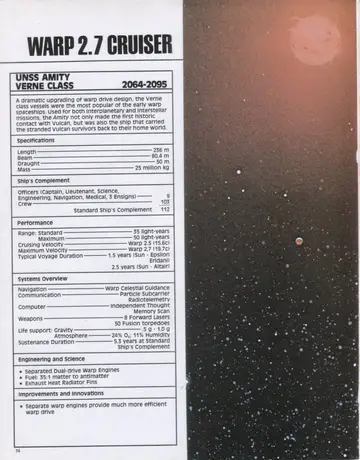
UNSS Amity — Verne Class (2064-2095)
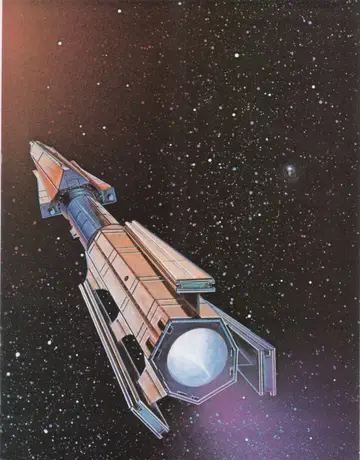
A dramatic upgrading of warp drive design, the Verne class vessels were the most popular of the early warp spaceships. Used for both interplanetary and interstellar missions, the Amity not only made the first historic contact with Vulcan, but was also the ship that carried the stranded Vulcan survivors back to their home world.
Specifications: Length 236 m; Beam 80.4 m; Draught 50 m; Mass 25 million kg.
Ship's Complement: Officers (Captain, Lieutenant, Science, Engineering, Navigation, Medical, 3 Ensigns) 9; Crew 103; Standard Ship's Complement 112.
Performance: Range Standard 35 light-years, Maximum 50 light-years; Cruising Velocity Warp 2.5 (15.6c); Maximum Velocity Warp 2.7 (19.7c); Typical Voyage Duration 1.5 years (Sun - Epsilon Eridani), 2.5 years (Sun - Altair).
Systems Overview: Navigation, Warp Celestial Guidance; Communication, Particle Subcarrier Radiotelemetry; Computer, Independent Thought Memory Scan; Weapons, 8 Forward Lasers, 50 Fusion torpedoes; Life support: Gravity 5 g - 10 g, Atmosphere 24% O2, 11% Humidity; Sustenance Duration 5.3 years at Standard Ship's Complement.
Engineering and Science: Separated Dual-drive Warp Engines; Fuel 35:1 matter to antimatter; Exhaust Heat Radiator Fins.
Improvements and Innovations: Separate warp engines provide much more efficient warp drive.
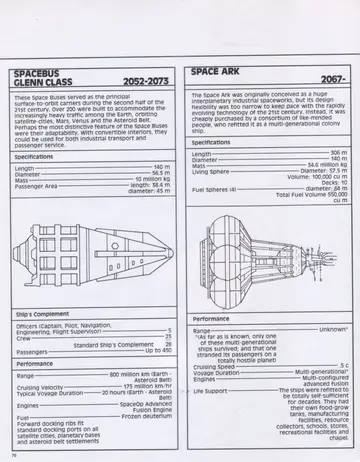
Space Bus — Glenn Class (2052-2073)
These Space Buses served as the principal surface-to-orbit carriers during the second half of the 21st century. Over 200 were built to accommodate the increasingly heavy traffic among the Earth, orbiting satellite-cities, Mars, Venus and the Asteroid Belt. Perhaps the most distinctive feature of the Space Buses were their adaptability. With convertible interiors, they could be used for both industrial transport and passenger service.
Specifications: Length 140 m; Diameter 56.5 m; Mass 10 million kg; Passenger Area length 38.4 m, diameter 45 m.
Ship's Complement: Officers (Captain, Pilot, Navigation, Engineering, Flight Supervisor) 5; Crew 23; Standard Ship's Complement 28; Passengers Up to 450.
Performance: Range 800 million km (Earth - Asteroid Belt); Cruising Velocity 175 million km/hr; Typical Voyage Duration 20 hours (Earth - Asteroid Belt); Engines SpaceOp Advanced Fusion Engine; Fuel Frozen deuterium. Forward docking ribs fit standard docking ports on all satellite cities, planetary bases and asteroid belt settlements.
Space Ark (2067- )
The Space Ark was originally conceived as a huge interplanetary industrial spaceworks, but its design flexibility was too narrow to keep pace with the rapidly evolving technology of the 21st century. Instead, it was cheaply purchased by a consortium of like-minded people, who refitted it as a multi-generational colony ship.
Specifications: Length 306 m; Diameter 565 m; Mass 34.6 million kg; Living Sphere Diameter 57.5 m, Volume 100,000 cu m, Decks 10; Fuel Spheres (4) diameter 64 m, Total Fuel Volume 550,000 cu m.
Performance: Range Unknown* (As far as is known, only one of these multi-generational ships survived; and that one stranded its passengers on a totally hostile planet); Cruising Speed 5c; Voyage Duration Multi-generational; Engines Multi-configured advanced fusion; Life Support The ships were refitted to be totally self-sufficient for decades. They had their own food-grow tanks, manufacturing facilities, resource collectors, schools, stores, recreational facilities and chapel.