9.0 Astrogation Map #5 — Quadrant 3 South (XY), Klingon Empire and Romulan Neutral Zone
Chart C presents Astrogation Map Five, a top-down (XY plane) view of Quadrant 3 South within the Enterprise's zone of patrol and the bordering First Federation, accompanied by a column of illustrated star-system insets (Sol, Triskelion, the Talos group, Deneb and Gamma Vertis), inset maps of the Klingon Empire and of the Romulan Star Empire and its Neutral Zone, and the Key to Astrogation Maps.
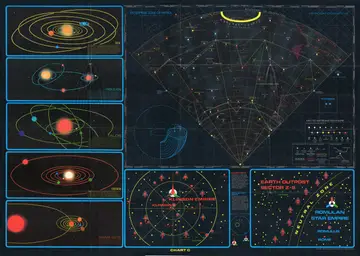
The Sol System
The Sol system, with two Class M planets (Terra and Mars), is considered a typical stellar system: the four inner planets are of terrestrial composition, and five of the six outer planets are gas giants (Persephone, the tenth planet, orbits at 79 AU, and is not illustrated here). The outermost terrestrial planet, Pluto, is believed to be an escaped moon of the gas giant Neptune, explaining its eccentric elliptical orbit.
Triskelion
Triskelion is the second planet orbiting the star M 24-Alpha, the primary in a trinary star system. The M 24 system is unusual in that the three stars have evolved a stable trojan relationship, all orbiting around a single center of gravity, and hence can support planetary systems. In addition to the two planets orbiting the primary, a single Class M planet orbits the system's secondary star.
The Talos Star Group
The Talos star group is composed largely of white dwarves and other "stellar corpses," but one red giant still supports a planetary system. The five inner planets are remarkable for their highly eccentric orbits, believed to be the result of terraforming or planetary engineering; six other planets, all gas giants (not illustrated here), have more conventional orbits and have become tidally locked with the same face always toward the primary.
Deneb
The Deneban system supports four Class M worlds (II through V) out of a total of five; outer planets, if any, have probably been displaced by a dim red dwarf star that orbits the primary at a distance of about 42 AU. The red dwarf is believed to be a fairly recent acquisition of the primary star.
Gamma Vertis
The only Class M world in this system is actually the fourth of a total of five orbiting a large gas giant; the giant, a "failed star" of about 3.5 Jupiter masses, radiates a considerable amount of energy, and the system should perhaps be thought of as a binary one.
The Klingon Empire
The inner star systems of the Klingon Empire are illustrated here, to the extent of Federation intelligence data. The Klingon home planet, Kazh, the second planet of an orange binary star, is protected by a ring of eight heavily-armed battle stations at a distance of about 40 light-years. These stations also serve as bases for the warships that patrol Klingon space.
The Romulan Star Empire
This view shows the Romulan Neutral Zone, ten light-years in width and extending a maximum of 50 light-years into Federation space. This zone, negotiated over subspace radio in 2162, is protected on the Federation side by a series of asteroid outposts that monitor traffic on both sides. Entry into the zone by either side constitutes an act of war under the terms of interstellar treaty.