2.2 Ships: Vostok, Apollo, Soyuz, Space Shuttle, UNSS Copernicus, Sputnik 1, Skylab
An illustrated ships chronology of the period, presenting an annotated timeline of the major spacecraft and probes from 1957 to 1999 alongside detailed specification panels for the principal ships and stations of the era.
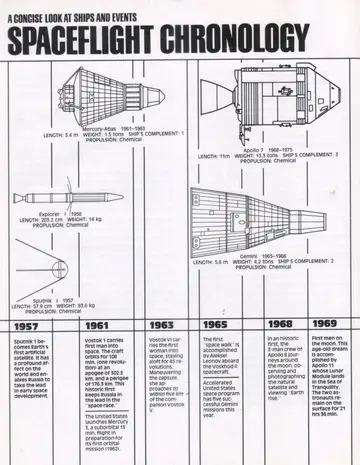
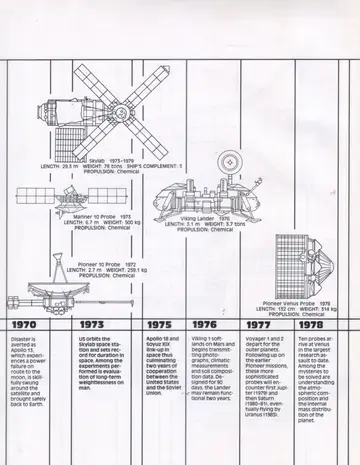
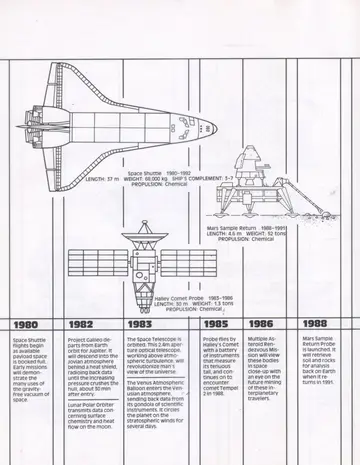
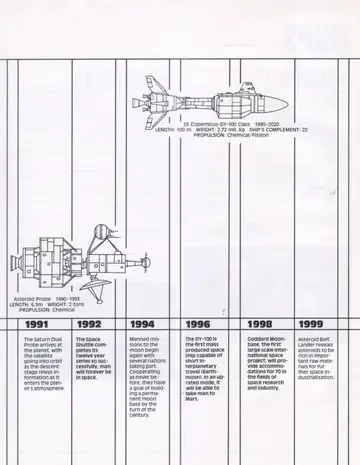
A Concise Look at Ships and Events: Spaceflight Chronology
1957—Sputnik 1 becomes Earth's first artificial satellite. It has a profound affect on the world and enables Russia to take the lead in early space development.
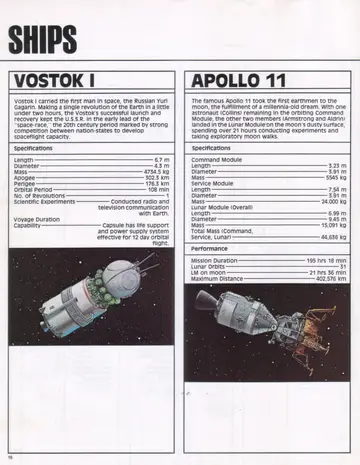
1961—Vostok 1 carries first man into space. The craft orbits for 108 min. (one revolution) at an apogee of 302.3 km. and a perigee of 176.3 km. This historic first keeps Russia in the lead in the "space race." The United States launches Mercury 3, a suborbital 15 min. flight in preparation for its first orbital mission (1962).
1963—Vostok VI carries the first woman into space, staying aloft for 45 revolutions.
1965—The first "space walk" is accomplished by Aleksei Leonov aboard the Voskhod II spacecraft. Accelerated United States space program has five successful Gemini missions this year.
1968—In an historic first, the 3-man crew of Apollo 8 journeys around the moon, observing and photographing the natural satellite and viewing "Earth rise."
1969—First men on the moon. This age-old dream is accomplished by Apollo 11 whose Lunar Module lands in the Sea of Tranquility. The two astronauts remain on the surface for 21 hrs 36 min.
1970—Disaster is averted as Apollo 13, which experiences a power failure on route to the moon, is skillfully swung around the satellite and brought safely back to Earth.
1973—US orbits the Skylab space station and sets record for duration in space. Among the experiments performed is evaluation of long-term weightlessness on man.
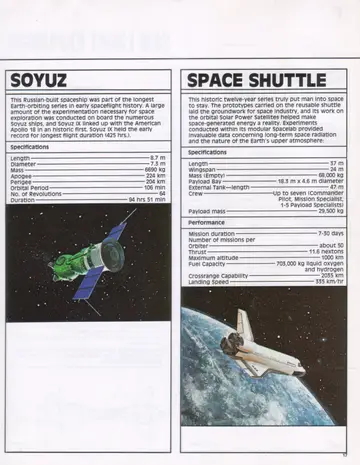
1975—Apollo 18 and Soyuz XIX link-up in space thus culminating two years of cooperation between the United States and the Soviet Union.
1976—Viking 1 soft-lands on Mars and begins transmitting photographs, climatic measurements and soil composition data. Designed for 90 days, the Lander may remain functional two years.
1977—Voyager 1 and 2 depart for the outer planets. Following up on the earlier Pioneer missions, these more sophisticated probes will encounter first Jupiter (1979) and then Saturn (1980-81), eventually flying by Uranus (1985).
1978—Ten probes arrive at Venus in the largest research assault to date. Among the mysteries to be solved are understanding the atmospheric composition and the internal mass distribution of the planet.
1980—Space Shuttle flights begin as available payload space is booked full. Early missions will demonstrate the many uses of the gravity-free vacuum of space.
1982—Project Galileo departs from Earth orbit for Jupiter. It will descend into the Jovian atmosphere behind a heat shield, radioing back data until the increasing pressure crushes the hull, about 30 min after entry. Lunar Polar Orbiter transmits data concerning surface chemistry and heat flow on the moon.
1983—The Space Telescope is orbited. This 2.4m aperture optical telescope, working above atmospheric turbulence, will revolutionize man's view of the universe. The Venus Atmospheric Balloon enters the Venusian atmosphere, sending back data from its gondola of scientific instruments. It circles the planet on the stratospheric winds for several days.
1985—Probe flies by Halley's Comet with a battery of instruments that measure its tenuous tail, and continues on to encounter comet Tempel 2 in 1988.
1986—Multiple Asteroid Rendezvous Mission will view these bodies in space close-up with an eye on the future mining of these interplanetary travelers.
1988—Mars Sample Return Probe is launched. It will retrieve soil and rocks for analysis back on Earth when it returns in 1991.
1991—The Saturn Dual Probe arrives at the planet, with the satellite going into orbit as the descent stage relays information as it enters the planet's atmosphere.
1992—The Space Shuttle completes its twelve year series so successfully, man will forever be in space.
1994—Manned missions to the moon begin again with several nations taking part. Cooperating as never before, they have a goal of building a permanent moon base by the turn of the century.
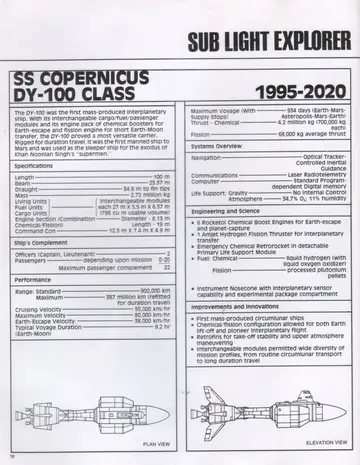
1996—The DY-100 is the first mass produced space ship capable of short interplanetary travel (Earth-moon). In an uprated mode, it will be able to take man to Mars.
1998—Goddard Moonbase, the first large scale international space project, will provide accommodations for 70 in the fields of space research and industry.
1999—Asteroid Belt Lander reveals asteroids to be rich in important raw materials for further space industrialization.
Ships
Vostok I
Vostok I carried the first man in space, the Russian Yuri Gagarin. Making a single revolution of the Earth in a little under two hours, the Vostok's successful launch and recovery kept the U.S.S.R. in the early lead of the "space-race," the 20th century period marked by strong competition between nation-states to develop spaceflight capacity.
Apollo 11
The famous Apollo 11 took the first earthmen to the moon, the fulfillment of a millennia-old dream. With one astronaut (Collins) remaining in the orbiting Command Module, the other two members (Armstrong and Aldrin) landed in the Lunar Module on the moon's dusty surface, spending over 21 hours conducting experiments and taking exploratory moon walks.
Soyuz
This Russian-built spaceship was part of the longest Earth-orbiting series in early spaceflight history. A large amount of the experimentation necessary for space exploration was conducted on board the numerous Soyuz ships, and Soyuz IX linked up with the American Apollo 18 in an historic first. Soyuz IX held the early record for longest flight duration (425 hrs.).
Space Shuttle
This historic twelve-year series truly put man into space to stay. The prototypes carried on the reusable shuttle laid the groundwork for space industry, and its work on the orbital Solar Power Satellites helped make space-generated energy a reality. Experiments conducted within its modular Spacelab provided invaluable data concerning long-term space radiation and the nature of the Earth's upper atmosphere.
SS Copernicus DY-100 Class
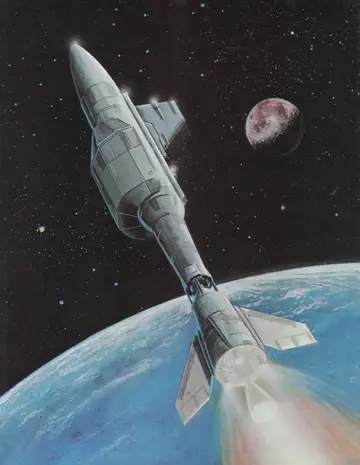
The DY-100 was the first mass-produced interplanetary ship. With its interchangeable cargo/fuel/passenger modules and its engine pack of chemical boosters for Earth-escape and fission engine for short Earth-Moon transfer, the DY-100 proved a most versatile carrier. Rigged for duration travel, it was the first manned ship to Mars and was used as the sleeper ship for the exodus of Khan Noonian Singh's "supermen."
Improvements and Innovations
- First mass-produced circumlunar ships
- Chemical/fission configuration allowed for both Earth lift-off and pioneer interplanetary flight
- Retrofins for take-off stability and upper atmosphere maneuvering
- Interchangeable modules permitted wide diversity of mission profiles, from routine circumlunar transport to long duration travel
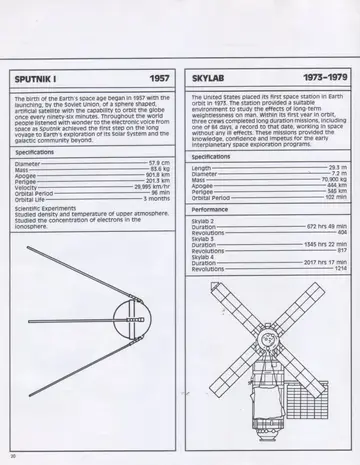
Sputnik I
The birth of the Earth's space age began in 1957 with the launching, by the Soviet Union, of a sphere shaped, artificial satellite with the capability to orbit the globe once every ninety-six minutes. Throughout the world people listened with wonder to the electronic voice from space as Sputnik achieved the first step on the long voyage to Earth's exploration of its Solar System and the galactic community beyond.
Skylab
The United States placed its first space station in Earth orbit in 1973. The station provided a suitable environment to study the effects of long-term weightlessness on man. Within its first year in orbit, three crews completed long duration missions, including one of 84 days, a record to that date, working in space without any ill effects. These missions provided the knowledge, confidence and impetus for the early interplanetary space exploration programs.