8.2 Transporter Systems Operation
Describes how all twenty-five transporter stations operate under Starfleet and Bajoran security clearance and CPG control, the charging of commercial cargo transmissions, the limits on transporting substances such as antideuterium and shape-shifters, and the key Cardassian system components compared with Starfleet equipment, including the transport chamber, console, scanners, energizing and phase transition coils, pattern buffer, biofilter, targeting scanners, and emitter pads.
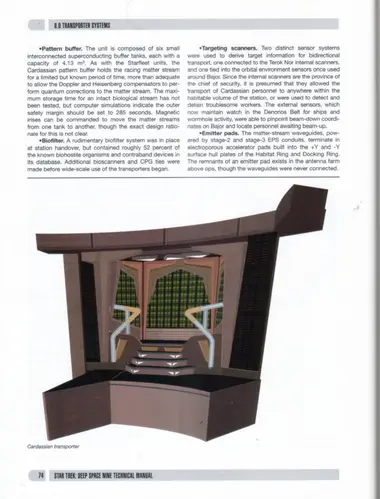
All transport operations are performed with clearance from the Starfleet and Bajoran security staff, for both official personnel movements and commercial cargo transfers. All twenty-five transporter stations are controlled by the Starfleet CPG attached to the Cardassian computer core and can be commanded from the individual stations or from ops. Commercial cargo transmissions are charged according to mass and total EPS energy expended. Since some substances and living entities, such as antideuterium and shape-shifters, respectively, cannot usually be safely transported, alternate methods must be used.
System Components
The Cardassian transporter system differs from familiar Starfleet hardware in some significant respects, though both achieve the same goal of breaking down matter and transmitting it to a remote site for reintegration. The following key Cardassian components comprise a typical personnel transporter, with comparisons to Starfleet equipment:
- Transport chamber. The enclosed volume is bounded by faceted field energy sustainer grids and accessed by three or four short steps. Inboard of the platform handrails, all annular confinement beam (ACB) energy is constrained to the chamber.
- Operator's console. All standard controls are available for targeting, energizing, destination input, pattern-buffer preferences, and emergency abort options.
- Transporter controller. No dedicated computer controller is used as part of the transporter unit. All command signals are routed through the CPG.
- Molecular imaging scanners. A single set of three 0.0009-micrometer scanners is set into the ceiling of the transport chamber. Quantum-state information is derived for the molecular structure of living entities and passed along to the energizing coils. No data storage of the quantum states is possible for more than 0.17 cubic centimeters of biological matter, and the scanners are tied to the energizing coils by the shortest microwaveguides possible for nearly instantaneous response.
- Primary energizing coils. Located at the top of the transport chamber. One of the chief differences lies in the ACB coils, which produce a single-stage traveling spiral wave to aid in fixing the three-dimensional position of the subject. Starfleet coils emit a two-stage unidirectional spatial matrix wave, which requires a minimum 1.21 seconds to allow dematerialization to begin. The spiral wave can begin matter-stream dissociation within 0.94 seconds.
- Phase transition coils. Located in the chamber platform. The system utilizes narrow-focus quark manipulation field devices to selectively decouple subatomic-particle binding energy. These coils also reorient the particles to form a continuous string, the matter stream, which can be spun up within the pattern buffer.
- Pattern buffer. The unit is composed of six small interconnected superconducting buffer tanks, each with a capacity of 4.13 m³. As with the Starfleet units, the Cardassian pattern buffer holds the racing matter stream for a limited but known period of time, more than adequate to allow the Doppler and Heisenberg compensators to perform quantum corrections to the matter stream. The maximum storage time for an intact biological stream has not been tested, but computer simulations indicate the outer safety margin should be set to 285 seconds. Magnetic irises can be commanded to move the matter streams from one tank to another, though the exact design rationale for this is not clear.
- Biofilter. A rudimentary biofilter system was in place at station handover, but contained roughly 52 percent of the known biohostile organisms and contraband devices in its database. Additional bioscanners and CPG ties were made before wide-scale use of the transporters began.
- Targeting scanners. Two distinct sensor systems were used to derive target information for bidirectional transport, one connected to the Terok Nor internal scanners, and one tied into the orbital environment sensors once used around Bajor. Since the internal scanners are the province of the chief of security, it is presumed that they allowed the transport of Cardassian personnel to anywhere within the habitable volume of the station, or were used to detect and detain troublesome workers. The external sensors, which now maintain watch in the Denorios Belt for ships and wormhole activity, were able to pinpoint beam-down coordinates on Bajor and locate personnel awaiting beam-up.
- Emitter pads. The matter-stream waveguides, powered by stage-2 and stage-3 EPS conduits, terminate in electroporous accelerator pads built into the +Y and -Y surface hull plates of the Habitat Ring and Docking Ring. The remnants of an emitter pad exists in the antenna farm above ops, though the waveguides were never connected.