12.4 Crew and Resident Quarters
Describes the primary grouping of living quarters within the Habitat Ring, its connection to the Mid-Core and Docking Ring by large and small crossover bridges, its five levels and circular corridors, the original Cardassian construction of large and small quarters and their current assignment to Starfleet and Bajoran crews, diplomats, and commercial operators, the moving of divider walls to create custom spaces and the additional Mid-Core overflow quarters, the typical residential space with its transparent aluminum windows, opacity controls, room layout, and original Cardassian replicators, the installation of Starfleet replicators and sonic showers, the EPS, RF, subspace, and ODN connections, the entertainment and news channels, the class-M standard environment with augmentations for other classes, and the audible emergency warning repeaters and computed evacuation routes.
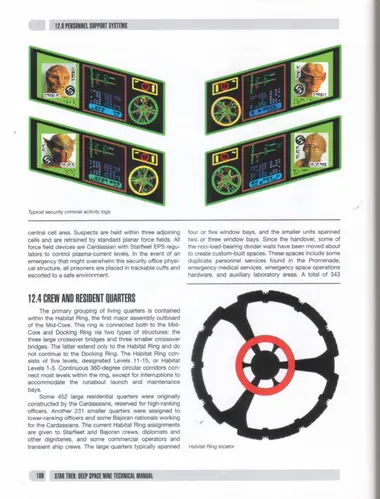
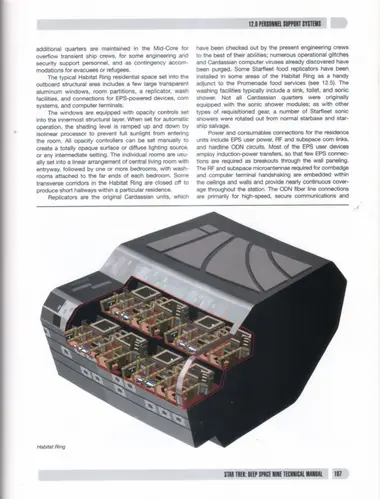
The primary grouping of living quarters is contained within the Habitat Ring, the first major assembly outboard of the Mid-Core. This ring is connected both to the Mid-Core and Docking Ring via two types of structures: the three large crossover bridges and three smaller crossover bridges. The latter extend only to the Habitat Ring and do not continue to the Docking Ring. The Habitat Ring consists of five levels, designated Levels 11-15, or Habitat Levels 1-5. Continuous 360-degree circular corridors connect most levels within the ring, except for interruptions to accommodate the runabout launch and maintenance bays. Some 452 large residential quarters were originally constructed by the Cardassians, reserved for high-ranking officers. Another 231 smaller quarters were assigned to lower-ranking officers and some Bajoran nationals working for the Cardassians. The current Habitat Ring assignments are given to Starfleet and Bajoran crews, diplomats and other dignitaries, and some commercial operators and transient ship crews. The large quarters typically spanned four or five window bays, and the smaller units spanned two or three window bays. Since the handover, some of the non-load-bearing divider walls have been moved about to create custom-built spaces. These spaces include some duplicate personnel services found in the Promenade, emergency medical services, emergency space operations hardware, and auxiliary laboratory areas. A total of 343 additional quarters are maintained in the Mid-Core for overflow transient ship crews, for some engineering and security support personnel, and as contingency accommodations for evacuees or refugees.
The typical Habitat Ring residential space set into the outboard structural area includes a few large transparent aluminum windows, room partitions, a replicator, wash facilities, and connections for EPS-powered devices, com systems, and computer terminals.
The windows are equipped with opacity controls set into the innermost structural layer. When set for automatic operation, the shading level is ramped up and down by isolinear processor to prevent full sunlight from entering the room. All opacity controllers can be set manually to create a totally opaque surface or diffuse lighting source, or any intermediate setting. The individual rooms are usually set into a linear arrangement of central living room with entryway, followed by one or more bedrooms, with wash rooms attached to the far ends of each bedroom. Some transverse corridors in the Habitat Ring are closed off to produce short hallways within a particular residence.
Replicators are the original Cardassian units, which have been checked out by the present engineering crews to the best of their abilities; numerous operational glitches and Cardassian computer viruses already discovered have been purged. Some Starfleet food replicators have been installed in some areas of the Habitat Ring as a handy adjunct to the Promenade food services (see 12.5). The washing facilities typically include a sink, toilet, and sonic shower. Not all Cardassian quarters were originally equipped with the sonic shower modules; as with other types of requisitioned gear, a number of Starfleet sonic showers were rotated out from normal starbase and starship salvage.
Power and consumables connections for the residence units include EPS user power, RF and subspace com links, and hardline ODN circuits. Most of the EPS user devices employ induction-power transfers, so that few EPS connections are required as breakouts through the wall paneling. The RF and subspace microantennae required for combadge and computer terminal handshaking are embedded within the ceilings and walls and provide nearly continuous coverage throughout the station. The ODN fiber line connections are primarily for high-speed, secure communications and encrypted IR, UV, and subspace converters built into computer operations and work with most short-range Starfleet and allied desktop and console units. All residences are also provided with entertainment and news channels through the room audio systems and display screens.
Standard environment for the units is that of class-M planets. Twenty-five percent of all quarters have been augmented with semipermanent breathing-gas and liquids-processing modules and subfloor connections to support class-H, -K, and -L environmental conditions. Transient facilities have been augmented to support an additional three percent class-B, -N, and -C environments, with reinforcements applied to the compartment force field systems to constrain non-class-M substances. In these cases, most interior walls and furnishings have been fabricated from compatible materials or sealed with anticorrosion agents.
The units are also equipped with audible emergency warning repeaters, configured for the exact location within the Habitat Ring or Mid-Core assembly. These repeaters are triggered by authorized security personnel and direct all Deep Space 9 inhabitants regarding the specific procedures required for a particular situation. Evacuation routes are calculated within the computer core and sent to each room. Space vessel dockings, lifeboat units, and sheltered areas are all considered in creating the required traffic-flow patterns.