14.2 Danube-Class Runabout
Covers the Danube-class runabout as a true multirole starship, detailing its mission objectives, launch and maintenance bays at Deep Space 9, modular structures, command, computer, warp and impulse propulsion, tactical, and personnel-support systems.
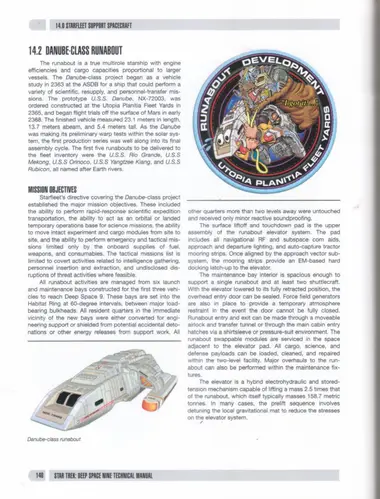
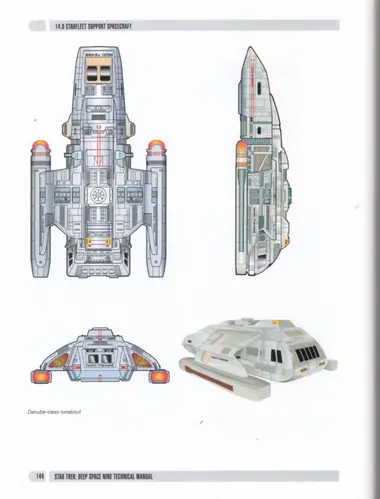
The runabout is a true multirole starship with engine efficiencies and cargo capacities proportional to larger vessels. The Danube-class project began as a vehicle study in 2363 at the ASDB for a ship that could perform a variety of scientific, resupply, and personnel-transfer missions. The prototype U.S.S. Danube, NX-72003, was ordered constructed at the Utopia Planitia Fleet Yards in 2365, and began flight trials off the surface of Mars in early 2368. The finished vehicle measured 23.1 meters in length, 13.7 meters abeam, and 5.4 meters tall. As the Danube was making its preliminary warp tests within the solar system, the first production series was well along into its final assembly cycle. The first five runabouts to be delivered to the fleet inventory were the U.S.S. Rio Grande, U.S.S. Mekong, U.S.S. Orinoco, U.S.S. Yangtzee Kiang, and U.S.S. Rubicon, all named after Earth rivers.
Mission Objectives
Starfleet's directive covering the Danube-class project established the major mission objectives. These included the ability to perform rapid-response scientific expedition transportation, the ability to act as an orbital or landed temporary operations base for science missions, the ability to move intact experiment and cargo modules from site to site, and the ability to perform emergency and tactical missions limited only by the onboard supplies of fuel, weapons, and consumables. The tactical missions list is limited to covert activities related to intelligence gathering, personnel insertion and extraction, and undisclosed disruptions of threat activities where feasible.
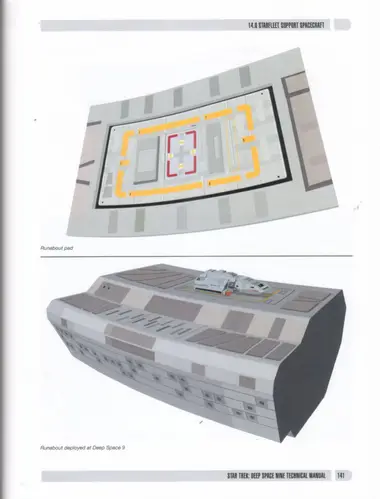
All runabout activities are managed from six launch and maintenance bays constructed for the first three vehicles to reach Deep Space 9. These bays are set into the Habitat Ring at 60-degree intervals, between major load-bearing bulkheads. All resident quarters in the immediate vicinity of the new bays were either converted for engineering support or shielded from potential accidental detonations or other energy releases from support work. All other quarters more than two levels away were untouched and received only minor reactive soundproofing.
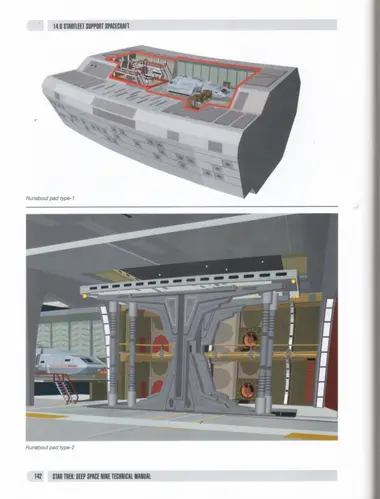
The surface liftoff and touchdown pad is the upper assembly of the runabout elevator system. The pad includes all navigational RF and subspace com aids, approach and departure lighting, and auto-capture tractor mooring strips. Once aligned by the approach vector subsystem, the mooring strips provide an EM-based hard docking latch-up to the elevator.
The maintenance bay interior is spacious enough to support a single runabout and at least two shuttlecraft. With the elevator lowered to its fully retracted position, the overhead entry door can be sealed. Force field generators are also in place to provide a temporary atmosphere restraint in the event the door cannot be fully closed. Runabout entry and exit can be made through a moveable airlock and transfer tunnel or through the main cabin entry hatches via a shirtsleeve or pressure-suit environment. The runabout swappable modules are serviced in the space adjacent to the elevator pad. All cargo, science, and defense payloads can be loaded, cleaned, and repaired within the two-level facility. Major overhauls to the runabout can also be performed within the maintenance fixtures.
The elevator is a hybrid electrohydraulic and stored-tension mechanism capable of lifting a mass 2.5 times that of the runabout, which itself typically masses 158.7 metric tonnes. In many cases, the prelift sequence involves detuning the local gravitational mat to reduce the stresses on the elevator system.
Spacecraft Structures
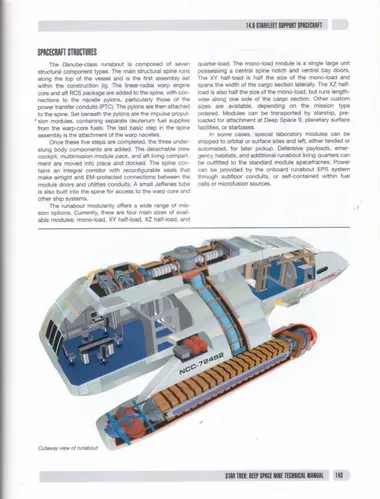
The Danube-class runabout is composed of seven structural component types. The main structural spine runs along the top of the vessel and is the first assembly set within the construction jig. The linear-radial warp engine core and aft RCS package are added to the spine, with connections to the nacelle pylons, particularly those of the power transfer conduits (PTC). The pylons are then attached to the spine. Set beneath the pylons are the impulse propulsion modules, containing separate deuterium fuel supplies from the warp-core fuels. The last basic step in the spine assembly is the attachment of the warp nacelles.
Once these five steps are completed, the three under-slung body components are added. The detachable crew cockpit, multimission module pack, and aft living compartment are moved into place and docked. The spine contains an integral corridor with reconfigurable seals that make airtight and EM-protected connections between the module doors and utilities conduits. A small Jefferies tube is also built into the spine for access to the warp core and other ship systems.
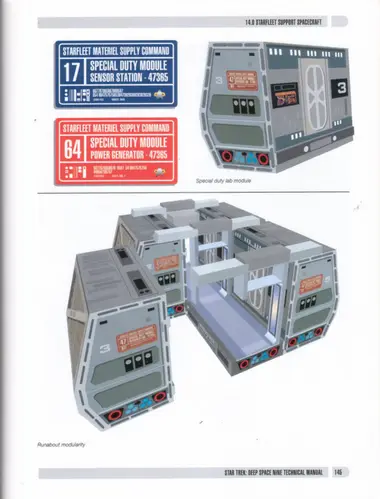
The runabout modularity offers a wide range of mission options. Currently, there are four main sizes of available modules: mono-load, XY half-load, XZ half-load, and quarter-load. The mono-load module is a single large unit possessing a central spine notch and ventral bay doors. The XY half-load is half the size of the mono-load and spans the width of the cargo section laterally. The XZ half-load is also half the size of the mono-load, but runs lengthwise along one side of the cargo section. Other custom sizes are available, depending on the mission type ordered. Modules can be transported by starship, preloaded for attachment at Deep Space 9, planetary surface facilities, or starbases.
In some cases, special laboratory modules can be shipped to orbital or surface sites and left, either tended or automated, for later pickup. Defensive payloads, emergency habitats, and additional runabout living quarters can be outfitted to the standard module spaceframes. Power can be provided by the onboard runabout EPS system through subfloor conduits, or self-contained within fuel cells or microfusion sources.
Command Systems
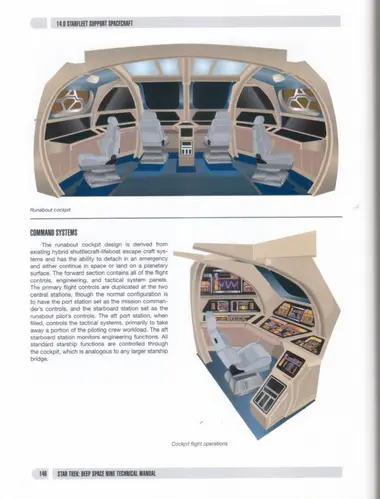
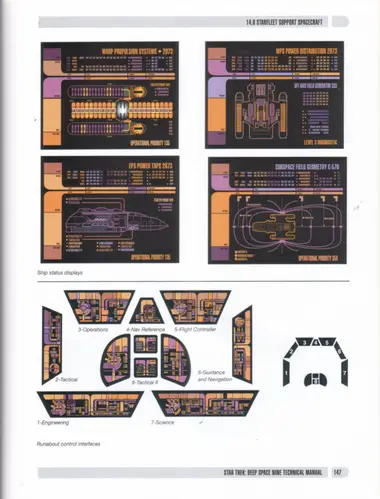
The runabout cockpit design is derived from existing hybrid shuttlecraft-lifeboat escape craft systems and has the ability to detach in an emergency and either continue in space or land on a planetary surface. The forward section contains all of the flight controls, engineering, and tactical system panels. The primary flight controls are duplicated at the two central stations, though the normal configuration is to have the port station set as the mission commander's controls, and the starboard station set as the runabout pilot's controls. The aft port station, when filled, controls the tactical systems, primarily to take away a portion of the piloting crew workload. The aft starboard station monitors engineering functions. All standard starship functions are controlled through the cockpit, which is analogous to any larger starship bridge.
Computer Systems
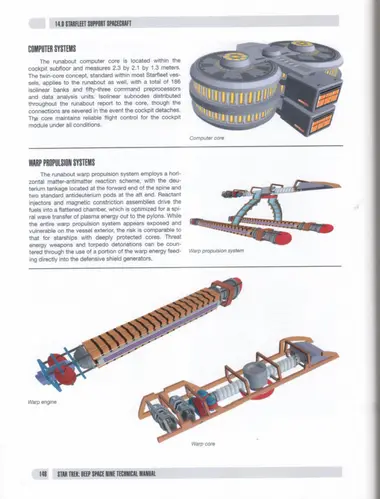
The runabout computer core is located within the cockpit subfloor and measures 2.3 by 2.1 by 1.3 meters. The twin-core concept, standard within most Starfleet vessels, applies to the runabout as well, with a total of 186 isolinear banks and fifty-three command preprocessors and data analysis units. Isolinear subnodes distributed throughout the runabout report to the core, though the connections are severed in the event the cockpit detaches. The core maintains reliable flight control for the cockpit module under all conditions.
Warp Propulsion Systems
The runabout warp propulsion system employs a horizontal matter-antimatter reaction scheme, with the deuterium tankage located at the forward end of the spine and two standard antideuterium pods at the aft end. Reactant injectors and magnetic constriction assemblies drive the fuels into a flattened chamber, which is optimized for a spiral wave transfer of plasma energy out to the pylons. While the entire warp propulsion system appears exposed and vulnerable on the vessel exterior, the risk is comparable to that for starships with deeply protected cores. Threat energy weapons and torpedo detonations can be countered through the use of a portion of the warp energy feeding directly into the defensive shield generators.
Impulse Propulsion Systems
The Danube class utilizes eight subscale impulse fusion reactors, space-time driver coils, and vectored exhaust directors. The impulse propulsion modules are serviceable by removal from the warp nacelle pylons and contain all required hardware for impulse flight, including interstellar or atmospheric intake vents and condenser-separators for liquefied fuel distillation. Control and fuel cross-feed connections are accomplished through standard magnetic conduits and ODN fiber bundles.
Tactical Systems
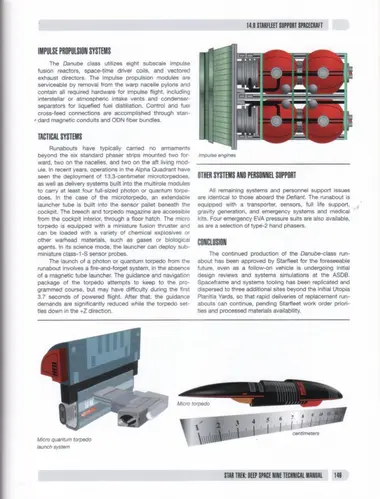
Runabouts have typically carried no armaments beyond the six standard phaser strips mounted two forward, two on the nacelles, and two on the aft living module. In recent years, operations in the Alpha Quadrant have seen the deployment of 13.3-centimeter microtorpedoes, as well as delivery systems built into the multirole modules to carry at least four full-sized photon or quantum torpedoes. In the case of the microtorpedo, an extendable launcher tube is built into the sensor pallet beneath the cockpit. The breech and torpedo magazine are accessible from the cockpit interior, through a floor hatch. The microtorpedo is equipped with a miniature fusion thruster and can be loaded with a variety of chemical explosives or other warhead materials, such as gases or biological agents. In its science mode, the launcher can deploy subminiature class-1-S sensor probes.
The launch of a photon or quantum torpedo from the runabout involves a fire-and-forget system, in the absence of a magnetic tube launcher. The guidance and navigation package of the torpedo attempts to keep to the programmed course, but may have difficulty during the first 3.7 seconds of powered flight. After that, the guidance demands are significantly reduced while the torpedo settles down in the +Z direction.
Other Systems and Personnel Support
All remaining systems and personnel support issues are identical to those aboard the Defiant. The runabout is equipped with a transporter, sensors, full life support, gravity generation, and emergency systems and medical kits. Four emergency EVA pressure suits are also available, as are a selection of type-2 hand phasers.
Conclusion
The continued production of the Danube-class runabout has been approved by Starfleet for the foreseeable future, even as a follow-on vehicle is undergoing initial design reviews and systems simulations at the ASDB. Spaceframe and systems tooling has been replicated and dispersed to three additional sites beyond the initial Utopia Planitia Yards, so that rapid deliveries of replacement runabouts can continue, pending Starfleet work order priorities and processed materials availability.