13.4 Emergency Space Hardware
Describes the limited emergency operations and escape capability the designers of Terok Nor provided for, the checkout of all serviceable Cardassian equipment and the addition of Starfleet ASRVs, EPGs, and SEWGs, the lifeboats and unusable survival suits abandoned by the Cardassians and the suspected industrial espionage behind the lifeboat design, the fact that only twenty-seven lifeboats were provided and reserved for senior Cardassian officers, the physical configuration, dimensions, materials, and construction of the Cardassian lifeboat, its mass and consumables and its limited capacity to sustain six Cardassians for a powered descent to Bajor compared to the year-long Starfleet ASRV, the three-part lifeboat propulsion and deorbit sequence and the high accelerations imparted to the crew, the recorded disposition of the twenty-seven Cardassian lifeboats, and the Starfleet Type-3 SEWG EVA pressure suit, including its modular sizing, masses, materials, consumables load, and power system.
The designers of Terok Nor provided for limited emergency operations and personnel escape from the space station in the event of a catastrophic failure of onboard systems, external attack, or cosmic threat. Since the arrival of the first Starfleet engineering crews to secure the new Deep Space 9, all serviceable Cardassian equipment has been run through rigorous checkout procedures. Allocations of Starfleet emergency equipment have been added to increase the survival chances of station crew and residents. The Starfleet equipment includes thirty-five standard lifeboats in the form of ASRVs, fifty-five EPGs, and thirty-eight SEWGs. All Starfleet equipment has been culled from starship and starbase supplies that had reached their primary operational lifetimes, but were still well within safety parameters.
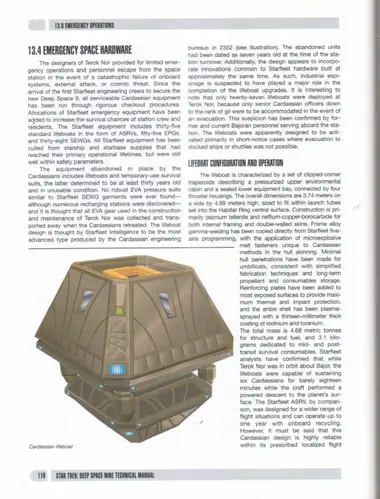
The equipment abandoned in place by the Cardassians includes lifeboats and temporary-use survival suits, the latter determined to be at least thirty years old and in unusable condition. No robust EVA pressure suits similar to Starfleet SEWG garments were ever found—although numerous recharging stations were discovered—and it is thought that all EVA gear used in the construction and maintenance of Terok Nor was collected and transported away when the Cardassians retreated. The lifeboat design is thought by Starfleet Intelligence to be the most advanced type produced by the Cardassian engineering bureaus in 2352 (see illustration). The abandoned units had been dated as seven years old at the time of the station turnover. Additionally, the design appears to incorporate innovations common to Starfleet hardware built at approximately the same time. As such, industrial espionage is suspected to have played a major role in the completion of the lifeboat upgrades. It is interesting to note that only twenty-seven lifeboats were deployed at Terok Nor, because only senior Cardassian officers down to the rank of gil were to be accommodated in the event of an evacuation. This suspicion has been confirmed by former and current Bajoran personnel serving aboard the station. The lifeboats were apparently designed to be activated primarily in short-notice cases where evacuation to docked ships or shuttles was not possible.
Lifeboat Configuration and Operation
The lifeboat is characterized by a set of clipped-corner trapezoids describing a pressurized upper environmental cabin and a sealed lower equipment bay, connected by four thruster housings. The overall dimensions are 3.74 meters on a side by 4.69 meters high, sized to fit within launch tubes set into the Habitat Ring ventral surface. Construction is primarily beznium tellenite and neffium-copper-borocarbide for both internal framing and double-walled skins. Frame alloy gamma-welding has been copied directly from Starfleet five-axis programming, with the application of microexplosive methods in the hull skinning. Minimal hull penetrations have been made for umbilicals, consistent with simplified fabrication techniques and long-term propellant and consumables storage. Reinforcing plates have been added to most exposed surfaces to provide maximum thermal and impact protection, and the entire shell has been plasma-sprayed with a thirteen-millimeter thick coating of rodinium and toranium. The total mass is 4.68 metric tonnes for structure and fuel, and 3.1 kilograms dedicated to mid- and post-transit survival consumables. Starfleet analysts have confirmed that while Terok Nor was in orbit about Bajor, the lifeboats were capable of sustaining six Cardassians for barely eighteen minutes while the craft performed a powered descent to the planet's surface. The Starfleet ASRV, by comparison, was designed for a wider range of flight situations and can operate up to one year with onboard recycling. However, it must be said that this Cardassian design is highly reliable within its prescribed localized flight environment and able to withstand large-scale operational stresses. More importantly, most Cardassian interstellar vessels, like the Galor-class warship, do employ ASRV-type lifeboats capable of performing over longer times and distances.
Lifeboat propulsion consists of a three-part system operating on a single isolinear navigation processor and event timer. The first section activates an argine initiator that propels the lifeboat downward away from its launch cavity. The event timer then fires pyro valves to sever the initiator circuits and automatically activate the second section, a force-feedback RCS that commands small microfusion thrusters to align and maintain the lifeboat's deorbit attitude. Upon reaching the correct angle and distance from the station, the timer fires the main engine in deorbit mode, propelling the lifeboat in a prograde orbital direction toward a predetermined touchdown location on Bajor. Typical maximum accelerations imparted to the crew reach 9.5g, necessary to leave the destruct radius of the station in the case of total weapons and fusion-generator detonation. Upon arrival at Bajor, the main engine fires in touchdown mode to set the lifeboat on the surface. Deceleration forces typically reach 12.5g in the final 25.8 seconds before ground contact.
Since the transfer of custody of the station and its move to the Denorios Belt, Bajoran and Starfleet authorities have recorded the disposition of the twenty-seven Cardassian lifeboats as follows:
- 5—Tested to destruction by Starfleet R&D and Bajoran Defense Forces
- 2—Disassembled, analyzed, and stored at undisclosed Starfleet locations
- 8—Upgraded and transferred to Bajor orbital facilities
- 12—Upgraded to interplanetary flight capability and retained at Deep Space 9
EVA Spacesuits
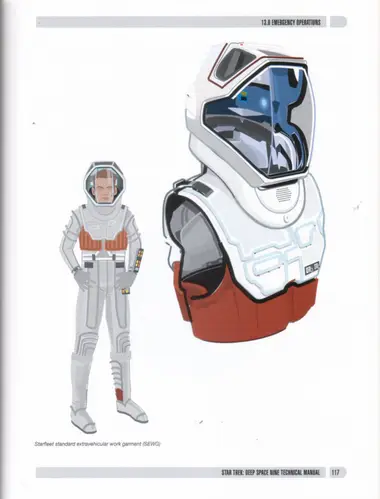
The current operational EVA pressure suit used aboard Deep Space 9 is Starfleet's Type-3 SEWG. This model is characterized by modular construction designed to fit from 38 to 76 percentile humanoid personnel. Torso, leg, boot, glove, and helmet assemblies are built in fifteen different sizes to allow for a wide range of body morphologies. The life support backpack and chest plate are furnished in three different sizes to accommodate different mission requirements and allow for custom loading of atmospheric gases, cooling liquids, recycling gear, power supplies, and communication equipment. The average suit empty mass is 19.6 kilograms, and 30.1 kilograms with backpack and full consumables loading. All flexible inner pressure bladders are constructed from fifty-nine alternating microlayers of duranium hexylamide and 2,1,3 polyurmedane, with a total thickness of 0.86 centimeters. The outer thermal micrometeoroid covering consists of sixty-one layers of woven disellenide-carbonitrium fibers jacketed with plasma-sprayed silica excelerine, with a total thickness of 1.2 centimeters. The helmet, backpack, and chest plate are typically molded from aluminum borotritonide, and standard transparent aluminum is employed in the helmet faceplates.
As in previous versions of the SEWG, an average consumables load of 9.6 kilograms of nitrogen-oxygen is designed to last a minimum of sixteen hours, and twenty hours in low tidal mode with maximum recycling. Suit power, provided by six sarium-krellide cells, is rated at a total of 95.6 kilowatt-hours, which exceeds by 15 percent the power required for three optional suites of external sensors and isolinear data recorders. The total power available for EVA missions is increased to 114.6 kilowatt-hours with the addition of a hot-gas thruster maneuvering unit.