3.3 Command Station
Explains that Deep Space 9 has no central command chair, describing instead the situation table at the center of ops, the senior staff who populate ops on duty, and the real-time default display driven through the Starfleet coprocessor and peripherals group with optronic translation buffers.
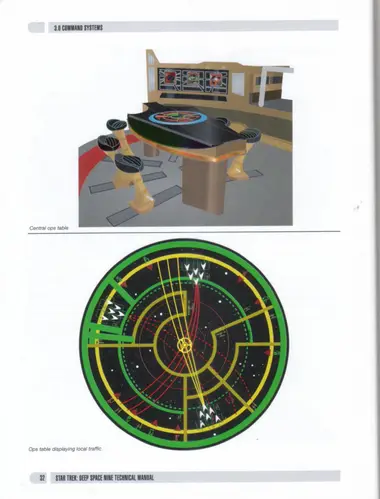
The primary command station on Deep Space 9 is located at the center of ops at the main situation-monitoring table. Unlike a typical frontline Starfleet vessel, with a captain’s chair and seating for other officers, Deep Space 9 maintains no comparable central location for commanding the station, other than the upper level office. Orders are given by the station commander or other ranking officers from most anywhere in ops, under a variety of operational conditions.
The situation table (see illustration) is ideally located for the display of key station data and for communication by way of the overhead gas-suspension screen. Seating is available for all senior officers. During a typical duty shift, ops will be populated with the core echelon, including station commander, Bajoran military liaison, science officer, and chief of operations. The station chief of security and chief medical officer are normally located in offices off the Promenade but are required in ops for briefings, discussions, and critical events. Adjacent to the table are a series of auxiliary Cardassian displays configured to present data and subspace communications.
The default table display screen presents the real-time conditions in the space surrounding the station. Display mode changes can be made at any time and can include any required graphical information, from internal sensor tracking to defensive weapon readiness to docked ship cargo operations. The real-time external plot affords the senior staff with a picture of the strategic environment, proven especially valuable in the recent wartime actions. Starfleet and threat-force movements have been tracked, using all available intelligence and sensor assets. The display retains the original Terok Nor multilayer screen and subprocessors and is connected to the main computer cores through the Starfleet coprocessor and peripherals group (CPG), which drives the standard Starfleet visual interface. A series of fifteen primary and three backup optronic translation buffers has been built into the table to adapt it to Federation data protocols.