14.3 Work Bee
Describes the Work Bee, a small microfusion-powered utility craft in continuous Starfleet service since 2268, used for inspection, repair, assembly, cargo transfer, and remote manipulation tasks.
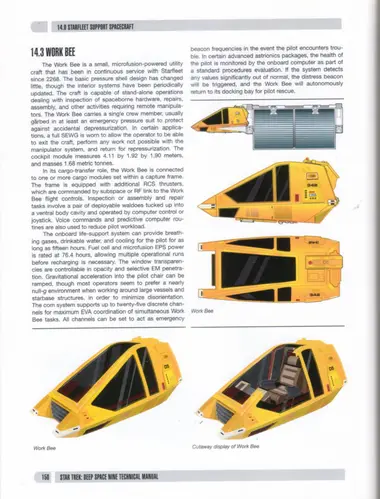
The Work Bee is a small, microfusion-powered utility craft that has been in continuous service with Starfleet since 2268. The basic pressure shell design has changed little, though the interior systems have been periodically updated. The craft is capable of stand-alone operations dealing with inspection of spaceborne hardware, repairs, assembly, and other activities requiring remote manipulators. The Work Bee carries a single crew member, usually garbed in at least an emergency pressure suit to protect against accidental depressurization. In certain applications, a full SEWG is worn to allow the operator to be able to exit the craft, perform any work not possible with the manipulator system, and return for repressurization. The cockpit module measures 4.11 by 1.92 by 1.90 meters and masses 1.68 metric tonnes.
In its cargo-transfer role, the Work Bee is connected to one or more cargo modules set within a capture frame. The frame is equipped with additional RCS thrusters, which are commanded by subspace or RF link to the Work Bee flight controls. Inspection or assembly and repair tasks involve a pair of deployable waldoes tucked up into a ventral body cavity and operated by computer control or joystick. Voice commands and predictive computer routines are also used to reduce pilot workload.
The onboard life-support system can provide breathing gases, drinkable water, and cooling for the pilot for as long as fifteen hours. Fuel cell and microfusion EPS power is rated at 76.4 hours, allowing multiple operational runs before recharging is necessary. The window transparencies are controllable in opacity and selective EM penetration. Gravitational acceleration into the pilot chair can be ramped, though most operators seem to prefer a nearly null-g environment when working around large vessels and starbase structures, in order to minimize disorientation.
The com system supports up to twenty-five discrete channels for maximum EVA coordination of simultaneous Work Bee tasks. All channels can be set to act as emergency beacon frequencies in the event the pilot encounters trouble. In certain advanced astrionics packages, the health of the pilot is monitored by the onboard computer as part of a standard procedures evaluation. If the system detects any values significantly out of normal, the distress beacon will be triggered, and the Work Bee will autonomously return to its docking bay for pilot rescue.