11.3 Gravity Generation
Explains the retained Cardassian gravity generator net aboard Deep Space 9, the design and operation of the graviton emitter block fabricated from alternating duralumin and gesselium ayanaminide layers, the block's dimensions and casing, the assembly of emitters into 5-by-5 matrix mats and their connection to the utility conduits, the residual graviton field provided by subspace capacitance during EPS interruptions, the distribution of gravity mats and spares across the station, the discovery of low-g laboratories in the Lower Core, and Starfleet's redundancy and computer-control modifications.
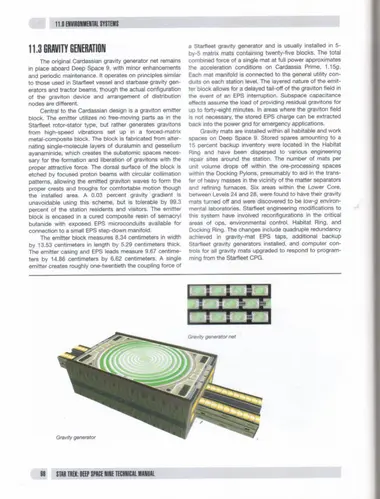
The original Cardassian gravity generator net remains in place aboard Deep Space 9, with minor enhancements and periodic maintenance. It operates on principles similar to those used in Starfleet vessel and starbase gravity generators and tractor beams, though the actual configuration of the graviton device and arrangement of distribution nodes are different.
Central to the Cardassian design is a graviton emitter block. The emitter utilizes no free-moving parts as in the Starfleet rotor-stator type, but rather generates gravitons from high-speed vibrations set up in a forced-matrix metal-composite block. The block is fabricated from alternating single-molecule layers of duralumin and gesselium ayanaminide, which creates the subatomic spaces necessary for the formation and liberation of gravitons with the proper attractive force. The dorsal surface of the block is etched by focused proton beams with circular collimation patterns, allowing the emitted graviton waves to form the proper crests and troughs for comfortable motion though the installed area. A 0.03 percent gravity gradient is unavoidable using this scheme, but is tolerable by 99.3 percent of the station residents and visitors. The emitter block is encased in a cured composite resin of semacryl butanide with exposed EPS microconduits available for connection to a small EPS step-down manifold.
The emitter block measures 8.34 centimeters in width by 13.53 centimeters in length by 5.29 centimeters thick. The emitter casing and EPS leads measure 9.67 centimeters by 14.86 centimeters by 6.62 centimeters. A single emitter creates roughly one-twentieth the coupling force of a Starfleet gravity generator and is usually installed in 5-by-5 matrix mats containing twenty-five blocks. The total combined force of a single mat at full power approximates the acceleration conditions on Cardassia Prime, 1.15g. Each mat manifold is connected to the general utility conduits on each station level. The layered nature of the emitter block allows for a delayed tail-off of the graviton field in the event of an EPS interruption. Subspace capacitance effects assume the load of providing residual gravitons for up to forty-eight minutes. In areas where the graviton field is not necessary, the stored EPS charge can be extracted back into the power grid for emergency applications.
Gravity mats are installed within all habitable and work spaces on Deep Space 9. Stored spares amounting to a 15 percent backup inventory were located in the Habitat Ring and have been dispersed to various engineering repair sites around the station. The number of mats per unit volume drops off within the ore-processing spaces within the Docking Pylons, presumably to aid in the transfer of heavy masses in the vicinity of the matter separators and refining furnaces. Six areas within the Lower Core, between Levels 24 and 28, were found to have their gravity mats turned off and were discovered to be low-g environmental laboratories. Starfleet engineering modifications to this system have involved reconfigurations in the critical areas of ops, environmental control, Habitat Ring, and Docking Ring. The changes include quadruple redundancy achieved in gravity-mat EPS taps, additional backup Starfleet gravity generators installed, and computer controls for all gravity mats upgraded to respond to programming from the Starfleet CPG.