10.4 Personal Phasers, Disruptors, and Blade Weapons
Surveys the hand-carried energy and bladed weapons used by Starfleet and the threat and allied forces around Deep Space 9, including the Starfleet type-1, type-2, type-3, type-3b, and type-3a phasers and their power cells and safety constraints, the Bajoran superconducting-crystal phasers, the Cardassian isotolinium-cell phasers, the Jem'Hadar pulsed-polaron disruptors with chemical enhancements, and the principal Klingon disruptors and bladed weapons such as the bat'leth, mek'leth, and d'k tahg.
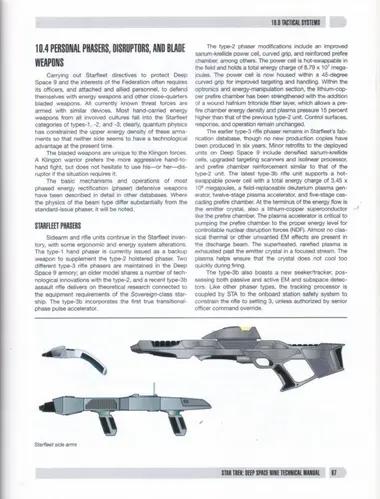
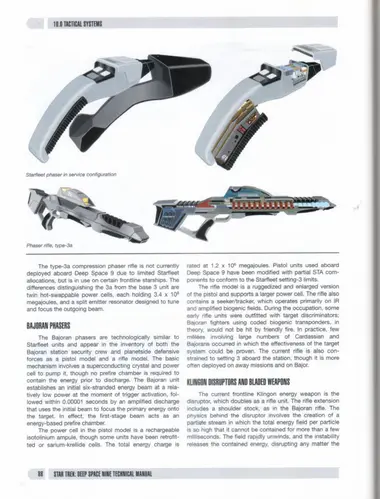
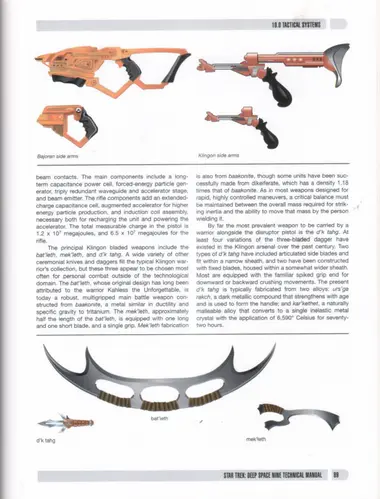
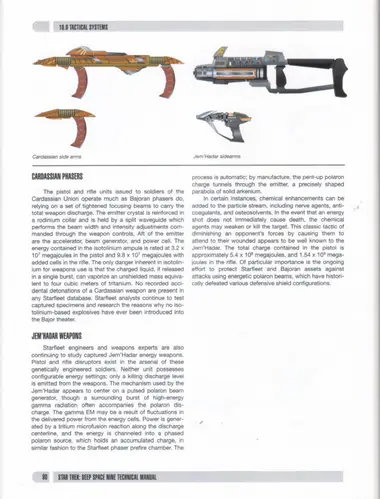
Carrying out Starfleet directives to protect Deep Space 9 and the interests of the Federation often requires its officers, and attached and allied personnel, to defend themselves with energy weapons and other close-quarters bladed weapons. All currently known threat forces are armed with similar devices. Most hand-carried energy weapons from all involved cultures fall into the Starfleet categories of types-1, -2, and -3; clearly, quantum physics has constrained the upper energy density of these armaments so that neither side seems to have a technological advantage at the present time.
The bladed weapons are unique to the Klingon forces. A Klingon warrior prefers the more aggressive hand-to-hand fight, but does not hesitate to use his—or her—disruptor if the situation requires it.
The basic mechanisms and operations of most phased energy rectification (phaser) defensive weapons have been described in detail in other databases. Where the physics of the beam type differ substantially from the standard-issue phaser, it will be noted.
Starfleet Phasers
Sidearm and rifle units continue in the Starfleet inventory, with some ergonomic and energy system alterations. The type-1 hand phaser is currently issued as a backup weapon to supplement the type-2 holstered phaser. Two different type-3 rifle phasers are maintained in the Deep Space 9 armory; an older model shares a number of technological innovations with the type-2, and a recent type-3b assault rifle delivers on theoretical research connected to the equipment requirements of the Sovereign-class starship. The type-3b incorporates the first true transitional-phase pulse accelerator.
The type-2 phaser modifications include an improved sarium-krellide power cell, curved grip, and reinforced prefire chamber, among others. The power cell is hot-swappable in the field and holds a total energy charge of 8.79 x 10⁶ megajoules. The power cell is now housed within a 45-degree curved grip for improved targeting and handling. Within the optronics and energy-manipulation section, the lithium-copper prefire chamber has been strengthened with the addition of a wound hafnium tritonide fiber layer, which allows a prefire chamber energy density and plasma pressure 15 percent higher than that of the previous type-2 unit. Control surfaces, response, and operation remain unchanged.
The earlier type-3 rifle phaser remains in Starfleet's fabrication database, though no new production copies have been produced in six years. Minor retrofits to the deployed units on Deep Space 9 include densified sarium-krellide cells, upgraded targeting scanners and isolinear processor, and prefire chamber reinforcement similar to that of the type-2 unit. The latest type-3b rifle unit supports a hot-swappable power cell with a total energy charge of 3.45 x 10⁶ megajoules, a field-replaceable deuterium plasma generator, twelve-stage plasma accelerator, and five-stage cascading prefire chamber. At the terminus of the energy flow is the emitter crystal, also a lithium-copper superconductor like the prefire chamber. The plasma accelerator is critical to pumping the prefire chamber to the proper energy level for controllable nuclear disruption forces (NDF). Almost no classical thermal or other unwanted EM effects are present in the discharge beam. The superheated, rarefied plasma is exhausted past the emitter crystal in a focused stream. The plasma helps ensure that the crystal does not cool too quickly during firing.
The type-3b also boasts a new seeker/tracker, possessing both passive and active EM and subspace detectors. Like other phaser types, the tracking processor is coupled by STA to the onboard station safety system to constrain the rifle to setting 3, unless authorized by senior officer command override.
The type-3a compression phaser rifle is not currently deployed aboard Deep Space 9 due to limited Starfleet allocations, but is in use on certain frontline starships. The differences distinguishing the 3a from the base 3 unit are twin hot-swappable power cells, each holding 3.4 x 10⁶ megajoules, and a split emitter resonator designed to tune and focus the outgoing beam.
Bajoran Phasers
The Bajoran phasers are technologically similar to Starfleet units and appear in the inventory of both the Bajoran station security crew and planetside defensive forces as a pistol model and a rifle model. The basic mechanism involves a superconducting crystal and power cell to pump it, though no prefire chamber is required to contain the energy prior to discharge. The Bajoran unit establishes an initial six-stranded energy beam at a relatively low power at the moment of trigger activation, followed within 0.00001 seconds by an amplified discharge that uses the initial beam to focus the primary energy onto the target. In effect, the first-stage beam acts as an energy-based prefire chamber.
The power cell in the pistol model is a rechargeable isotolinium ampule, though some units have been retrofitted or sarium-krellide cells. The total energy charge is rated at 1.2 x 10⁶ megajoules. Pistol units used aboard Deep Space 9 have been modified with partial STA components to conform to the Starfleet setting-3 limits.
The rifle model is a ruggedized and enlarged version of the pistol and supports a larger power cell. The rifle also contains a seeker/tracker, which operates primarily on IR and amplified biogenic fields. During the occupation, some early rifle units were outfitted with target discriminators; Bajoran fighters using coded biogenic transponders, in theory, would not be hit by friendly fire. In practice, few mêlées involving large numbers of Cardassian and Bajorans occurred in which the effectiveness of the target system could be proven. The current rifle is also constrained to setting 3 aboard the station, though it is more often deployed on away missions and on Bajor.
Klingon Disruptors and Bladed Weapons
The current frontline Klingon energy weapon is the disruptor, which doubles as a rifle unit. The rifle extension includes a shoulder stock, as in the Bajoran rifle. The physics behind the disruptor involves the creation of a particle stream in which the total energy field per particle is so high that it cannot be contained for more than a few milliseconds. The field rapidly unwinds, and the instability releases the contained energy, disrupting any matter the beam contacts. The main components include a long-term capacitance power cell, forced-energy particle generator, triply redundant waveguide and accelerator stage, and beam emitter. The rifle components add an extended-charge capacitance cell, augmented accelerator for higher energy particle production, and induction coil assembly, necessary both for recharging the unit and powering the accelerator. The total measurable charge in the pistol is 1.2 x 10⁷ megajoules, and 6.5 x 10⁷ megajoules for the rifle.
The principal Klingon bladed weapons include the bat'leth, mek'leth, and d'k tahg. A wide variety of other ceremonial knives and daggers fill the typical Klingon warrior's collection, but these three appear to be chosen most often for personal combat outside of the technological domain. The bat'leth, whose original design has long been attributed to the warrior Kahless the Unforgettable, is today a robust, multigripped main battle weapon constructed from baakonite, a metal similar in ductility and specific gravity to tritanium. The mek'leth, approximately half the length of the bat'leth, is equipped with one long and one short blade, and a single grip. Mek'leth fabrication is also from baakonite, though some units have been successfully made from dikeiferate, which has a density 1.18 times that of baakonite. As in most weapons designed for rapid, highly controlled maneuvers, a critical balance must be maintained between the overall mass required for striking inertia and the ability to move that mass by the person wielding it.
By far the most prevalent weapon to be carried by a warrior alongside the disruptor pistol is the d'k tahg. At least four variations of the three-bladed dagger have existed in the Klingon arsenal over the past century. Two types of d'k tahg have included articulated side blades and fit within a narrow sheath, and two have been constructed with fixed blades, housed within a somewhat wider sheath. Most are equipped with the familiar spiked grip end for downward or backward crushing movements. The present d'k tahg is typically fabricated from two alloys: urs'ga rakch, a dark metallic compound that strengthens with age and is used to form the handle; and kar'kethet, a naturally malleable alloy that converts to a single inelastic metal crystal with the application of 6,590° Celsius for seventy-two hours.
Cardassian Phasers
The pistol and rifle units issued to soldiers of the Cardassian Union operate much as Bajoran phasers do, relying on a set of tightened focusing beams to carry the total weapon discharge. The emitter crystal is reinforced in a rodinium collar and is held by a split waveguide which performs the beam width and intensity adjustments commanded through the weapon controls. Aft of the emitter are the accelerator, beam generator, and power cell. The energy contained in the isotolinium ampule is rated at 3.2 x 10⁷ megajoules in the pistol and 9.8 x 10⁷ megajoules with added cells in the rifle. The only danger inherent in isotolinium for weapons use is that the charged liquid, if released in a single burst, can vaporize an unshielded mass equivalent to four cubic meters of tritanium. No recorded accidental detonations of a Cardassian weapon are present in any Starfleet database. Starfleet analysts continue to test captured specimens and research the reasons why no isotolinium-based explosives have ever been introduced into the Bajor theater.
Jem'Hadar Weapons
Starfleet engineers and weapons experts are also continuing to study captured Jem'Hadar energy weapons. Pistol and rifle disruptors exist in the arsenal of these genetically engineered soldiers. Neither unit possesses configurable energy settings; only a killing discharge level is emitted from the weapons. The mechanism used by the Jem'Hadar appears to center on a pulsed polaron beam generator, though a surrounding burst of high-energy gamma radiation often accompanies the polaron discharge. The gamma EM may be a result of fluctuations in the delivered power from the energy cells. Power is generated by a tritium microfusion reaction along the discharge centerline, and the energy is channeled into a phased polaron source, which holds an accumulated charge, in similar fashion to the Starfleet phaser prefire chamber. The process is automatic; by manufacture, the pent-up polaron charge tunnels through the emitter, a precisely shaped parabola of solid arkenium.
In certain instances, chemical enhancements can be added to the particle stream, including nerve agents, anticoagulants, and osteosolvents. In the event that an energy shot does not immediately cause death, the chemical agents may weaken or kill the target. This classic tactic of diminishing an opponent's forces by causing them to attend to their wounded appears to be well known to the Jem'Hadar. The total charge contained in the pistol is approximately 5.4 x 10⁸ megajoules, and 1.54 x 10⁹ megajoules in the rifle. Of particular importance is the ongoing effort to protect Starfleet and Bajoran assets against attacks using energetic polaron beams, which have historically defeated various defensive shield configurations.