5.1 Fusion System Structure and Operation
Describes the six-chamber fusion generator at the -Y end of the Lower Core, its 790-terawatt capacity and reduced operational status, the construction and dimensions of the rodinium pentacarbide reaction chambers, the deuterium fuel-conditioning and pellet-forming process, the laser-detonator ignition cycle, capacitance start-up cells, magnetic EPS plasma exhaust, and the overload danger from excessive plasma density.
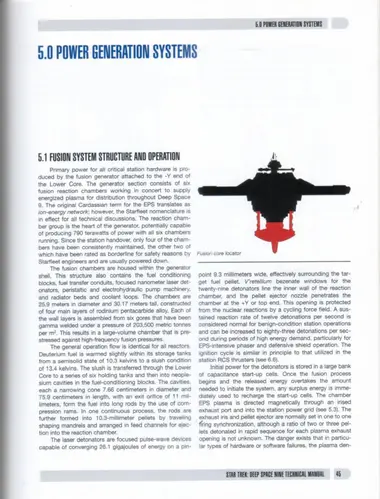
Primary power for all critical station hardware is produced by the fusion generator attached to the -Y end of the Lower Core. The generator section consists of six fusion reaction chambers working in concert to supply energized plasma for distribution throughout Deep Space 9. The original Cardassian term for the EPS translates as ion-energy network; however, the Starfleet nomenclature is in effect for all technical discussions. The reaction chamber group is the heart of the generator, potentially capable of producing 790 terawatts of power with all six chambers running. Since the station handover, only four of the chambers have been consistently maintained, the other two of which have been rated as borderline for safety reasons by Starfleet engineers and are usually powered down.
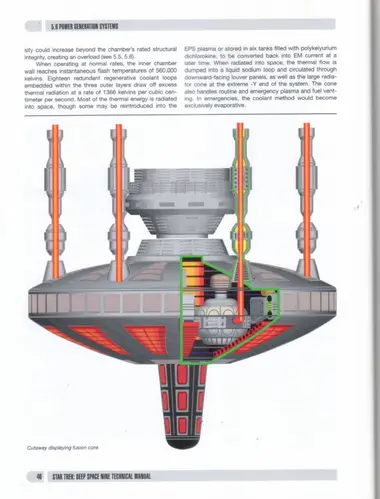
The fusion chambers are housed within the generator shell. This structure also contains the fuel conditioning blocks, fuel transfer conduits, focused nanometer laser detonators, peristaltic and electrohydraulic pump machinery, and radiator beds and coolant loops. The chambers are 25.9 meters in diameter and 30.17 meters tall, constructed of four main layers of rodinium pentacarbide alloy. Each of the wall layers is assembled from six gores that have been gamma welded under a pressure of 203,500 metric tonnes per m2. This results in a large-volume chamber that is prestressed against high-frequency fusion pressures.
The general operation flow is identical for all reactors. Deuterium fuel is warmed slightly within its storage tanks from a semisolid state of 10.3 kelvins to a slush condition of 13.4 kelvins. The slush is transferred through the Lower Core to a series of six holding tanks and then into neoplesium cavities in the fuel-conditioning blocks. The cavities, each a narrowing cone 7.66 centimeters in diameter and 75.9 centimeters in length, with an exit orifice of 11 millimeters, form the fuel into long rods by the use of compression rams. In one continuous process, the rods are further formed into 10.3-millimeter pellets by traveling shaping mandrels and arranged in feed channels for ejection into the reaction chamber.
The laser detonators are focused pulse-wave devices capable of converging 26.1 gigajoules of energy on a pinpoint 9.3 millimeters wide, effectively surrounding the target fuel pellet. V'retellium bezenate windows for the twenty-nine detonators line the inner wall of the reaction chamber, and the pellet ejector nozzle penetrates the chamber at the +Y or top end. This opening is protected from the nuclear reactions by a cycling force field. A sustained reaction rate of twelve detonations per second is considered normal for benign-condition station operations and can be increased to eighty-three detonations per second during periods of high energy demand, particularly for EPS-intensive phaser and defensive shield operation. The ignition cycle is similar in principle to that utilized in the station RCS thrusters (see 6.6).
Initial power for the detonators is stored in a large bank of capacitance start-up cells. Once the fusion process begins and the released energy overtakes the amount needed to initiate the system, any surplus energy is immediately used to recharge the start-up cells. The chamber EPS plasma is directed magnetically through an irised exhaust port and into the station power grid (see 5.3). The exhaust iris and pellet ejector are normally set in one to one firing synchronization, although a ratio of two or three pellets detonated in rapid sequence for each plasma exhaust opening is not unknown. The danger exists that in particular types of hardware or software failures, the plasma density could increase beyond the chamber's rated structural integrity, creating an overload (see 5.5, 5.6).
When operating at normal rates, the inner chamber wall reaches instantaneous flash temperatures of 560,000 kelvins. Eighteen redundant regenerative coolant loops embedded within the three outer layers draw off excess thermal radiation at a rate of 1366 kelvins per cubic centimeter per second. Most of the thermal energy is radiated into space, though some may be reintroduced into the EPS plasma or stored in six tanks filled with polykeiyurium dichlorokine, to be converted back into EM current at a later time. When radiated into space, the thermal flow is dumped into a liquid sodium loop and circulated through downward-facing louver panels, as well as the large radiator cone at the extreme -Y end of the system. The cone also handles routine and emergency plasma and fuel venting. In emergencies, the coolant method would become exclusively evaporative.