10.6 Auto-Destruct Systems
Recounts the Cardassian-designed auto-destruct system inherited with the station, including its single aborted activation in 2371 and its original purpose, the Starfleet-Bajoran agreement to keep it at full readiness and the docking-contract liability clause, the command authorization codes and personnel succession rules, the warning sequence, the original fusion-overload detonation scheme with its yield comparison, and the proposed Starfleet enhancements using matter-antimatter ordnance packages and shield containment.
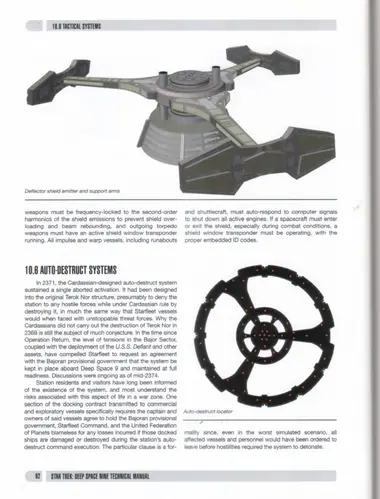
In 2371, the Cardassian-designed auto-destruct system sustained a single aborted activation. It had been designed into the original Terok Nor structure, presumably to deny the station to any hostile forces while under Cardassian rule by destroying it, in much the same way that Starfleet vessels would when faced with unstoppable threat forces. Why the Cardassians did not carry out the destruction of Terok Nor in 2369 is still the subject of much conjecture. In the time since Operation Return, the level of tensions in the Bajor Sector, coupled with the deployment of the U.S.S. Defiant and other assets, have compelled Starfleet to request an agreement with the Bajoran provisional government that the system be kept in place aboard Deep Space 9 and maintained at full readiness. Discussions were ongoing as of mid-2374.
Station residents and visitors have long been informed of the existence of the system, and most understand the risks associated with this aspect of life in a war zone. One section of the docking contract transmitted to commercial and exploratory vessels specifically requires the captain and owners of said vessels agree to hold the Bajoran provisional government, Starfleet Command, and the United Federation of Planets blameless for any losses incurred if those docked ships are damaged or destroyed during the station's auto-destruct command execution. The particular clause is a formality since, even in the worst simulated scenario, all affected vessels and personnel would have been ordered to leave before hostilities required the system to detonate.
Command Authorization
With the station under the operational custody of Starfleet Command and the Bajoran security forces, the computer authorization codes required for station destruction must be verified by one Starfleet and one Bajoran officer. All operational destruct software codes have been rewritten and placed within the Starfleet computer CPG, and all original Cardassian counterinsurgency program code discovered to date has been copied for analysis and deleted from the main computer. The present code will accept inputs from Starfleet personnel down to the position of the chief of operations and Bajoran security personnel down to the rank of lieutenant.
Predictive/adaptive computer routines in the CPG regularly monitor combadge signals, lifesign-sensor readings, and incoming subspace communications during major military actions to check for valid authorization codes. If the station commander and Bajoran chief of security are not available, the CPG checks for the succession of command personnel using rules established for Starfleet vessels. Verbal or keyboard input procedures requesting initiation and concurrence codes remain the same, as do destruct cancellation prior to T-minus-zero, when the system activates. Audible warnings in all represented languages on the station will sound, the specific language determined by the operational area in question. Warnings are also output through individual com devices. Warnings commence with the requested time-to-destruct setting and continue every fifteen seconds until the T-minus-one-minute mark, when the audible warning counts off each second. Graphics displays in all languages provide time-remaining information.
Hardware Configuration and Operation
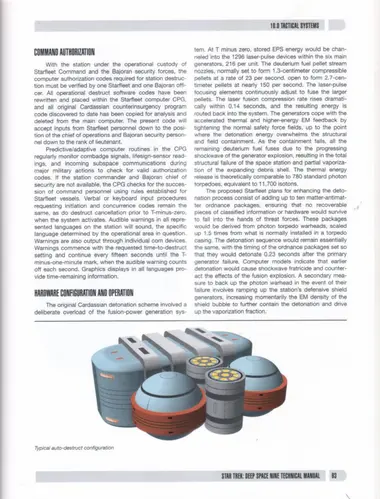
The original Cardassian detonation scheme involved a deliberate overload of the fusion-power generation system. At T minus zero, stored EPS energy would be channeled into the 1296 laser-pulse devices within the six main generators, 216 per unit. The deuterium fuel pellet stream nozzles, normally set to form 1.3-centimeter compressible pellets at a rate of 23 per second, open to form 2.7-centimeter pellets at nearly 150 per second. The laser-pulse focusing elements continuously adjust to fuse the larger pellets. The laser fusion compression rate rises dramatically within 0.14 seconds, and the resulting energy is routed back into the system. The generators cope with the accelerated thermal and higher-energy EM feedback by tightening the normal safety force fields, up to the point where the detonation energy overwhelms the structural and field containment. As the containment fails, all the remaining deuterium fuel fuses due to the progressing shockwave of the generator explosion, resulting in the total structural failure of the space station and partial vaporization of the expanding debris shell. The thermal energy release is theoretically comparable to 780 standard photon torpedoes, equivalent to 11,700 isotons.
The proposed Starfleet plans for enhancing the detonation process consist of adding up to ten matter-antimatter ordnance packages, ensuring that no recoverable pieces of classified information or hardware would survive to fall into the hands of threat forces. These packages would be derived from photon torpedo warheads, scaled up 1.5 times from what is normally installed in a torpedo casing. The detonation sequence would remain essentially the same, with the timing of the ordnance packages set so that they would detonate 0.23 seconds after the primary generator failure. Computer models indicate that earlier detonation would cause shockwave fratricide and counteract the effects of the fusion explosion. A secondary measure to back up the photon warhead in the event of their failure involves ramping up the station's defensive shield generators, increasing momentarily the EM density of the shield bubble to further contain the detonation and drive up the vaporization fraction.