13.3 Emergency Medical Operations
Describes how the well-known starship and starbase procedures for medical emergencies have been adapted for Deep Space 9, the computer-generated disaster prediction trees, the smaller ratio of trained medical crew to potential patients and the cross-training of at least twenty percent of the combined crew, the makeup of the initial rapid-response medical team and the rotation of staff after the first fifteen hours, the activation of the Habitat Ring contingency medical stations and their scaled-down infirmary capabilities, the goal of providing patient care from simple walk-in needs to organ-system stabilization, the portable medical kit and its standard contents and distribution, and the chief medical officer's orders for quarantine, compartment conversion, and evacuation as the patient load expands through the laboratory spaces, quarters, and cargo bays.
The well-known procedures for dealing with medical emergencies aboard starships and starbases have been adapted for execution aboard Deep Space 9. Disaster plans have evolved in the years since the station handover and are meant to cover, through computer-generated prediction trees, every possible permutation of biological and physical ordeal. The relative proportion of trained medical crew to potential patients is much smaller than that encountered on the typical frontline starship, which would tend to make a station-wide catastrophe difficult to manage. However, at least 20 percent of the combined Starfleet-Bajoran crew have been cross-trained for various secondary assignments in emergency medical, triage, and other disaster-response functions.
During most predicted station-wide emergencies, all ten staff physicians, nine medical technicians, and twenty nurses would be called up to form the initial rapid-response medical team. Rotations of staff members and cross-trained crew would be initiated after the first fifteen hours, if the situation were not stabilized by that time. All qualified laboratory and medical engineering specialists available on the station are also pressed into service. All contingency medical stations in the Habitat Ring will be activated by medical department personnel and placed on alert status.
Each contingency medical station contains what amounts to a smaller scale copy of the infirmary, with limitations on specialized surgical hardware and amounts of standard supplies. Medical tricorders and small overhead sensor clusters provide rapid comprehensive scanning capabilities, and the collected data can be fed to semiautomated diagnostic and treatment gear. The contingency station computer processors adjust the operating modes of the equipment to match the qualification ranking of the personnel performing the medical procedures. The goal of the contingency system is to provide patient care ranging from simple walk-in needs to organ-system stabilization prior to movement of a patient to the infirmary or other department section.
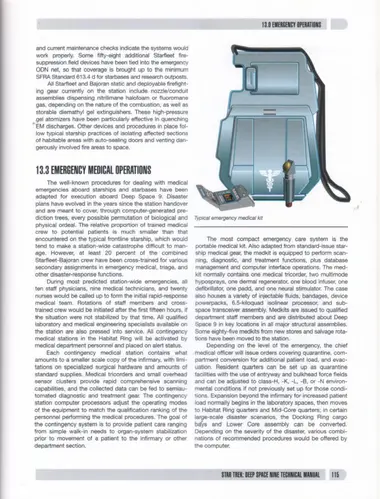
The most compact emergency care system is the portable medical kit. Also adapted from standard-issue starship medical gear, the medkit is equipped to perform scanning, diagnostic, and treatment functions, plus database management and computer interface operations. The medkit normally contains one medical tricorder, two multimode hyposprays, one dermal regenerator, one blood infuser, one defibrillator, one padd, and one neural stimulator. The case also houses a variety of injectable fluids, bandages, device powerpacks, 6.5-kiloquad isolinear processor, and subspace transceiver assembly. Medkits are issued to qualified department staff members and are distributed about Deep Space 9 in key locations in all major structural assemblies. Some eighty-five medkits from new stores and salvage rotations have been moved to the station.
Depending on the level of the emergency, the chief medical officer will issue orders covering quarantine, compartment conversion for additional patient load, and evacuation. Resident quarters can be set up as quarantine facilities with the use of entryway and bulkhead force fields and can be adjusted to class-H, -K, -L, -B, or -N environmental conditions if not previously set up for those conditions. Expansion beyond the infirmary for increased patient load normally begins in the laboratory spaces, then moves to Habitat Ring quarters and Mid-Core quarters; in certain large-scale disaster scenarios, the Docking Ring cargo bays and Lower Core assembly can be converted. Depending on the severity of the disaster, various combinations of recommended procedures would be offered by the computer.