6.4 Airlocks and Security Gates
Describes the doubly compartmentalized airlocks that serve as Deep Space 9's primary pressure isolation structures, the retention of three Promenade airlocks as security gates and the station's total of twenty-one airlocks, the construction and materials of the three geared pressure doors and surrounding framing, the expandable delcromin toroid pressure seals and backup force field emitters, the redundant electrohydraulic actuators and manual operation methods, and the manual backups for mooring clamps and adaptive docking tunnels housed at the docking port locations.
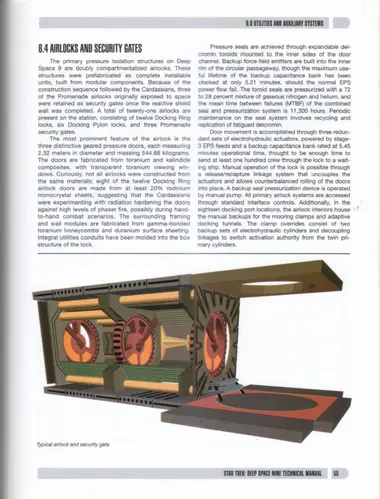
The primary pressure isolation structures on Deep Space 9 are doubly compartmentalized airlocks. These structures were prefabricated as complete installable units, built from modular components. Because of the construction sequence followed by the Cardassians, three of the Promenade airlocks originally exposed to space were retained as security gates once the reactive shield wall was completed. A total of twenty-one airlocks are present on the station, consisting of twelve Docking Ring locks, six Docking Pylon locks, and three Promenade security gates.
The most prominent feature of the airlock is the three distinctive geared pressure doors, each measuring 2.32 meters in diameter and massing 544.68 kilograms. The doors are fabricated from toranium and kelindide composites, with transparent toranium viewing windows. Curiously, not all airlocks were constructed from the same materials; eight of the twelve Docking Ring airlock doors are made from at least 20% rodinium monocrystal sheets, suggesting that the Cardassians were experimenting with radiation hardening the doors against high levels of phaser fire, possibly during hand-to-hand combat scenarios. The surrounding framing and wall modules are fabricated from gamma-bonded toranium honeycombs and duranium surface sheeting. Integral utilities conduits have been molded into the box structure of the lock.
Pressure seals are achieved through expandable delcromin toroids mounted to the inner sides of the door channel. Backup force field emitters are built into the inner rim of the circular passageway, though the maximum useful lifetime of the backup capacitance bank has been clocked at only 5.21 minutes, should the normal EPS power flow fail. The toroid seals are pressurized with a 72 to 28 percent mixture of gaseous nitrogen and helium, and the mean time between failures (MTBF) of the combined seal and pressurization system is 11,300 hours. Periodic maintenance on the seal system involves recycling and replication of fatigued delcromin.
Door movement is accomplished through three redundant sets of electrohydraulic actuators, powered by stage-3 EPS feeds and a backup capacitance bank rated at 5.45 minutes operational time, thought to be enough time to send at least one hundred crew through the lock to a waiting ship. Manual operation of the lock is possible through a release/recapture linkage system that uncouples the actuators and allows counterbalanced rolling of the doors into place. A backup seal pressurization device is operated by manual pump. All primary airlock systems are accessed through standard interface controls. Additionally, in the eighteen docking port locations, the airlock interiors house the manual backups for the mooring clamps and adaptive docking tunnels. The clamp overrides consist of two backup sets of electrohydraulic cylinders and decoupling linkages to switch activation authority from the twin primary cylinders.