7.5 Subspace Communications Network
Explains the subspace communications network's "97/22" velocity and distance limit and the need for uncrewed relay stations, the rising beacon deployment rate driven by hostile losses, Starfleet's relay-protection and pullback strategy, the controlled access in contested areas, and the Bajoran-Cardassian-Federation wormhole relay system and its destruction.
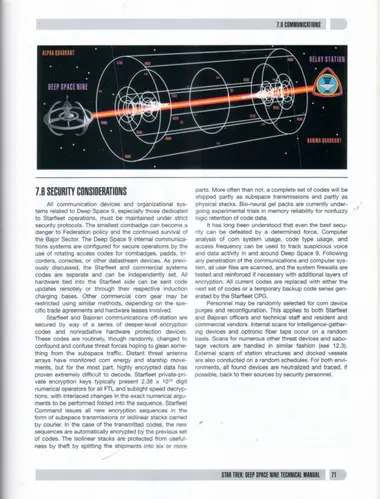
Despite Starfleet's best efforts to expand the subspace communications envelope, no single technology experiment program currently under way has demonstrated the capability to drive an energetic signal beyond the "97/22" limit, the equivalent Warp Factor 9.9997 carrier speed and 22.65 light-year distance traveled by the signal prior to unsalvageable data loss. The need for uncrewed subspace relay stations remains.
Ongoing dangers exist to the current relay system, however. Starfleet had seen an increase of 250 percent in the deployment rate, from 500 new beacons per year to 1,250 beginning in 2370. The rise in the deployment rate was initially due to normal expanded subspace coverage, but within two years the primary cause became the replacement of units destroyed by hostile actions in the Alpha Quadrant. The subspace communications network was particularly vulnerable, since the Cardassians and later the Jem'Hadar knew from basic subspace physics that there had to be another relay within 22.65 light-years of any unit they encountered. All vital com links between Starfleet assets could be severed. To prevent Cardassian forces from using the relays that they had established during the occupation, Starfleet embarked on its own campaign to make certain that Cardassian devices within thirty light-years of Bajor, primarily in the direction of Sol Sector, were found and either destroyed or captured.
Starfleet realized that a vast multiplication of relay numbers or decoys could confuse and bog down a threat effort to cut Deep Space 9's ties to Sol Sector. However, a pullback of most surviving booster beacons and crew-tended relay stations was deemed strategically more practical. In 2371, 80 percent of the units were retrieved for ready storage within Sector 001, and another 10 percent were deliberately destroyed to prevent them from falling into threat force hands. The remaining 10 percent were pulled into random string formations, away from supply convoy lanes, and maintained by well-armed Starfleet defensive forces. Access to the network in contested areas is tightly controlled (see 7.6). Other strings of subspace relays, established by resident cultures aboard the station or by their agents, exist throughout the Bajor Sector and can be accessed by their controlling organizations. In some sectors, coverage is spotty, and hails must often be circuitously routed to achieve loop closure to distant star systems, particularly those near Klingon and Romulan territories.
Wormhole Relay System
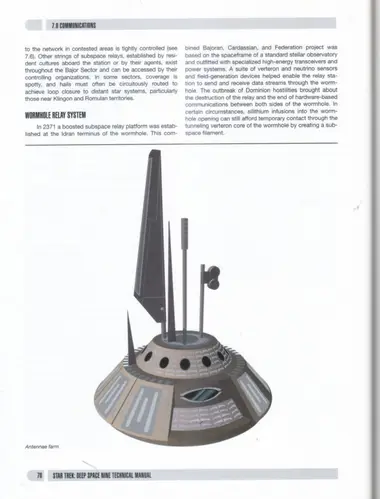
In 2371 a boosted subspace relay platform was established at the Idran terminus of the wormhole. This combined Bajoran, Cardassian, and Federation project was based on the spaceframe of a standard stellar observatory and outfitted with specialized high-energy transceivers and power systems. A suite of verteron and neutrino sensors and field-generation devices helped enable the relay station to send and receive data streams through the wormhole. The outbreak of Dominion hostilities brought about the destruction of the relay and the end of hardware-based communications between both sides of the wormhole. In certain circumstances, silithium infusions into the wormhole opening can still afford temporary contact through the tunneling verteron core of the wormhole by creating a subspace filament.