6.3 Docking Pylon Connections
Continues the docking description by covering the computer-controlled clamps and transfer tunnels and their manual overrides, the nine smaller secondary ports of the Docking Ring and their grab plates and ratings, the approach lighting and subspace and RF docking aids, the limited defensive-shield protection for docked vessels, and then explains the docking pylons themselves as former Cardassian ore-processing centers with immovable clamps, material-conveyor chutes, sequenced freighter operations, antigrav-assisted ore flow, Starfleet re-engineering for Federation ships, and special precautions for ships docked at the Upper Pylons.
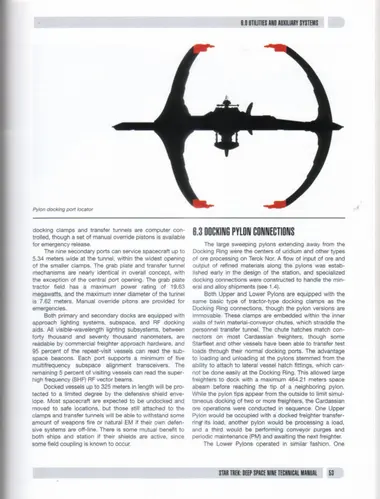
docking clamps and transfer tunnels are computer controlled, though a set of manual override pistons is available for emergency release.
The nine secondary ports can service spacecraft up to 5.34 meters wide at the tunnel, within the widest opening of the smaller clamps. The grab plate and transfer tunnel mechanisms are nearly identical in overall concept, with the exception of the central port opening. The grab plate tractor field has a maximum power rating of 19.63 megawatts, and the maximum inner diameter of the tunnel is 7.62 meters. Manual override pistons are provided for emergencies.
Both primary and secondary docks are equipped with approach lighting systems, subspace, and RF docking aids. All visible-wavelength lighting subsystems, between forty thousand and seventy thousand nanometers, are readable by commercial freighter approach hardware, and 95 percent of the repeat-visit vessels can read the subspace beacons. Each port supports a minimum of five multifrequency subspace alignment transceivers. The remaining 5 percent of visiting vessels can read the super-high frequency (SHF) RF vector beams.
Docked vessels up to 325 meters in length will be protected to a limited degree by the defensive shield envelope. Most spacecraft are expected to be undocked and moved to safe locations, but those still attached to the clamps and transfer tunnels will be able to withstand some amount of weapons fire or natural EM if their own defensive systems are off-line. There is some mutual benefit to both ships and station if their shields are active, since some field coupling is known to occur.
The large sweeping pylons extending away from the Docking Ring were the centers of uridium and other types of ore processing on Terok Nor. A flow of input of ore and output of refined materials along the pylons was established early in the design of the station, and specialized docking connections were constructed to handle the mineral and alloy shipments (see 1.4).
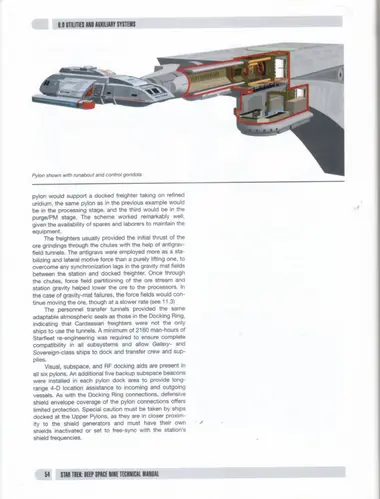
Both Upper and Lower Pylons are equipped with the same basic type of tractor-type docking clamps as the Docking Ring connections, though the pylon versions are immovable. These clamps are embedded within the inner walls of twin material-conveyor chutes, which straddle the personnel transfer tunnel. The chute hatches match connectors on most Cardassian freighters, though some Starfleet and other vessels have been able to transfer test loads through their normal docking ports. The advantage to loading and unloading at the pylons stemmed from the ability to attach to lateral vessel hatch fittings, which cannot be done easily at the Docking Ring. This allowed large freighters to dock with a maximum 464.21 meters space abeam before reaching the tip of a neighboring pylon. While the pylon tips appear from the outside to limit simultaneous docking of two or more freighters, the Cardassian ore operations were conducted in sequence. One Upper Pylon would be occupied with a docked freighter transferring its load, another pylon would be processing a load, and a third would be performing conveyor purges and periodic maintenance (PM) and awaiting the next freighter.
The Lower Pylons operated in similar fashion. One pylon would support a docked freighter taking on refined uridium, the same pylon as in the previous example would be in the processing stage, and the third would be in the purge/PM stage. The scheme worked remarkably well, given the availability of spares and laborers to maintain the equipment.
The freighters usually provided the initial thrust of the ore grindings through the chutes with the help of antigrav-field tunnels. The antigravs were employed more as a stabilizing and lateral motive force than a purely lifting one, to overcome any synchronization lags in the gravity mat fields between the station and docked freighter. Once through the chutes, force field partitioning of the ore stream and station gravity helped lower the ore to the processors. In the case of gravity-mat failures, the force fields would continue moving the ore, though at a slower rate (see 11.3).
The personnel transfer tunnels provided the same adaptable atmospheric seals as those in the Docking Ring, indicating that Cardassian freighters were not the only ships to use the tunnels. A minimum of 2160 man-hours of Starfleet re-engineering was required to ensure complete compatibility in all subsystems and allow Galaxy- and Sovereign-class ships to dock and transfer crew and supplies.
Visual, subspace, and RF docking aids are present in all six pylons. An additional five backup subspace beacons were installed in each pylon dock area to provide long-range 4-D location assistance to incoming and outgoing vessels. As with the Docking Ring connections, defensive shield envelope coverage of the pylon connections offers limited protection. Special caution must be taken by ships docked at the Upper Pylons, as they are in closer proximity to the shield generators and must have their own shields inactivated or set to free-sync with the station's shield frequencies.