2.9 Transporter
Explains the transporter: how it converts matter to energy and back, how it is used, its range and shield limitations, replication technology, direct (site-to-site) beaming, other transporters aboard, and the biofilter.
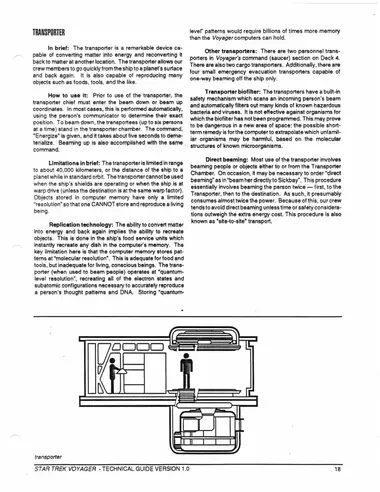
In brief: The transporter is a remarkable device capable of converting matter into energy and reconverting it back to matter at another location. The transporter allows our crew members to go quickly from the ship to a planet’s surface and back again. It is also capable of reproducing many objects such as foods, tools, and the like.
How to use it: Prior to use of the transporter, the transporter chief must enter the beam down or beam up coordinates. In most cases, this is performed automatically, using the person’s communicator to determine their exact position. To beam down, the transportees (up to six persons at a time) stand in the transporter chamber. The command, “Energize” is given, and it takes about five seconds to dematerialize. Beaming up is also accomplished with the same command.
Limitations in brief: The transporter is limited in range to about 40,000 kilometers, or the distance of the ship to a planet while in standard orbit. The transporter cannot be used when the ship’s shields are operating or when the ship is at warp drive (unless the destination is at the same warp factor). Objects stored in computer memory have only a limited “resolution” so that one CANNOT store and reproduce a living being.
Replication technology: The ability to convert matter into energy and back again implies the ability to recreate objects. This is done in the ship’s food service units which instantly recreate any dish in the computer’s memory. The key limitation here is that the computer memory stores patterns at “molecular resolution”. This is adequate for food and tools, but inadequate for living, conscious beings. The transporter (when used to beam people) operates at “quantum-level resolution”, recreating all of the electron states and subatomic configurations necessary to accurately reproduce a person’s thought patterns and DNA. Storing “quantum-level” patterns would require billions of times more memory than the Voyager computers can hold.
Other transporters: There are two personnel transporters in Voyager’s command (saucer) section on Deck 4. There are also two cargo transporters. Additionally, there are four small emergency evacuation transporters capable of one-way beaming off the ship only.
Transporter biofilter: The transporters have a built-in safety mechanism which scans an incoming person’s beam and automatically filters out many kinds of known hazardous bacteria and viruses. It is not effective against organisms for which the biofilter has not been programmed. This may prove to be dangerous in a new area of space; the possible short-term remedy is for the computer to extrapolate which unfamiliar organisms may be harmful, based on the molecular structures of known microorganisms.
Direct beaming: Most use of the transporter involves beaming people or objects directly to or from the Transporter. On occasion, it may be necessary to order “direct beaming” as in “beam her directly to Sickbay”. This procedure essentially involves beaming the person twice — first, to the Transporter, then to the destination. As such, it presumably consumes almost twice the power. Because of this, our crew tends to avoid direct beaming unless time or safety considerations outweigh the extra energy cost. This procedure is also known as “site-to-site” transport.