6.5 Cargo Processing and Storage
Covers the handling of goods on and off Deep Space 9, beginning with the airlock subprocessor's atmospheric gas equalization for docked spacecraft and the airlock environment database, then the trade protocols and the large and small cargo bays, the separated commercial and military processing, storage allocation and fees, cargo size limits and the ventral removable-pod locks, the Transited Cargo Inspection station and contraband scanning, the routing and separation of consumables and raw materials with proximity-caution protocols, the antigrav lifters and gravity reduction for heavy cargo, short- and long-term storage in the crossover bridges and core fabrication facilities, and the commandeering of cargo to aid station survival in a crisis.
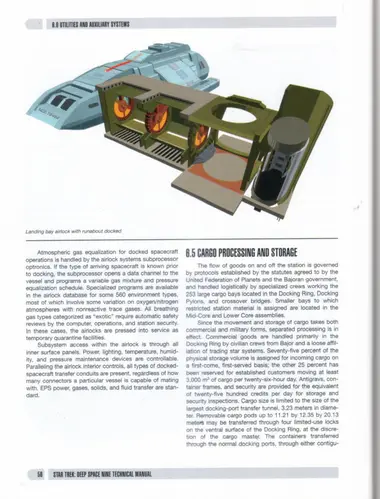
Atmospheric gas equalization for docked spacecraft operations is handled by the airlock systems subprocessor optronics. If the type of arriving spacecraft is known prior to docking, the subprocessor opens a data channel to the vessel and programs a variable gas mixture and pressure equalization schedule. Specialized programs are available in the airlock database for some 560 environment types, most of which involve some variation on oxygen/nitrogen atmospheres with nonreactive trace gases. All breathing gas types categorized as “exotic” require automatic safety reviews by the computer, operations, and station security. In these cases, the airlocks are pressed into service as temporary quarantine facilities.
Subsystem access within the airlock is through all inner surface panels. Power, lighting, temperature, humidity, and pressure maintenance devices are controllable. Paralleling the airlock interior controls, all types of docked-spacecraft transfer conduits are present, regardless of how many connectors a particular vessel is capable of mating with. EPS power, gases, solids, and fluid transfer are standard.
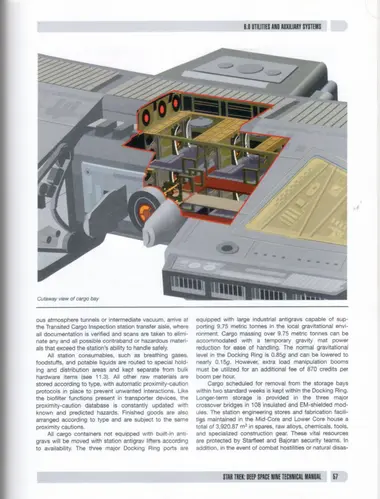
The flow of goods on and off the station is governed by protocols established by the statutes agreed to by the United Federation of Planets and the Bajoran government, and handled logistically by specialized crews working the 253 large cargo bays located in the Docking Ring, Docking Pylons, and crossover bridges. Smaller bays to which restricted station material is assigned are located in the Mid-Core and Lower Core assemblies.
Since the movement and storage of cargo takes both commercial and military forms, separated processing is in effect. Commercial goods are handled primarily in the Docking Ring by civilian crews from Bajor and a loose affiliation of trading star systems. Seventy-five percent of the physical storage volume is assigned for incoming cargo on a first-come, first-served basis; the other 25 percent has been reserved for established customers moving at least 3,000 m³ of cargo per twenty-six-hour day. Antigravs, container frames, and security are provided for the equivalent of twenty-five hundred credits per day for storage and security inspections. Cargo size is limited to the size of the largest docking-port transfer tunnel, 3.23 meters in diameter. Removable cargo pods up to 11.21 by 12.35 by 20.13 meters may be transferred through four limited-use locks on the ventral surface of the Docking Ring, at the discretion of the cargo master. The containers transferred through the normal docking ports, through either contiguous atmosphere tunnels or intermediate vacuum, arrive at the Transited Cargo Inspection station transfer aisle, where all documentation is verified and scans are taken to eliminate any and all possible contraband or hazardous materials that exceed the station's ability to handle safely.
All station consumables, such as breathing gases, foodstuffs, and potable liquids are routed to special holding and distribution areas and kept separate from bulk hardware items (see 11.3). All other raw materials are stored according to type, with automatic proximity-caution protocols in place to prevent unwanted interactions. Like the biofilter functions present in transporter devices, the proximity-caution database is constantly updated with known and predicted hazards. Finished goods are also arranged according to type and are subject to the same proximity cautions.
All cargo containers not equipped with built-in antigravs will be moved with station antigrav lifters according to availability. The three major Docking Ring ports are equipped with large industrial antigravs capable of supporting 9.75 metric tonnes in the local gravitational environment. Cargo massing over 9.75 metric tonnes can be accommodated with a temporary gravity mat power reduction for ease of handling. The normal gravitational level in the Docking Ring is 0.85g and can be lowered to nearly 0.15g. However, extra load manipulation booms must be utilized for an additional fee of 870 credits per boom per hour.
Cargo scheduled for removal from the storage bays within two standard weeks is kept within the Docking Ring. Longer-term storage is provided in the three major crossover bridges in 108 insulated and EM-shielded modules. The station engineering stores and fabrication facilities maintained in the Mid-Core and Lower Core house a total of 3,920.87 m³ in spares, raw alloys, chemicals, tools, and specialized construction gear. These vital resources are protected by Starfleet and Bajoran security teams. In addition, in the event of combat hostilities or natural disaster, all cargo left aboard Deep Space 9 may be considered available to aid in station survival under the revised 2372/SD49538.51 Sector Trade Contract. Every effort would be made to restore, replace, and return any material commandeered after the end of the crisis.