12.5 Food Replication System
Describes the crew-support replicators located in nearly all residences and key locations, used primarily to replicate potable liquids and foodstuffs, the storage of replication templates as high-resolution data in the main computer core or local isolinear modules, the augmentation of original Cardassian units with salvaged Starfleet replicators modified with a small molecular matrix unit, the Cardassian units' individual matrix-field manipulation devices and nutrient conduits, the two basic Cardassian unit sizes and their isolinear storage rods, the comparable Starfleet units that store food and inorganic-object templates in isolinear form, the creation of new data templates by molecular imaging scanners, the maintenance and replenishment of raw food stock through the cargo-processing bays, the osmotic, electrolytic, and uptake recycling of food materials, and the improvements in molecular resolution and nutritional efficiency despite persistent single-bit errors.
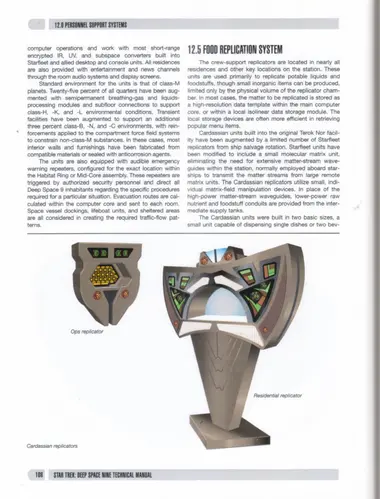
The crew-support replicators are located in nearly all residences and other key locations on the station. These units are used primarily to replicate potable liquids and foodstuffs, though small inorganic items can be produced, limited only by the physical volume of the replicator chamber. In most cases, the matter to be replicated is stored as a high-resolution data template within the main computer core, or within a local isolinear data storage module. The local storage devices are often more efficient in retrieving popular menu items.
Cardassian units built into the original Terok Nor facility have been augmented by a limited number of Starfleet replicators from ship salvage rotation. Starfleet units have been modified to include a small molecular matrix unit, eliminating the need for extensive matter-stream waveguides within the station, normally employed aboard starships to transmit the matter streams from large remote matrix units. The Cardassian replicators utilize small, individual matrix-field manipulation devices. In place of the high-power matter-stream waveguides, lower-power raw nutrient and foodstuff conduits are provided from the intermediate supply tanks.
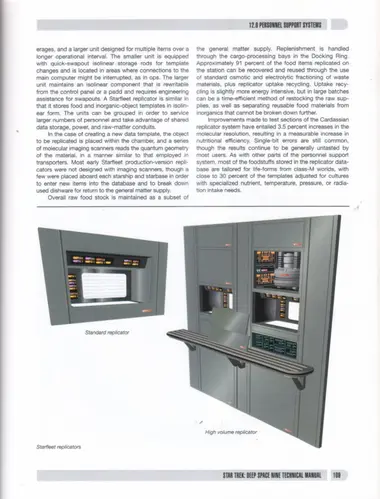
The Cardassian units were built in two basic sizes, a small unit capable of dispensing single dishes or two beverages, and a larger unit designed for multiple items over a longer operational interval. The smaller unit is equipped with quick-swapout isolinear storage rods for template changes and is located in areas where connections to the main computer might be interrupted, as in ops. The larger unit maintains an isolinear component that is rewritable from the control panel or a padd and requires engineering assistance for swapouts. A Starfleet replicator is similar in that it stores food and inorganic-object templates in isolinear form. The units can be grouped in order to service larger numbers of personnel and take advantage of shared data storage, power, and raw-matter conduits.
In the case of creating a new data template, the object to be replicated is placed within the chamber, and a series of molecular imaging scanners reads the quantum geometry of the material, in a manner similar to that employed in transporters. Most early Starfleet production-version replicators were not designed with imaging scanners, though a few were placed aboard each starship and starbase in order to enter new items into the database and to break down used dishware for return to the general matter supply.
Overall raw food stock is maintained as a subset of the general matter supply. Replenishment is handled through the cargo-processing bays in the Docking Ring. Approximately 91 percent of the food items replicated on the station can be recovered and reused through the use of standard osmotic and electrolytic fractioning of waste materials, plus replicator uptake recycling. Uptake recycling is slightly more energy intensive, but in large batches can be a time-efficient method of restocking the raw supplies, as well as separating reusable food materials from inorganics that cannot be broken down further.
Improvements made to test sections of the Cardassian replicator system have entailed 3.5 percent increases in the molecular resolution, resulting in a measurable increase in nutritional efficiency. Single-bit errors are still common, though the results continue to be generally untasted by most users. As with other parts of the personnel support system, most of the foodstuffs stored in the replicator database are tailored for life-forms from class-M worlds, with close to 30 percent of the templates adjusted for cultures with specialized nutrient, temperature, pressure, or radiation intake needs.