6.6 Attitude and Translational Control
Describes the reaction control system (RCS) once used to keep the station in synchronous orbit around Bajor and now used for planar stabilization in the Denorios Belt, the original Cardassian designation and the orbit-keeping role aligning the Y-axis with the Bajoran pole, the shield-assisted translational move to the belt, the circumferential series of fifty-four Protean-cycle fusion thrusters in the Docking Ring and their components, the deuterium fuel feed, the azurine-cortenide micronozzles and annular positron beam emitters, the pulse-valve firing cycle and delta-v range, the throttleable exhaust director vents, the recycling of excess fusion power, and the MHD shunt chambers used for direct monitoring.
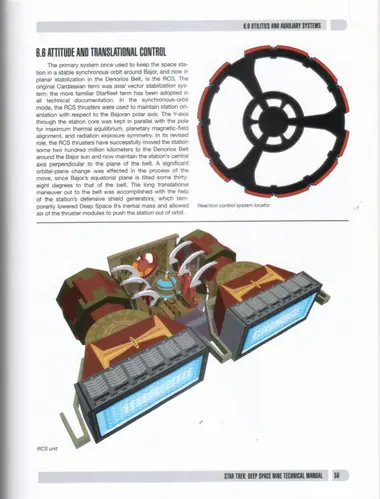
The primary system once used to keep the space station in a stable synchronous orbit around Bajor, and now in planar stabilization in the Denorios Belt, is the RCS. The original Cardassian term was axial vector stabilization system; the more familiar Starfleet term has been adopted in all technical documentation. In the synchronous-orbit mode, the RCS thrusters were used to maintain station orientation with respect to the Bajoran polar axis. The Y-axis through the station core was kept in parallel with the pole for maximum thermal equilibrium, planetary magnetic-field alignment, and radiation exposure symmetry. In its revised role, the RCS thrusters have successfully moved the station some two hundred million kilometers to the Denorios Belt around the Bajor sun and now maintain the station's central axis perpendicular to the plane of the belt. A significant orbital-plane change was effected in the process of the move, since Bajor's equatorial plane is tilted some thirty-eight degrees to that of the belt. The long translational maneuver out to the belt was accomplished with the help of the station's defensive shield generators, which temporarily lowered Deep Space 9's inertial mass and allowed six of the thruster modules to push the station out of orbit.
A single circumferential series of fifty-four Protean-cycle fusion thrusters is built into the extreme periphery of the Docking Ring, divided into six groups of four thrusters and six groups of five thrusters between the large and small docking ports. Each thruster consists of a fuel manifold assembly, hexagonal ignition chamber and accelerator, and exhaust director. The technology is similar to that used in Federation equipment designed for low-thrust, low-residual-impact applications.
Deuterium slush fuel, maintained at 13.8 kelvins and pumped through anti-backflow transfer piping, is supplied to the manifold assembly and control pulse-valve blocks. It is then divided into six convergent micronozzles ranged about the equator of the ignition chamber. The micronozzles are notable in having been manufactured from 9-5-3 azurine-cortenide, a transparent alloy similar in atomic structure to the verterium-cortenide used in Starfleet warp coils. An annular positron beam emitter surrounds each micronozzle, with all beams focusing upon the ignition chamber central axis. The pulse-valves synchronize and create the required firing cycle 0.05 seconds prior to beam energizing. The pulse duration varies from 12 to 1674 pulses per second, equivalent to a measurable delta-v between 0.03 meters per second and 1.21 meters per second. Adaptive subroutines in the thruster control processors work to smooth out adverse harmonic amplification in the chamber-firing sequence. The final stage for the fusion reaction is the exhaust director, where each thruster is divided into six independently throttleable vents for maximum flexibility in vector control. Vents can be infinitely ramped from straight-through firing (unidirectional propulsive) to diffused venting (omnidirectional nonpropulsive), most useful in rapid control of structural, rotational, and translational oscillations.
Excess power generated by the fusion process is cycled back into the RCS system for pump, positron beam, and other system needs. Initial starting energies are tapped from the onboard station plasma conduit network. In addition to automatic sensor network polling, thruster operation can be monitored directly by visual and tricorder examinations of magneto-hydrodynamic (MHD) shunt chambers, located between pairs of thrusters.