2.1 Main Skeletal Structure
Describes the station's central framing skeleton of shaped girders forming a tension and compression grid, the alloy proportions used in each major assembly, and how the girders were fabricated and fastened.
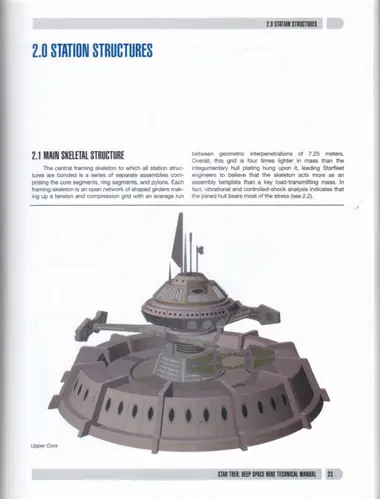
The central framing skeleton to which all station structures are bonded is a series of separate assemblies comprising the core segments, ring segments, and pylons. Each framing skeleton is an open network of shaped girders making up a tension and compression grid with an average run between geometric interpenetrations of 7.25 meters. Overall, this grid is four times lighter in mass than the integumentary hull plating hung upon it, leading Starfleet engineers to believe that the skeleton acts more as an assembly template than a key load-transmitting mass. In fact, vibrational and controlled-shock analysis indicates that the joined hull bears most of the stress (see 2.2).
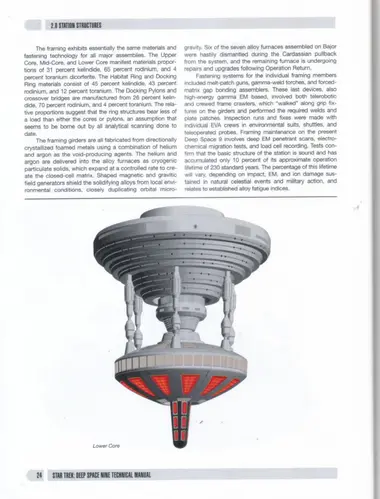
The framing exhibits essentially the same materials and fastening technology for all major assemblies. The Upper Core, Mid-Core, and Lower Core manifest materials proportions of 31 percent kelindide, 65 percent rodinium, and 4 percent toranium dicorferite. The Habitat Ring and Docking Ring materials consist of 45 percent kelindide, 43 percent rodinium, and 12 percent toranium. The Docking Pylons and crossover bridges are manufactured from 26 percent kelindide, 70 percent rodinium, and 4 percent toranium. The relative proportions suggest that the ring structures bear less of a load than either the cores or pylons, an assumption that seems to be borne out by all analytical scanning done to date.
The framing girders are all fabricated from directionally crystallized foamed metals using a combination of helium and argon as the void-producing agents. The helium and argon are delivered into the alloy furnaces as cryogenic particulate solids, which expand at a controlled rate to create the closed-cell matrix. Shaped magnetic and gravitic field generators shield the solidifying alloys from local environmental conditions, closely duplicating orbital microgravity. Six of the seven alloy furnaces assembled on Bajor were hastily dismantled during the Cardassian pullback from the system, and the remaining furnace is undergoing repairs and upgrades following Operation Return.
Fastening systems for the individual framing members included melt-patch guns, gamma-weld torches, and forced-matrix gap bonding assemblers. These last devices, also high-energy gamma EM based, involved both telerobotic and crewed frame crawlers, which “walked” along grip fixtures on the girders and performed the required welds and plate patches. Inspection runs and fixes were made with individual EVA crews in environmental suits, shuttles, and teleoperated probes. Framing maintenance on the present Deep Space 9 involves deep EM penetrant scans, electrochemical migration tests, and load cell recording. Tests confirm that the basic structure of the station is sound and has accumulated only 10 percent of its approximate operation lifetime of 230 standard years. The percentage of this lifetime will vary, depending on impact, EM, and ion damage sustained in natural celestial events and military action, and relates to established alloy fatigue indices.