4.3 Personal Access Display Devices
Surveys the personal access display device (padd) as the primary handheld tool aboard the station, describing the shared humanoid design influences and isolation safeguards, then detailing the construction, dimensions, power, memory, and display characteristics of the Starfleet, Cardassian, Ferengi, and Klingon padd variants.
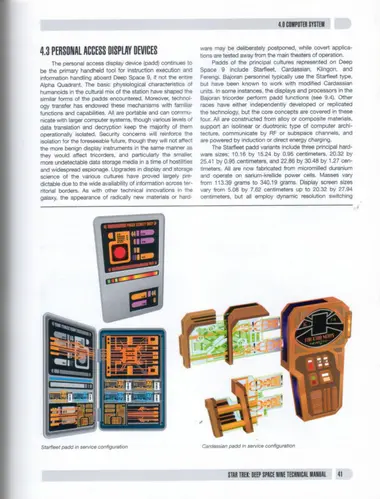
The personal access display device (padd) continues to be the primary handheld tool for instruction execution and information handling aboard Deep Space 9, if not the entire Alpha Quadrant. The basic physiological characteristics of humanoids in the cultural mix of the station have shaped the similar forms of the padds encountered. Moreover, technology transfer has endowed these mechanisms with familiar functions and capabilities. All are portable and can communicate with larger computer systems, though various levels of data translation and decryption keep the majority of them operationally isolated. Security concerns will reinforce the isolation for the foreseeable future, though they will not affect the more benign display instruments in the same manner as they would affect tricorders, and particularly the smaller, more undetectable data storage media in a time of hostilities and widespread espionage. Upgrades in display and storage science of the various cultures have proved largely predictable due to the wide availability of information across territorial borders. As with other technical innovations in the galaxy, the appearance of radically new materials or hardware may be deliberately postponed, while covert applications are tested away from the main theaters of operation.
Padds of the principal cultures represented on Deep Space 9 include Starfleet, Cardassian, Klingon, and Ferengi. Bajoran personnel typically use the Starfleet type, but have been known to work with modified Cardassian units. In some instances, the displays and processors in the Bajoran tricorder perform padd functions (see 9.4). Other races have either independently developed or replicated the technology, but the core concepts are covered in these four. All are constructed from alloy or composite materials, support an isolinear or duotronic type of computer architecture, communicate by RF or subspace channels, and are powered by induction or direct energy charging.
The Starfleet padd variants include three principal hardware sizes: 10.16 by 15.24 by 0.95 centimeters, 20.32 by 25.41 by 0.95 centimeters, and 22.86 by 30.48 by 1.27 centimeters. All are now fabricated from micromilled duranium and operate on sarium-krellide power cells. Masses vary from 113.39 grams to 340.19 grams. Display screen sizes vary from 5.08 by 7.62 centimeters up to 20.32 by 27.94 centimeters, but all employ dynamic resolution switching created by a nanopixel molecular matrix. The matrix is the result of a fivefold improvement on previous padd, tricorder, and control panel imaging thin films. All variants contain subspace transceiver assemblies (STA) for data transmissions to larger core computers. Isolinear memory storage capacity ranges from 15.3 kiloquads to 97.5 kiloquads, depending on the variant. Development units employing encapsulated bioneural gel wafers are scheduled to be delivered shortly after the Research, Development, Testing, and Evaluation (RDT&E) cycle is complete for all data devices.
Cardassian padds appear to be hybrid products of their own materials developments and borrowed technology from other worlds. The primary model is a ruggedized unit molded from rodinium boronate, mostly from ore tailings. The housing measures 18.41 centimeters by 9.53 centimeters, with a tapered handhold, and masses 198.2 grams. The display employs a gas-field suspension screen with a standoff gap distance of 0.3 millimeters and is capable of imaging both two-dimensional and limited holostereo data. Isolinear processors and memory chips are piggyback-paired in hot-swappable modules, with two type-2 memory rods for a total capacity of 12.1 kiloquads. Controls include capacitance sliders and voice activation. Power for 29.3 hours continuous operation is provided by liquid isotolinium ampules. In the modified units aboard the station, two Starfleet-type sarium-krellide cells power the padd for 37.5 hours continuous operation.
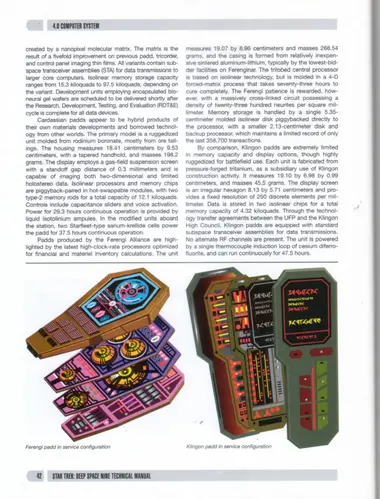
Padds produced by the Ferengi Alliance are highlighted by the latest high-clock-rate processors optimized for financial and materiel inventory calculations. The unit measures 19.07 by 8.96 centimeters and masses 268.54 grams, and the casing is formed from relatively inexpensive sintered aluminum-lithium, typically by the lowest-bidder facilities on Ferenginar. The trilobed central processor is based on isolinear technology, but is molded in a 4-D forced-matrix process that takes seventy-three hours to cure completely. The Ferengi patience is rewarded, however, with a massively cross-linked circuit possessing a density of twenty-three hundred neurites per square millimeter. Memory storage is handled by a single 5.35-centimeter molded isolinear disk piggybacked directly to the processor, with a smaller 2.13-centimeter disk and backup processor, which maintains a limited record of only the last 358,700 transactions.
By comparison, Klingon padds are extremely limited in memory capacity and display options, though highly ruggedized for battlefield use. Each unit is fabricated from pressure-forged tritanium, as a subsidiary use of Klingon construction activity. It measures 19.10 by 6.98 by 0.99 centimeters, and masses 45.5 grams. The display screen is an irregular hexagon 8.13 by 5.71 centimeters and provides a fixed resolution of 250 discrete elements per millimeter. Data is stored in two isolinear chips for a total memory capacity of 4.32 kiloquads. Through the technology transfer agreements between the UFP and the Klingon High Council, Klingon padds are equipped with standard subspace transceiver assemblies for data transmissions. No alternate RF channels are present. The unit is powered by a single thermocouple induction loop of cesium diferrofluorite, and can run continuously for 47.5 hours.