1.1 The Strategic Situation: Terok Nor to Deep Space 9
Surveys the broader galactic and local strategic picture surrounding Deep Space 9, covering subspace tunneling phenomena, the Bajor Sector, the Bajor system, Operation Return, and the Bajoran wormhole.
The tensions and outright war arising in the Bajor Sector are well known, though rather more difficult to fully comprehend or bring to a peaceful conclusion. Threat forces from the Alpha Quadrant, particularly the Cardassians, have joined with the Dominion fleets from the distant Gamma Quadrant to endanger the survival of many races. As with the Q incident, which brought the Federation into early direct conflict with the Borg, the discovery of a stable, artificially generated wormhole has reduced the time before the Alpha Quadrant would make contact with the Founders, the Vorta, and the Jem'Hadar.
Galactic Space
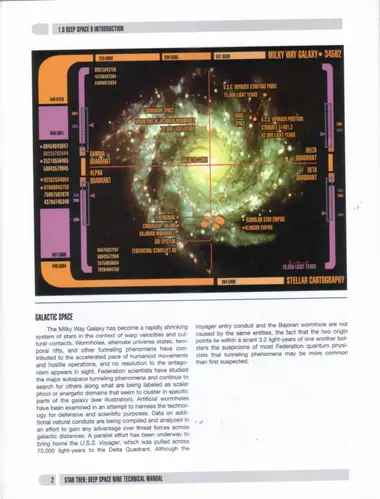
The Milky Way Galaxy has become a rapidly shrinking system of stars in the context of warp velocities and cultural contacts. Wormholes, alternate universe states, temporal rifts, and other tunneling phenomena have contributed to the accelerated pace of humanoid movement and hostile operations, and no resolution to the antagonism appears in sight. Federation scientists have studied the major subspace tunneling phenomena and continue to search for others along what are being labeled as scalar phoci or energetic domains that seem to cluster in specific parts of the galaxy (see illustration). Artificial wormholes have been examined in an attempt to harness the technology for defensive and scientific purposes. Data on additional natural conduits are being compiled and analyzed in an effort to gain any advantage over threat forces across galactic distances. A parallel effort has been underway to bring home the U.S.S. Voyager, which was pulled across 75,000 light-years to the Delta Quadrant. Although the Voyager entry conduit and the Bajoran wormhole are not caused by the same entities, the fact that the two origin points lie within a scant 3.2 light-years of one another bolsters the suspicions of most Federation quantum physicists that tunneling phenomena may be more common than first suspected.
Local Stellar Neighborhood
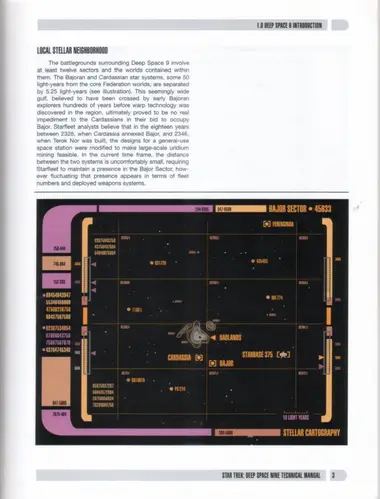
The battlegrounds surrounding Deep Space 9 involve at least twelve sectors and the worlds contained within them. The Bajoran and Cardassian star systems, some 50 light-years from the core Federation worlds, are separated by 5.25 light-years (see illustration). This seemingly wide gulf, believed to have been crossed by early Bajoran explorers hundreds of years before warp technology was discovered in the region, ultimately proved to be no real impediment to the Cardassians in their bid to occupy Bajor. Starfleet analysts believe that in the eighteen years between 2328, when Cardassia annexed Bajor, and 2346, when Terok Nor was built, the designs for a general-use space station were modified to make large-scale uridium mining feasible. In the current time frame, the distance between the two systems is uncomfortably small, requiring Starfleet to maintain a presence in the Bajor Sector, however fluctuating that presence appears in terms of fleet numbers and deployed weapons systems.
The Bajor System
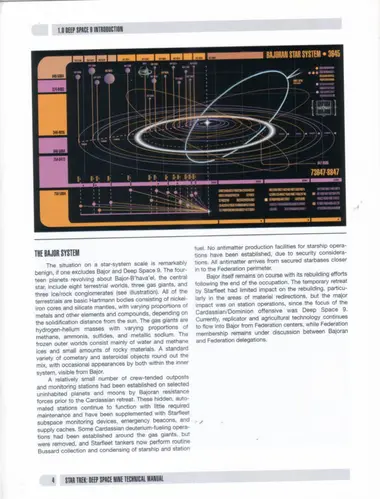
The situation on a star-system scale is remarkably benign, if one excludes Bajor and Deep Space 9. The fourteen planets revolving about Bajor-B'hava'el, the central star, include eight terrestrial worlds, three gas giants, and three ice/rock conglomerates (see illustration). All of the terrestrials are basic Hartmann bodies consisting of nickel-iron cores and silicate mantles, with varying proportions of metals and other elements and compounds depending on the solidification distance from the sun. The gas giants are hydrogen-helium masses with varying proportions of methane, ammonia, sulfides, and metallic sodium. The frozen outer worlds consist mainly of water and methane ices and small amounts of rocky materials. A standard variety of cometary and asteroidal objects round out the mix, with occasional appearances by both within the inner system, visible from Bajor.
A relatively small number of crew-tended outposts and monitoring stations had been established on selected uninhabited planets and moons by Bajoran resistance forces prior to the Cardassian retreat. These hidden, automated stations continue to function with little required maintenance and have been supplemented with Starfleet subspace monitoring devices, emergency beacons, and supply caches. Some Cardassian deuterium-fueling operations had been established around the gas giants, but were removed, and Starfleet tankers now perform routine Bussard collection and condensing of starship and station fuel. No antimatter production facilities for starship operations have been established, due to security considerations. All antimatter arrives from secured starbases closer in to the Federation perimeter.
Bajor itself remains on course with its rebuilding efforts following the end of the occupation. The temporary retreat by Starfleet had limited impact on the rebuilding, particularly in the areas of materiel redirections, but the major impact was on station operations, since the focus of the Cardassian/Dominion offensive was Deep Space 9. Currently, replicator and agricultural technology continues to flow into Bajor from Federation centers, while Federation membership remains under discussion between Bajoran and Federation delegations.
Operation Return
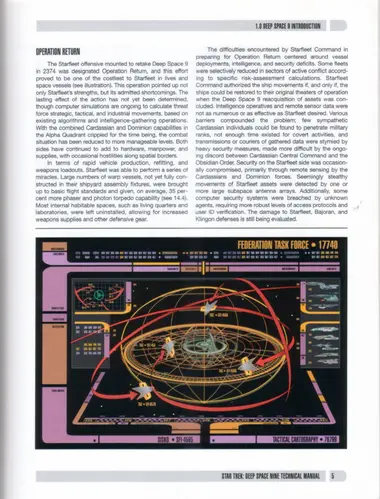
The Starfleet offensive mounted to retake Deep Space 9 in 2374 was designated Operation Return, and this effort proved to be one of the costliest to Starfleet in lives and space vessels (see illustration). This operation pointed up not only Starfleet's strengths, but its admitted shortcomings. The lasting effect of the action has not yet been determined, though computer simulations are ongoing to calculate threat force strategic, tactical, and industrial movements, based on existing algorithms and intelligence-gathering operations. With the combined Cardassian and Dominion capabilities in the Alpha Quadrant crippled for the time being, the combat situation has been reduced to more manageable levels. Both sides have continued to add to hardware, manpower, and supplies, with occasional hostilities along spatial borders.
In terms of rapid vehicle production, refitting, and weapons loadouts, Starfleet was able to perform a series of miracles. Large numbers of warp vessels, not yet fully constructed in their shipyard assembly fixtures, were brought up to basic flight standards and given, on average, 35 percent more phaser and photon torpedo capability (see 14.4). Most internal habitable spaces, such as living quarters and laboratories, were left uninstalled, allowing for increased weapons supplies and other defensive gear.
The difficulties encountered by Starfleet Command in preparing for Operation Return centered around vessel deployments, intelligence, and security deficits. Some fleets were selectively reduced in sectors of active conflict according to specific risk-assessment calculations. Starfleet Command authorized the ship movements if, and only if, the ships could be restored to their original theaters of operation when the Deep Space 9 reacquisition of assets was concluded. Intelligence operatives and remote sensor data were not as numerous or as effective as Starfleet desired. Various barriers compounded the problem; few sympathetic Cardassian individuals could be found to penetrate military ranks, not enough time existed for covert activities, and transmissions or couriers of gathered data were stymied by heavy security measures, made more difficult by the ongoing discord between Cardassian Central Command and the Obsidian Order. Security on the Starfleet side was occasionally compromised, primarily through remote sensing by the Cardassians and Dominion forces. Seemingly stealthy movements of Starfleet assets were detected by one or more large subspace antenna arrays. Additionally, some computer security systems were breached by unknown agents, requiring more robust levels of access protocols and user ID verification. The damage to Starfleet, Bajoran, and Klingon defenses is still being evaluated.
The Wormhole
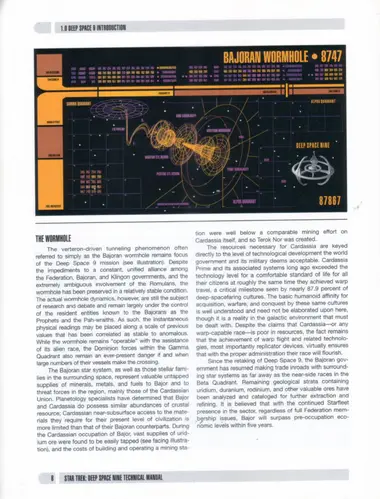
The verteron-driven tunneling phenomenon often referred to simply as the Bajoran wormhole remains focus of the Deep Space 9 mission (see illustration). Despite the impediments to a constant, unified alliance among the Federation, Bajoran, and Klingon governments, and the extremely ambiguous involvement of the Romulans, the wormhole has been preserved in a relatively stable condition. The actual wormhole dynamics, however, are still the subject of research and debate and remain largely under the control of the resident entities known to the Bajorans as the Prophets and the Pah-wraiths. As such, the instantaneous physical readings may be placed along a scale of previous values that has been correlated as stable to anomalous. While the wormhole remains "operable" with the assistance of its alien race, the Dominion forces within the Gamma Quadrant also remain an ever-present danger if and when large numbers of their vessels make the crossing.
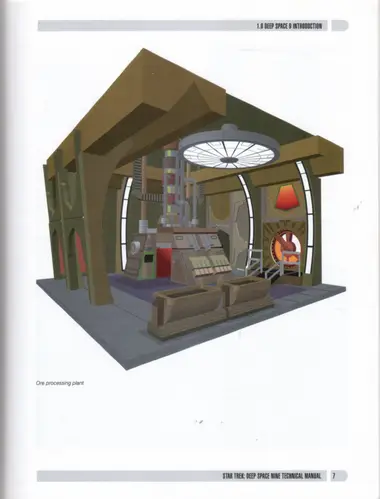
The Bajoran star system, as well as those stellar families in the surrounding space, represent valuable untapped supplies of minerals, metals, and fuels to Bajor and to threat forces in the region, mainly those of the Cardassian Union. Planetology specialists have determined that Bajor and Cardassia do possess similar abundances of crustal resource; Cardassian near-subsurface access to the materials they require for their present level of civilization is more limited than that of their Bajoran counterparts. During the Cardassian occupation of Bajor, vast supplies of uridium ore were found to be easily tapped (see facing illustration), and the costs of building and operating a mining station were well below a comparable mining effort on Cardassia itself, and so Terok Nor was created.
The resources necessary for Cardassia are keyed directly to the level of technological development the world government and its military deems acceptable. Cardassia Prime and its associated systems long ago exceeded the technology level for a comfortable standard of life for all their citizens at roughly the same time they achieved warp travel, a critical milestone seen by nearly 87.9 percent of deep-spacefaring cultures. The basic humanoid affinity for acquisition, warfare, and conquest by these same cultures is well understood and need not be elaborated upon here, though it is a reality in the galactic environment that must be dealt with. Despite the claims that Cardassia—or any warp-capable race—is poor in resources, the fact remains that the achievement of warp flight and related technologies, most importantly replicator devices, virtually ensures that with the proper administration their race will flourish.
Since the retaking of Deep Space 9, the Bajoran government has resumed making trade inroads with surrounding star systems as far away as the near-side races in the Beta Quadrant. Remaining geological strata containing uridium, duranium, rodinium, and other valuable ores have been analyzed and cataloged for further extraction and refining. It is believed that with the continued Starfleet presence in the sector, regardless of full Federation membership issues, Bajor will surpass pre-occupation economic levels within five years.