8.1 Transporter Systems Introduction
Introduces the Cardassian subspace transporter system aboard Deep Space 9, detailing the twenty-five personnel and cargo transporters and their distribution, the high quantum resolution and mass limits of the units, the shift to station-to-ship operation after the station move, and the use of starship transporters for emergency evacuation.
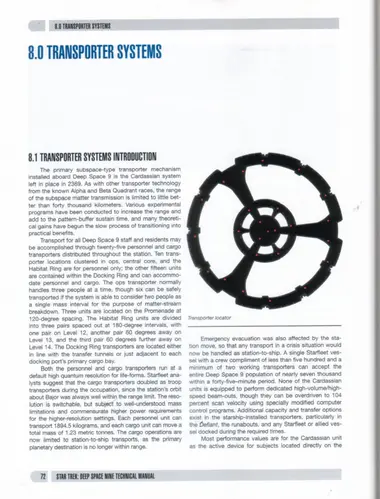
The primary subspace-type transporter mechanism installed aboard Deep Space 9 is the Cardassian system left in place in 2369. As with other transporter technology from the known Alpha and Beta Quadrant races, the range of the subspace matter transmission is limited to little better than forty thousand kilometers. Various experimental programs have been conducted to increase the range and add to the pattern-buffer sustain time, and many theoretical gains have begun the slow process of transitioning into practical benefits.
Transport for all Deep Space 9 staff and residents may be accomplished through twenty-five personnel and cargo transporters distributed throughout the station. Ten transporter locations clustered in ops, central core, and the Habitat Ring are for personnel only; the other fifteen units are contained within the Docking Ring and can accommodate personnel and cargo. The ops transporter normally handles three people at a time, though six can be safely transported if the system is able to consider two people as a single mass interval for the purpose of matter-stream breakdown. Three units are located on the Promenade at 120-degree spacing. The Habitat Ring units are divided into three pairs spaced out at 180-degree intervals, with one pair on Level 12, another pair 60 degrees away on Level 13, and the third pair 60 degrees further away on Level 14. The Docking Ring transporters are located either in line with the transfer tunnels or just adjacent to each docking port's primary cargo bay.
Both the personnel and cargo transporters run at a default high quantum resolution for life-forms. Starfleet analysts suggest that the cargo transporters doubled as troop transporters during the occupation, since the station's orbit about Bajor was always well within the range limit. The resolution is switchable, but subject to well-understood mass limitations and commensurate higher power requirements for the higher-resolution settings. Each personnel unit can transport 1894.5 kilograms, and each cargo unit can move a total mass of 1.23 metric tonnes. The cargo operations are now limited to station-to-ship transports, as the primary planetary destination is no longer within range.
Emergency evacuation was also affected by the station move, so that any transport in a crisis situation would now be handled as station-to-ship. A single Starfleet vessel with a crew compliment of less than five hundred and a minimum of two working transporters can accept the entire Deep Space 9 population of nearly seven thousand within a forty-five-minute period. None of the Cardassian units is equipped to perform dedicated high-volume/high-speed beam-outs, though they can be overdriven to 104 percent scan velocity using specially modified computer control programs. Additional capacity and transfer options exist in the starship-installed transporters, particularly in the Defiant, the runabouts, and any Starfleet or allied vessel docked during the required times.
Most performance values are for the Cardassian unit as the active device for subjects located directly on the transport platform. Performance is somewhat degraded if the unit must target the subject off-platform, especially in widely separated areas of the station. The most efficient transports occur between platforms of like design, and even between platforms of dissimilar design, as in a beam-out from the ops platform to one aboard the Defiant. Since all transports involving living entities are zero fault-tolerant, degraded system performance is related only to a decreased amount of mass delivered per unit time. Transports employing lower resolution scans of nonbiologics may tolerate nanometer-scale voids and 0.001 percent molecular recombination errors.