3.4 Science Station
Details the science station's reconfiguration from Cardassian labor monitoring and ore processing into a detection and analysis suite, its staffing and data linkages, its variable data rates and processing capabilities, its monitoring of the wormhole and remote probes, and its signal-intelligence role.
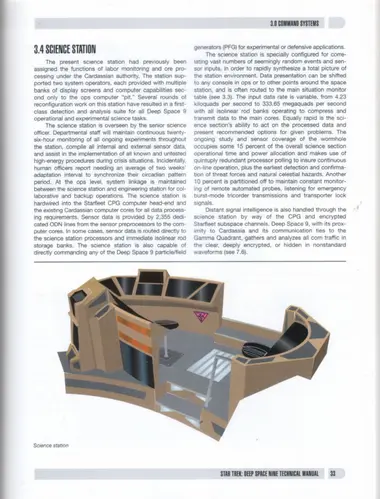
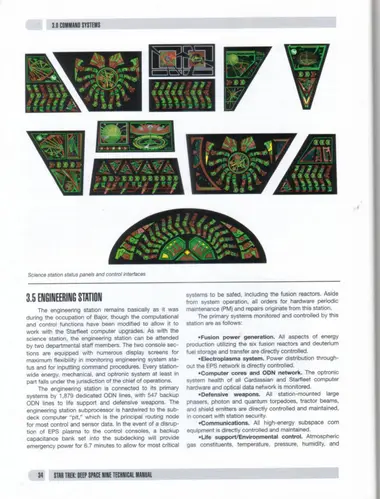
The present science station had previously been assigned the functions of labor monitoring and ore processing under the Cardassian authority. The station supported two system operators, each provided with multiple banks of display screens and computer capabilities second only to the ops computer “pit.” Several rounds of reconfiguration work on this station have resulted in a first-class detection and analysis suite for all Deep Space 9 operational and experimental science tasks.
The science station is overseen by the senior science officer. Departmental staff will maintain continuous twenty-six-hour monitoring of all ongoing experiments throughout the station, compile all internal and external sensor data, and assist in the implementation of all known and untested high-energy procedures during crisis situations. Incidentally, human officers report needing an average of two weeks’ adaptation interval to synchronize their circadian pattern period. At the ops level, system linkage is maintained between the science station and engineering station for collaborative and backup operations. The science station is hardwired into the Starfleet CPG computer head-end and the existing Cardassian computer cores for all data processing requirements. Sensor data is provided by 2,355 dedicated ODN lines from the sensor preprocessors to the computer cores. In some cases, sensor data is routed directly to the science station processors and immediate isolinear rod storage banks. The science station is also capable of directly commanding any of the Deep Space 9 particle/field generators (PFG) for experimental or defensive applications.
The science station is specially configured for correlating vast numbers of seemingly random events and sensor inputs, in order to rapidly synthesize a total picture of the station environment. Data presentation can be shifted to any console in ops or to other points around the space station, and is often routed to the main situation monitor table (see 3.3). The input data rate is variable, from 4.23 kiloquads per second to 333.65 megaquads per second with all isolinear rod banks operating to compress and transmit data to the main cores. Equally rapid is the science section’s ability to act on the processed data and present recommended options for given problems. The ongoing study and sensor coverage of the wormhole occupies some 15 percent of the overall science section operational time and power allocation and makes use of quintuply redundant processor polling to insure continuous on-line operation, plus the earliest detection and confirmation of threat forces and natural celestial hazards. Another 10 percent is partitioned off to maintain constant monitoring of remote automated probes, listening for emergency burst-mode tricorder transmissions and transporter lock signals.
Distant signal intelligence is also handled through the science station by way of the CPG and encrypted Starfleet subspace channels. Deep Space 9, with its proximity to Cardassia and its communication ties to the Gamma Quadrant, gathers and analyzes all com traffic in the clear, deeply encrypted, or hidden in nonstandard waveforms (see 7.6).