6.2 Docking Ring Connections
Describes the adaptable berthing facilities of Deep Space 9's three dock types, focusing on the two systems within the Docking Ring, detailing the large primary docking ports, their dimensions and the swing-out central ellipse for special pods, the electrohydraulic grab plates and amplitude-pulse tractor field emitters of the docking clamps, the dedicated docking data channels and structural-scanning fallback, and the variable-morphology hull seals that establish atmospheric integrity.
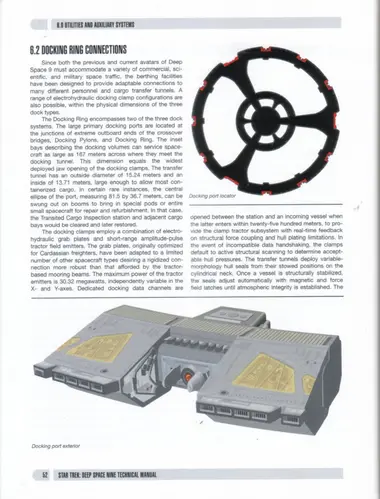
Since both the previous and current avatars of Deep Space 9 must accommodate a variety of commercial, scientific, and military space traffic, the berthing facilities have been designed to provide adaptable connections to many different personnel and cargo transfer tunnels. A range of electrohydraulic docking clamp configurations are also possible, within the physical dimensions of the three dock types.
The Docking Ring encompasses two of the three dock systems. The large primary docking ports are located at the junctions of extreme outboard ends of the crossover bridges, Docking Pylons, and Docking Ring. The inset bays describing the docking volumes can service spacecraft as large as 167 meters across where they meet the docking tunnel. This dimension equals the widest deployed jaw opening of the docking clamps. The transfer tunnel has an outside diameter of 15.24 meters and an inside of 13.71 meters, large enough to allow most containerized cargo. In certain rare instances, the central ellipse of the port, measuring 81.5 by 36.7 meters, can be swung out on booms to bring in special pods or entire small spacecraft for repair and refurbishment. In that case, the Transited Cargo Inspection station and adjacent cargo bays would be cleared and later restored.
The docking clamps employ a combination of electrohydraulic grab plates and short-range amplitude-pulse tractor field emitters. The grab plates, originally optimized for Cardassian freighters, have been adapted to a limited number of other spacecraft types desiring a rigidized connection more robust than that afforded by the tractor-based mooring beams. The maximum power of the tractor emitters is 30.32 megawatts, independently variable in the X- and Y-axes. Dedicated docking data channels are opened between the station and an incoming vessel when the latter enters within twenty-five hundred meters, to provide the clamp tractor subsystem with real-time feedback on structural force coupling and hull plating limitations. In the event of incompatible data handshaking, the clamps default to active structural scanning to determine acceptable hull pressures. The transfer tunnels deploy variable-morphology hull seals from their stowed positions on the cylindrical neck. Once a vessel is structurally stabilized, the seals adjust automatically with magnetic and force field latches until atmospheric integrity is established. The