5.4 Engineering Operations and Safety
Recounts the Starfleet analysis and maintenance of the fusion power systems following the handover, the maintenance-while-active repair procedures enabled by partitioned reactor housings, the inspection cycles and tolerances for chamber walls, fuel-conditioning blocks, pumps, radiator beds, and sodium transfer conduits, the tolerable over-100-percent power levels and crisis-situation limits, the per-chamber maximum power and status table, and the standard cryogenic fuel safety protocols.
Even as one Starfleet engineering team began analyzing exhaustive scans of the fusion power systems, another was compiling operational protocols and documentation on system safety. From the day the first Federation ship docked at the station, it was clear that the fusion reactors were in need of long hours of maintenance and safety checks. Two of the six reactors were completely inactive, and the load was taken up by the remaining four chambers. This is not normally a critical situation, but high-level power usage for weapons and full shields would have required at least one other reactor to be operational as backup in case one failed.
Since the power system is purely laser-induced fusion, and the multiple chambers allow for maintenance-while-active (MWA) procedures, hardware teardown and rebuilding is similar to that of ship-installed primary impulse reactors and auxiliary fusion generators. Each reactor is partitioned off into its own sealed housing so crews can, for example, replace the deuterium injector on one reactor, while the two adjacent units are providing EPS power. No starbase-class facilities are required for repairs or upgrades to this particular system. Following reactor shutdown and mandatory cold-soak thermal energy bleed-off of thirty-five minutes, a chamber is accessible for internal scans and hardware replacement through a magnetically-sealed inspection port built into the chamber equatorial band. The laser detonators and fuel pellet injector can be reached using extensible boom fixtures built into each generator outer housing. The typical inspection cycle for internal components has been set at 550 operating hours. All inner chamber wall seam melds must be inspected for stress microfractures and resurfaced when voids in the rodinium excelinate reach rates and sizes of greater than two hundred voids 0.02 millimeters in diameter. All chamber pressure surge levels greater than six hundred kilopascals/m2 trigger automatic resurfacing at the earliest available time, since exposure to this amount of force risks multiple fractures of the interior coating.
The other components subject to inspection at 1,200-hour intervals are the fuel conditioning blocks, fuel transfer conduits, peristaltic and electrohydraulic pumps, and external radiator beds. All circulating sodium thermal transfer conduits are inspected at 1,650-hour intervals, and all liquid sodium metal is shunted to catalyst filters for contaminant removal at those times. The neoplesium cavities in the fuel conditioning blocks must be removed to the generator servicing lab and resurfaced with a new flash-evaporated neoplesium coating. This coating must be reapplied whenever the optimal surface contour is degraded by 0.31 centimeters.
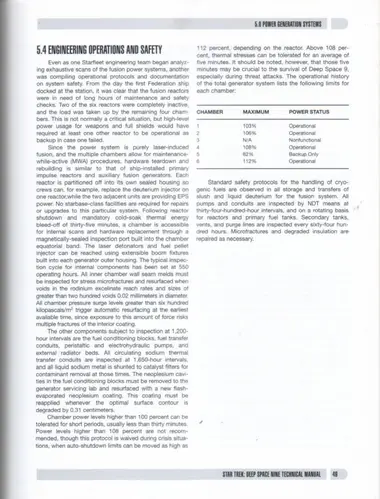
Chamber power levels higher than 100 percent can be tolerated for short periods, usually less than thirty minutes. Power levels higher than 108 percent are not recommended, though this protocol is waived during crisis situations, when auto-shutdown limits can be moved as high as 112 percent, depending on the reactor. Above 108 percent, thermal stresses can be tolerated for an average of five minutes. It should be noted, however, that those five minutes may be crucial to the survival of Deep Space 9, especially during threat attacks. The operational history of the total generator system lists the following limits for each chamber:
- Chamber 1: maximum 103%, status Operational.
- Chamber 2: maximum 106%, status Operational.
- Chamber 3: maximum N/A, status Nonfunctional.
- Chamber 4: maximum 108%, status Operational.
- Chamber 5: maximum 82%, status Backup Only.
- Chamber 6: maximum 112%, status Operational.
Standard safety protocols for the handling of cryogenic fuels are observed in all storage and transfers of slush and liquid deuterium for the fusion system. All pumps and conduits are inspected by NDT means at thirty-four-hundred-hour intervals, and on a rotating basis for reactors and primary fuel tanks. Secondary tanks, vents, and purge lines are inspected every sixty-four hundred hours. Microfractures and degraded insulation are repaired as necessary.