4.4 Desktop and Console Computer Access
Describes the stand-alone and networked desktop terminals and console units in use aboard the station, detailing the Starfleet desktop unit's construction, power, memory, and voice and touch input handling, the user-configuration limits, and the retained Cardassian console interfaces with their layered semacrylide and duvenite display surfaces.
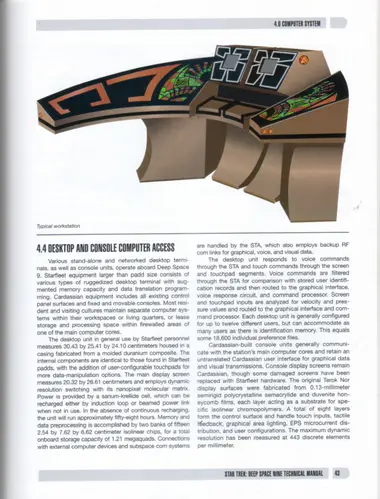
Various stand-alone and networked desktop terminals, as well as console units, operate aboard Deep Space 9. Starfleet equipment larger than padd size consists of various types of ruggedized desktop terminal with augmented memory capacity and data translation programming. Cardassian equipment includes all existing control panel surfaces and fixed and movable consoles. Most resident and visiting cultures maintain separate computer systems within their workspaces or living quarters, or lease storage and processing space within firewalled areas of one of the main computer cores.
The desktop unit in general use by Starfleet personnel measures 30.43 by 25.41 by 24.10 centimeters housed in a casing fabricated from a molded duranium composite. The internal components are identical to those found in Starfleet padds, with the addition of user-configurable touchpads for more data-manipulation options. The main display screen measures 20.32 by 26.61 centimeters and employs dynamic resolution switching with its nanopixel molecular matrix. Power is provided by a sarium-krellide cell, which can be recharged either by induction loop or beamed power link when not in use. In the absence of continuous recharging, the unit will run approximately fifty-eight hours. Memory and data preprocessing is accomplished by two banks of fifteen 2.54 by 7.62 by 6.62 centimeter isolinear chips, for a total onboard storage capacity of 1.21 megaquads. Connections with external computer devices and subspace com systems are handled by the STA, which also employs backup RF com links for graphical, voice, and visual data.
The desktop unit responds to voice commands through the STA and touch commands through the screen and touchpad segments. Voice commands are filtered through the STA for comparison with stored user identification records and then routed to the graphical interface, voice response circuit, and command processor. Screen and touchpad inputs are analyzed for velocity and pressure values and routed to the graphical interface and command processor. Each desktop unit is generally configured for up to twelve different users, but can accommodate as many users as there is identification memory. This equals some 18,600 individual preference files.
Cardassian-built console units generally communicate with the station's main computer cores and retain an untranslated Cardassian user interface for graphical data and visual transmissions. Console display screens remain Cardassian, though some damaged screens have been replaced with Starfleet hardware. The original Terok Nor display surfaces were fabricated from 0.13-millimeter semirigid polycrystalline semacrylide and duvenite honeycomb films, each layer acting as a substrate for specific isolinear chromopolymers. A total of eight layers form the control surface and handle touch inputs, tactile feedback, graphical area lighting, EPS microcurrent distribution, and user configurations. The maximum dynamic resolution has been measured at 443 discrete elements per millimeter.
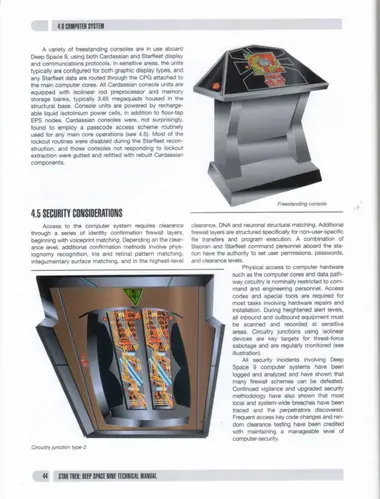
A variety of freestanding consoles are in use aboard Deep Space 9, using both Cardassian and Starfleet display and communications protocols. In sensitive areas, the units typically are configured for both graphic display types, and any Starfleet data are routed through the CPG attached to the main computer cores. All Cardassian console units are equipped with isolinear rod preprocessor and memory storage banks, typically 3.65 megaquads housed in the structural base. Console units are powered by rechargeable liquid isotolinium power cells, in addition to floor-tap EPS nodes. Cardassian consoles were, not surprisingly, found to employ a passcode access scheme routinely used for any main core operations (see 4.5). Most of the lockout routines were disabled during the Starfleet reconstruction, and those consoles not responding to lockout extraction were gutted and refitted with rebuilt Cardassian components.