10.1 Phasers and Operations
Describes the phased rollout of Deep Space 9's defensive weapons after 2369, the station's current phaser inventory of type-10 emitter segments and type-11 planetary defense emitters, the rapid nadion effect mechanism and Tokyo R&D improvements, the installation and cooling of the sail-tower emitters, the rotary phaser cannons and adapted planetary phasers, and the special challenges of station-based phaser operations against threat vessels.
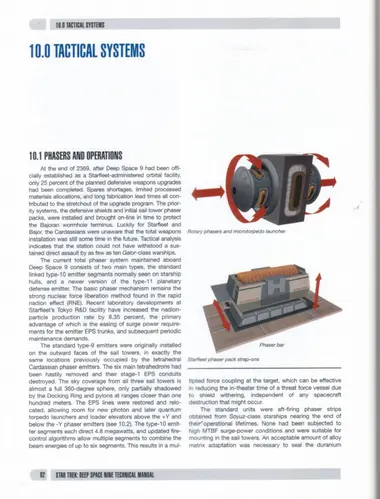
At the end of 2369, after Deep Space 9 had been officially established as a Starfleet-administered orbital facility, only 25 percent of the planned defensive weapons upgrades had been completed. Spares shortages, limited processed materials allocations, and long fabrication lead times all contributed to the stretchout of the upgrade program. The priority systems, the defensive shields and initial sail tower phaser packs, were installed and brought on-line in time to protect the Bajoran wormhole terminus. Luckily for Starfleet and Bajor, the Cardassians were unaware that the total weapons installation was still some time in the future. Tactical analysis indicates that the station could not have withstood a sustained direct assault by as few as ten Galor-class warships.
The current total phaser system maintained aboard Deep Space 9 consists of two main types, the standard linked type-10 emitter segments normally seen on starship hulls, and a newer version of the type-11 planetary defense emitter. The basic phaser mechanism remains the strong nuclear force liberation method found in the rapid nadion effect (RNE). Recent laboratory developments at Starfleet's Tokyo R&D facility have increased the nadion-particle production rate by 8.35 percent, the primary advantage of which is the easing of surge power requirements for the emitter EPS trunks, and subsequent periodic maintenance demands.
The standard type-9 emitters were originally installed on the outward faces of the sail towers, in exactly the same locations previously occupied by the tetrahedral Cardassian phaser emitters. The six main tetrahedrons had been hastily removed and their stage-1 EPS conduits destroyed. The sky coverage from all three sail towers is almost a full 360-degree sphere, only partially shadowed by the Docking Ring and pylons at ranges closer than one hundred meters. The EPS lines were restored and relocated, allowing room for new photon and later quantum torpedo launchers and loader elevators above the +Y and below the -Y phaser emitters (see 10.2). The type-10 emitter segments each direct 4.8 megawatts, and updated fire-control algorithms allow multiple segments to combine the beam energies of up to six segments. This results in a multiplied force coupling at the target, which can be effective in reducing the in-theater time of a threat force vessel due to shield withering, independent of any spacecraft destruction that might occur.
The standard units were aft-firing phaser strips obtained from Soyuz-class starships nearing the end of their operational lifetimes. None had been subjected to high MTBF surge-power conditions and were suitable for mounting in the sail towers. An acceptable amount of alloy matrix adaptation was necessary to seal the duranium phaser frames to the Cardassian rodinium hull plating, since almost no inner skeletal beams exist in the towers to provide a deeper structural bonding. Cooling is provided by a modified liquid helium loop, which transfers thermal energy to the existing tower radiator beds as well as to the fusion generator radiators during peak load periods.
The stage-1 EPS conduits are routed directly from the fusion generator cross-feeds, through Level 15 in the Habitat Ring, and into the towers. They end at the prephaser power conditioners and fire control magnetic iris valves, which adjust the power levels and plasma frequencies. Plasma contact with the emitter crystal occurs after all safety interlocks and fire control codes are authorized and transmitted to the iris valves. All targeting and fire signals must come from senior officers and are handled by the computer CPG to perform the actual directional and sequence calculations.
The original Cardassian weapon monitoring rooms were converted in 2372 into large rotary phaser cannons and microtorpedo launchers and were instrumental in the station's defense during the short-lived Klingon-led actions against the Federation. The rotary units are composed of type-9 emitter segments taken from Ambassador-class starships with similar MTBF ratings to the stationary sail emitters. EPS connections are made through sonodanite and rabium-tritonide rotary conduit joints. Plasma pressure variations are smoothed out through a set of four surge tanks set into the rotary cannon housing. Cooling is accomplished by a standard supersonic regenerative liquid nitrogen system, and excess thermal energy is shunted to the sail tower radiator bed.
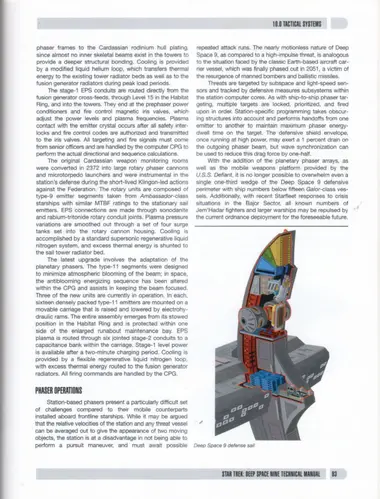
The latest upgrade involves the adaptation of the planetary phasers. The type-11 segments were designed to minimize atmospheric blooming of the beam; in space, the antiblooming energizing sequence has been altered within the CPG and assists in keeping the beam focused. Three of the new units are currently in operation. In each, sixteen densely packed type-11 emitters are mounted on a movable carriage that is raised and lowered by electrohydraulic rams. The entire assembly emerges from its stowed position in the Habitat Ring and is protected within one side of the enlarged runabout maintenance bay. EPS plasma is routed through six jointed stage-2 conduits to a capacitance bank within the carriage. Stage-1 level power is available after a two-minute charging period. Cooling is provided by a flexible regenerative liquid nitrogen loop, with excess thermal energy routed to the fusion generator radiators. All firing commands are handled by the CPG.
Phaser Operations
Station-based phasers present a particularly difficult set of challenges compared to their mobile counterparts installed aboard frontline starships. While it may be argued that the relative velocities of the station and any threat vessel can be averaged out to give the appearance of two moving objects, the station is at a disadvantage in not being able to perform a pursuit maneuver, and must await possible repeated attack runs. The nearly motionless nature of Deep Space 9, as compared to a high-impulse threat, is analogous to the situation faced by the classic Earth-based aircraft carrier vessel, which was finally phased out in 2051, a victim of the resurgence of manned bombers and ballistic missiles.
Threats are targeted by subspace and light-speed sensors and tracked by defensive measures subsystems within the station computer cores. As with ship-to-ship phaser targeting, multiple targets are locked, prioritized, and fired upon in order. Station-specific programming takes obscuring structures into account and performs handoffs from one emitter to another to maintain maximum phaser energy-dwell time on the target. The defensive shield envelope, once running at high power, may exert a 1 percent drain on the outgoing phaser beam, but wave synchronization can be used to reduce this drag force by one-half.
With the addition of the planetary phaser arrays, as well as the mobile weapons platform provided by the U.S.S. Defiant, it is no longer possible to overwhelm even a single one-third wedge of the Deep Space 9 defensive perimeter with ship numbers below fifteen Galor-class vessels. Additionally, with recent Starfleet responses to crisis situations in the Bajor Sector, all known numbers of Jem'Hadar fighters and larger warships may be repulsed by the current ordnance deployment for the foreseeable future.