1.4 Station Overview
Introduces Deep Space 9 as one of the galaxy's largest free-flying stations, describing its overall form, the functions of its major components, the reversed pylon orientation, and its principal dimensions.
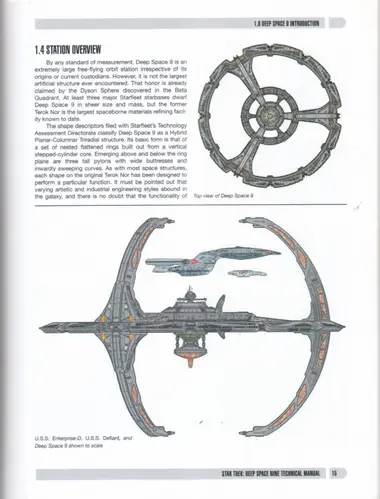
By any standard of measurement, Deep Space 9 is an extremely large free-flying orbit station irrespective of its origins or current custodians. However, it is not the largest artificial structure ever encountered. That honor is already claimed by the Dyson Sphere discovered in the Beta Quadrant. At least three major Starfleet starbases dwarf Deep Space 9 in sheer size and mass, but the former Terok Nor is the largest spaceborne materials refining facility known to date.
The shape descriptors filed with Starfleet's Technology Assessment Directorate classify Deep Space 9 as a Hybrid Planar-Columnar Triradial structure. Its basic form is that of a set of nested flattened rings built out from a vertical stepped-cylinder core. Emerging above and below the ring plane are three tall pylons with wide buttresses and inwardly sweeping curves. As with most space structures, each shape on the original Terok Nor has been designed to perform a particular function. It must be pointed out that varying artistic and industrial engineering styles abound in the galaxy, and there is no doubt that the functionality of the hardware has been melded together with a stylistic sense that appears to govern the Cardassians as builders. Indeed, the design of Terok Nor has been heavily influenced by the architectural marvels created by Tavor Kell on Cardassia Prime.
The massive assemblage of steels and composites, which grew to its present proportions in orbit about the besieged Bajor, can be broken down conceptually into a number of logical components. In 2346, the core assemblies supported the control, scientific, maintenance, recreational, computing, and power-generating areas of the station. The Habitat Ring housed the station's Cardassian masters. The Docking Ring provided cargo movement and storage spaces. The Docking Pylons processed raw materials into refined ones, contributing to the Cardassian economic base. The current form is different mainly in the way the station is used by its residents; the Habitat Ring is populated by a wider variety of cultures, the Promenade supports a larger number of merchants and visitors, and the pylons no longer process uridium ore using the labor of the Bajoran people.
At one time in the design process, the pylons were turned to sweep outward to better accommodate the movements of large numbers of freighter vessels. The orientation was reversed when it was deemed a better move to keep all station appendages within a smaller, more powerful defensive shield envelope. Docked vessels as well as ships suspended within the shield envelope can be protected. Ships within the shield volume can hold position with active thrusters set to station-keeping or can be secured by tractor beam.
The basic dimensions of the station have been determined from auto-geometer scans taken by off-station Starfleet ships and corrected for EM scattering and subspace scan frequency drift. The scans revealed a curious shape anomaly present in all three ring structures. Three apparently random points on each ring exhibit a subtle deformation, either inboard or outboard, by an average of 0.47 meters. While not yet explained by subspace shock, impact, internal pressure, or thermal imbalance, the deformations do not seem to have an adverse effect on the station structure.
Dimensions
Overall Diameter: 1451.82 meters. Habitat Ring Diameter: 579.12 meters. Upper Core Diameter (Max): 285.90 meters. Mid-Core Diameter (Max): 182.88 meters. Lower Core Diameter (Max): 184.46 meters. Ops Diameter (Max): 59.43 meters. Height of Core (Ops to Fusion Exhaust Cone): 368.80 meters. Height of Docking pylons (Total): 969.26 meters. Height of Weapon Sail Towers: 192.02 meters.