4.1 Computer Cores
Describes the three main Cardassian processing cores and the Starfleet coprocessor and peripherals group, their location and shielding within the Mid-Core, the subwarp transtator-cluster architecture, EPS power feeds, isolinear rod data storage, the dedicated ODN network, deep data recovery efforts, and the backup RF and superconducting control links between the cores and station systems.
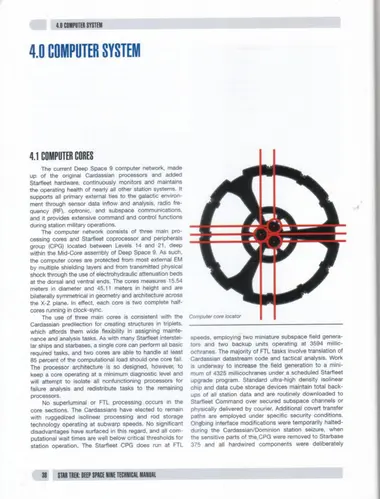
The current Deep Space 9 computer network, made up of the original Cardassian processors and added Starfleet hardware, continuously monitors and maintains the operating health of nearly all other station systems. It supports all primary external ties to the galactic environment through sensor data inflow and analysis, radio frequency (RF), optronic, and subspace communications, and it provides extensive command and control functions during station military operations.
The computer network consists of three main processing cores and a Starfleet coprocessor and peripherals group (CPG) located between Levels 14 and 21, deep within the Mid-Core assembly of Deep Space 9. As such, the computer cores are protected from most external EM by multiple shielding layers and from transmitted physical shock through the use of electrohydraulic attenuation beds at the dorsal and ventral ends. The cores measure 15.54 meters in diameter and 45.11 meters in height and are bilaterally symmetrical in geometry and architecture across the X-Z plane. In effect, each core is two complete half-cores running in clock-sync. The use of three main cores is consistent with the Cardassian predilection for creating structures in triplets, which affords them wide flexibility in assigning maintenance and analysis tasks. As with many Starfleet interstellar ships and starbases, a single core can perform all basic required tasks, and two cores are able to handle at least 85 percent of the computational load should one core fail. The processor architecture is so designed, however, to keep a core operating at a minimum diagnostic level and will attempt to isolate all nonfunctioning processors for failure analysis and redistribute tasks to the remaining processors.
No superluminal or FTL processing occurs in the core sections. The Cardassians have elected to remain with ruggedized isolinear processing and rod storage technology operating at subwarp speeds. No significant disadvantages have surfaced in this regard, and all computational wait times are well below critical thresholds for station operation. The Starfleet CPG does run at FTL speeds, employing two miniature subspace field generators and two backup units operating at 3594 millicochranes. The majority of FTL tasks involve translation of Cardassian datastream code and tactical analysis. Work is underway to increase the field generation to a minimum of 4325 millicochranes under a scheduled Starfleet upgrade program. Standard ultra-high density isolinear chip and data cube storage devices maintain total backups of all station data and are routinely downloaded to Starfleet Command over secured subspace channels or physically delivered by courier. Additional covert transfer paths are employed under specific security conditions. Ongoing interface modifications were temporarily halted during the Cardassian/Dominion station seizure, when the sensitive parts of the CPG were removed to Starbase 375 and all hardwired components were deliberately destroyed. The CPG was replaced during Operation Return. In a previous station takeover by the Bajoran Alliance for Global Unity, all classified equipment was briefly rendered inoperable but not extracted.
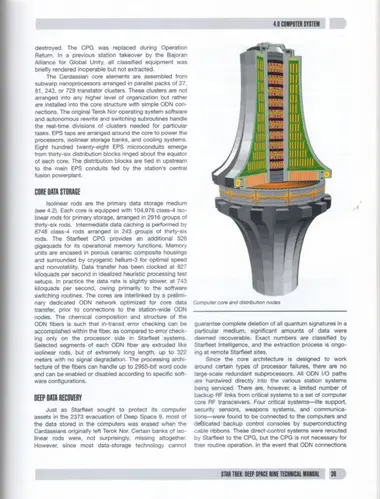
The Cardassian core elements are assembled from subwarp nanoprocessors arranged in parallel packs of 27, 81, 243, or 729 transtator clusters. These clusters are not arranged into any higher level of organization but rather are installed into the core structure with simple ODN connections. The original Terok Nor operating system software and autonomous rewrite and switching subroutines handle the real-time divisions of clusters needed for particular tasks. EPS taps are arranged around the core to power the processors, isolinear storage banks, and cooling systems. Eight hundred twenty-eight EPS microconduits emerge from thirty-six distribution blocks ringed about the equator of each core. The distribution blocks are tied in upstream to the main EPS conduits fed by the station's central fusion powerplant.
Core Data Storage
Isolinear rods are the primary data storage medium (see 4.2). Each core is equipped with 104,976 class-4 isolinear rods for primary storage, arranged in 2916 groups of thirty-six rods. Intermediate data caching is performed by 8748 class-4 rods arranged in 243 groups of thirty-six rods. The Starfleet CPG provides an additional 526 gigaquads for its operational memory functions. Memory units are encased in porous ceramic composite housings and surrounded by cryogenic helium-3 for optimal speed and nonvolatility. Data transfer has been clocked at 827 kiloquads per second in idealized heuristic processing test setups. In practice the data rate is slightly slower, at 743 kiloquads per second, owing primarily to the software switching routines. The cores are interlinked by a preliminary dedicated ODN network optimized for core data transfer, prior to connections to the station-wide ODN nodes. The chemical composition and structure of the ODN fibers is such that in-transit error checking can be accomplished within the fiber, as compared to error checking only on the processor side in Starfleet systems. Selected segments of each ODN fiber are extruded like isolinear rods, but of extremely long length, up to 322 meters with no signal degradation. The processing architecture of the fibers can handle up to 2955-bit word code and can be enabled or disabled according to specific software configurations.
Deep Data Recovery
Just as Starfleet sought to protect its computer assets in the 2373 evacuation of Deep Space 9, most of the data stored in the computers was erased when the Cardassians originally left Terok Nor. Certain banks of isolinear rods were, not surprisingly, missing altogether. However, since most data-storage technology cannot guarantee complete deletion of all quantum signatures in a particular medium, significant amounts of data were deemed recoverable. Exact numbers are classified by Starfleet Intelligence, and the extraction process is ongoing at remote Starfleet sites.
Since the core architecture is designed to work around certain types of processor failures, there are no large-scale redundant subprocessors. All ODN I/O paths are hardwired directly into the various station systems being serviced. There are, however, a limited number of backup RF links from critical systems to a set of computer core RF transceivers. Four critical systems—life support, sensors, weapons systems, and communications—were found to be connected to the computers and dedicated backup control consoles by superconducting cable ribbons. These direct-control systems were rerouted by Starfleet to the CPG, but the CPG is not necessary for their routine operation. In the event that ODN connections are severed, the individual station systems were designed to switch to auto-safe mode until an operator could assume control. A total of 13,655 ODN bundles interconnect the computer and the various station systems, equaling an estimated 67,900 kilometers of optical fibers. The superconducting control cables are thought to total another 1300 kilometers.
Short- and medium-range RF links continue to provide data and control connections among station systems, the computers, and portable and handheld devices such as tricorders and padds. Data translation header codes from non-Cardassian devices are normally routed through the CPG, which also handles data from Bajoran devices. All other non-station-critical data from visiting or resident entities is processed through stand-alone sections of the cores, which have no direct connection—physical, optronic, subspace, or RF—to the bulk of the core processors.
As with other station systems, control terminals located throughout the station are tied into the ODN and then to the cores. Alphanumerical, graphical, and other visual transmission data are filtered through the CPG in both directions. Terminals in all critical locations, including ops, environmental control, defensive systems, and power generation, are connected via nine redundant optical circuits so that failures or interference in as many as six circuits will still allow, from a probability standpoint, a correct signal to pass through.