5.2 Fuel Storage and Transfer
Explains how Deep Space 9 power generation depends on stored supercold cryogenic deuterium, describing the isotope's properties and densified storage form, the six large and six surge deuterium tanks in the Lower Core with their dimensions, triple-walled construction, structural linkages, thermal-migration control, and volumes, and recounts the failed and unreplaced large external spherical deuterium tank once mounted to the Mid-Core and the suspicion of sabotage.
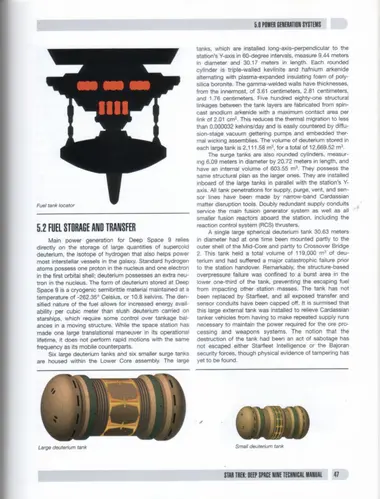
Main power generation for Deep Space 9 relies directly on the storage of large quantities of supercold deuterium, the isotope of hydrogen that also helps power most interstellar vessels in the galaxy. Standard hydrogen atoms possess one proton in the nucleus and one electron in the first orbital shell; deuterium possesses an extra neutron in the nucleus. The form of deuterium stored at Deep Space 9 is a cryogenic semibrittle material maintained at a temperature of -262.35° Celsius, or 10.8 kelvins. The densified nature of the fuel allows for increased energy availability per cubic meter than slush deuterium carried on starships, which require some control over tankage balances in a moving structure. While the space station has made one large translational maneuver in its operational lifetime, it does not perform rapid motions with the same frequency as its mobile counterparts.
Six large deuterium tanks and six smaller surge tanks are housed within the Lower Core assembly. The large tanks, which are installed long-axis-perpendicular to the station's Y-axis in 60-degree intervals, measure 9.44 meters in diameter and 30.17 meters in length. Each rounded cylinder is triple-walled kevlinite and hafnium arkenide alternating with plasma-expanded insulating foam of polysilica boronite. The gamma-welded walls have thicknesses, from the innermost, of 3.61 centimeters, 2.81 centimeters, and 1.76 centimeters. Five hundred eighty-one structural linkages between the tank layers are fabricated from spincast anodium arkenide with a maximum contact area per link of 2.01 cm2. This reduces the thermal migration to less than 0.000032 kelvins/day and is easily countered by diffusion-stage vacuum gettering pumps and embedded thermal wicking assemblies. The volume of deuterium stored in each large tank is 2,111.58 m3, for a total of 12,669.52 m3.
The surge tanks are also rounded cylinders, measuring 6.09 meters in diameter by 20.72 meters in length, and have an internal volume of 603.55 m3. They possess the same structural plan as the larger ones. They are installed inboard of the large tanks in parallel with the station's Y-axis. All tank penetrations for supply, purge, vent, and sensor lines have been made by narrow-band Cardassian matter disruption tools. Doubly redundant supply conduits service the main fusion generator system as well as all smaller fusion reactors aboard the station, including the reaction control system (RCS) thrusters.
A single large spherical deuterium tank 30.63 meters in diameter had at one time been mounted partly to the outer shell of the Mid-Core and partly to Crossover Bridge 2. This tank held a total volume of 119,000 m3 of deuterium and had suffered a major catastrophic failure prior to the station handover. Remarkably, the structure-based overpressure failure was confined to a burst area in the lower one-third of the tank, preventing the escaping fuel from impacting other station masses. The tank has not been replaced by Starfleet, and all exposed transfer and sensor conduits have been capped off. It is surmised that this large external tank was installed to relieve Cardassian tanker vehicles from having to make repeated supply runs necessary to maintain the power required for the ore processing and weapons systems. The notion that the destruction of the tank had been an act of sabotage has not escaped either Starfleet Intelligence or the Bajoran security forces, though physical evidence of tampering has yet to be found.