2.3 Internal Structural Systems
Compares Cardassian and Starfleet internal framing, explaining how Terok Nor relies on exterior hull plating to hold atmospheric pressure, and describes the level grids, bulkheads, room modules, corridors, and access tunnels attached to the skeletal framing.
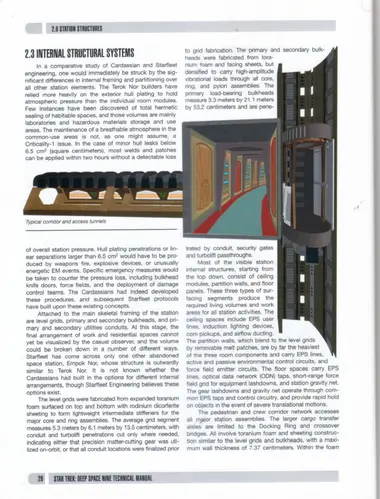
In a comparative study of Cardassian and Starfleet engineering, one would immediately be struck by the significant differences in internal framing and partitioning over all other station elements. The Terok Nor builders have relied more heavily on the exterior hull plating to hold atmospheric pressure than the individual room modules. Few instances have been discovered of total hermetic sealing of habitable spaces, and those volumes are mainly laboratories and hazardous materials storage and use areas. The maintenance of a breathable atmosphere in the common-use areas is not, as one might assume, a Criticality-1 issue. In the case of minor hull leaks below 6.5 cm² (square centimeters), most welds and patches can be applied within two hours without a detectable loss of overall station pressure. Hull plating penetrations or linear separations larger than 6.5 cm² would have to be produced by weapons fire, explosive devices, or unusually energetic EM events. Specific emergency measures would be taken to counter the pressure loss, including bulkhead knife doors, force fields, and the deployment of damage control teams. The Cardassians had indeed developed these procedures, and subsequent Starfleet protocols have built upon these existing concepts.
Attached to the main skeletal framing of the station are level grids, primary and secondary bulkheads, and primary and secondary utilities conduits. At this stage, the final arrangement of work and residential spaces cannot yet be visualized by the casual observer, and the volume to the level grids could be broken down in a number of different ways. Starfleet has come across only one other abandoned space station, Empok Nor, whose structure is outwardly similar to Terok Nor. It is not known whether the Cardassians had built in the options for different internal arrangements, though Starfleet Engineering believes these options exist.
The level grids were fabricated from expanded toranium foam surfaced on top and bottom with rodinium dicorferite sheeting to form lightweight intermediate stiffeners for the major core and ring assemblies. The average grid segment measures 5.3 meters by 6.1 meters by 13.5 centimeters, with conduit and turbolift penetrations cut only where needed, indicating either that precision matter-cutting gear was utilized on-orbit, or that all conduit locations were finalized prior to grid fabrication. The primary and secondary bulkheads were fabricated from toranium foam and facing sheets, but densified to carry high-amplitude vibrational loads through all core, ring, and pylon assemblies. The primary load-bearing bulkheads measure 3.3 meters by 21.1 meters by 53.2 centimeters and are penetrated by conduit, security gates and turbolift passthroughs.
Most of the visible station internal structures, starting from the top down, consist of ceiling modules, partition walls, and floor panels. These three types of surfacing segments produce the required living volumes and work areas for all station activities. The ceiling spaces include EPS user lines, induction lighting devices, com pickups, and airflow ducting. The partition walls, which blend to the level grids by removable melt patches, are by far the heaviest of the three room components and carry EPS lines, active and passive environmental control circuits, and force field emitter circuits. The floor spaces carry EPS lines, optical data network (ODN) taps, short-range force field grid for equipment lashdowns, and station gravity net. The gear lashdowns and gravity net operate through common EPS taps and control circuitry, and provide rapid hold on objects in the event of severe translational motions.
The pedestrian and crew corridor network accesses all major station assemblies. The larger cargo transfer aisles are limited to the Docking Ring and crossover bridges. All involve toranium foam and sheeting construction similar to the level grids and bulkheads, with a maximum wall thickness of 7.37 centimeters. Within the foam are molded micro-EPS conduits, com pickups, ODN lines, and security scanning pickups. Continuity between segments is provided by induction node junctions in order to route encrypted signals to their proper destinations. Corridor segments are interrupted at regular intervals by force field arches and knife doors.
Access tunnels run perpendicular to most corridors and service a variety of station systems. The typical access tunnel measures 1.3 meters by 1.4 meters in cross section, and is fabricated from toranium frames and duranium skinning panels. Records indicate that the access tunnels were produced in an automated rapid forming and welding jig on Bajor and shipped by transporter into orbit. Access tunnels are equipped with standard EPS, ODN, and com monitoring panels, plus specialized maintenance control as required for particular areas. They are effectively shielded from external EM interference as well as active scanning beams, making some security functions difficult. The tunnels, similar in function to Starfleet's Jefferies tubes, have been the focus of a uniquely Cardassian problem. Numerous gaps in wall construction have allowed some species of Cardassian vole to elude capture and disrupt EPS service, due to the voles’ proclivity for gnawing through live conduits. The total run of access tunnels in the station measures some 18.1 kilometers. Most tunnel hatches are placed under restricted entry protocols, with security systems tied into the corridor ODN lines.