2.2 External Structural Systems
Details the composition and configuration of the station's primary structural shell, including how the densest alloys are applied at high-stress points and how the pylons derive most of their strength from the hull plating to create an exoskeleton.
The primary structural shell of Deep Space 9 varies from section to section in relative abundances of elements and physical configuration. At least thirty alloys are present in the hull plating, but by far the most common ones found are a simple mix of four: kelindide, polyduranium, rodinium, and toranium. The densest alloys, rodinium and toranium, have been applied to areas of greatest stress, particularly at major directional changes in station geometry. One example is at the interpenetration of the Docking Ring and both Upper and Lower Pylons. Tension and compression computer simulations of Deep Space 9, based on existing sensor networks and Starfleet-installed strain gauges, were conducted in mid-2370. The data analysis indicate that the “footprint” area of the pylons receives nearly 70 percent of its tensile strength from the hull plating covering the transitions from the pylons down to the crossover bridges. This effectively creates an exoskeleton, counter to most familiar construction methods. The internal skeletal structure provides only 22 percent, the remaining 8 percent being derived from the EPS conduit field effect, which acts as a crude structural integrity field (SIF) system. While some Starfleet engineers have looked upon this area as over-designed, it has worked exceedingly well for the Cardassians, especially in the pylons’ ability to damp out lateral and rotational forces imparted by both docking space vessels and large moving masses within the pylons.
Hull Plate Manufacturing
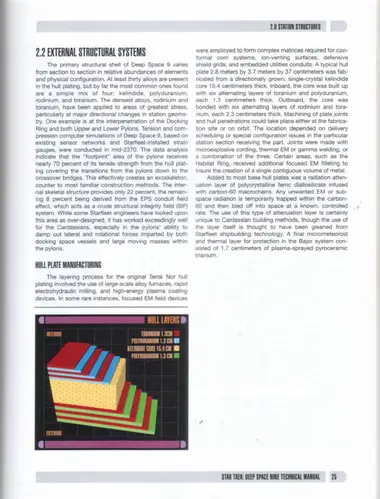
The layering process for the original Terok Nor hull plating involved the use of large-scale alloy furnaces, rapid electrohydraulic milling, and high-energy plasma coating devices. In some rare instances, focused EM field devices were employed to form complex matrices required for conformal com systems, ion-venting surfaces, defensive shield grids, and embedded utilities conduits. A typical hull plate 2.8 meters by 3.7 meters by 37 centimeters was fabricated from a directionally grown, single-crystal kelindide core 15.4 centimeters thick. Inboard, the core was built up with six alternating layers of toranium and polyduranium, each 1.3 centimeters thick. Outboard, the core was bonded with six alternating layers of rodinium and toranium, each 2.3 centimeters thick. Machining of plate joints and hull penetrations could take place either at the fabrication site or on orbit. The location depended on delivery scheduling or special configuration issues in the particular station section receiving the part. Joints were made with microexplosive cording, thermal EM or gamma welding, or a combination of the three. Certain areas, such as the Habitat Ring, received additional focused EM filleting to insure the creation of a single contiguous volume of metal.
Added to most base hull plates was a radiation attenuation layer of polycrystalline ferric diallosilicate infused with carbon-60 macrochains. Any unwanted EM or subspace radiation is temporarily trapped within the carbon-60 and then bled off into space at a known, controlled rate. The use of this type of attenuation layer is certainly unique to Cardassian building methods, though the use of the layer itself is thought to have been gleaned from Starfleet shipbuilding technology. A final micrometeoroid and thermal layer for protection in the Bajor system consisted of 1.7 centimeters of plasma-sprayed pyroceramic trianium.