1.3 Technological Assessment of the Cardassian Union
Assesses the Cardassian Union's industrial and military capabilities relative to the Federation, including production estimates, distinctive design methodology, predicted technological advancements, and exploitable deficiencies.
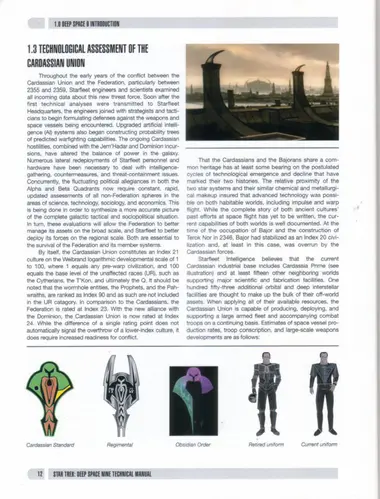
Throughout the early years of the conflict between the Cardassian Union and the Federation, particularly between 2355 and 2359, Starfleet engineers and scientists examined all incoming data about this new threat force. Soon after the first technical analyses were transmitted to Starfleet Headquarters, the engineers joined with strategists and tacticians to begin formulating defenses against the weapons and space vessels being encountered. Upgraded artificial intelligence (AI) systems also began constructing probability trees of predicted warfighting capabilities. The ongoing Cardassian hostilities, combined with the Jem'Hadar and Dominion incursions, have altered the balance of power in the galaxy. Numerous lateral redeployments of Starfleet personnel and hardware have been necessary to deal with intelligence-gathering, countermeasures, and threat-containment issues. Concurrently, the fluctuating political allegiances in both the Alpha and Beta Quadrants now require constant, rapid, updated assessments of all non-Federation spheres in the areas of science, technology, sociology, and economics. This is being done in order to synthesize a more accurate picture of the complete galactic tactical and sociopolitical situation. In turn, these evaluations will allow the Federation to better manage its assets on the broad scale, and Starfleet to better deploy its forces on the regional scale. Both are essential to the survival of the Federation and its member systems.
By itself, the Cardassian Union constitutes an Index 21 culture on the Weibrand logarithmic developmental scale of 1 to 100, where 1 equals any pre-warp civilization, and 100 equals the base level of the unaffected races (UR), such as the Cytherians, the T'Kon, and ultimately the Q. It should be noted that the wormhole entities, the Prophets, and the Pah-wraiths, are ranked as Index 90 and as such are not included in the UR category. In comparison to the Cardassians, the Federation is rated at Index 23. With the new alliance with the Dominion, the Cardassian Union is now rated at Index 24. While the difference of a single rating point does not automatically signal the overthrow of a lower-index culture, it does require increased readiness for conflict.
That the Cardassians and the Bajorans share a common heritage has at least some bearing on the postulated cycles of technological emergence and decline that have marked their two histories. The relative proximity of the two star systems and their similar chemical and metallurgical makeup insured that advanced technology was possible on both habitable worlds, including impulse and warp flight. While the complete story of both ancient cultures' past efforts at space flight has yet to be written, the current capabilities of both worlds is well documented. At the time of the occupation of Bajor and the construction of Terok Nor in 2346, Bajor had stabilized as an Index 20 civilization and, at least in this case, was overrun by the Cardassian forces.
Starfleet Intelligence believes that the current Cardassian industrial base includes Cardassia Prime (see illustration) and at least fifteen other neighboring worlds supporting major scientific and fabrication facilities. One hundred fifty-three additional orbital and deep interstellar facilities are thought to make up the bulk of their off-world assets. When applying all of their available resources, the Cardassian Union is capable of producing, deploying, and supporting a large armed fleet and accompanying combat troops on a continuing basis. Estimates of space vessel production rates, troop conscription, and large-scale weapons developments are as follows:
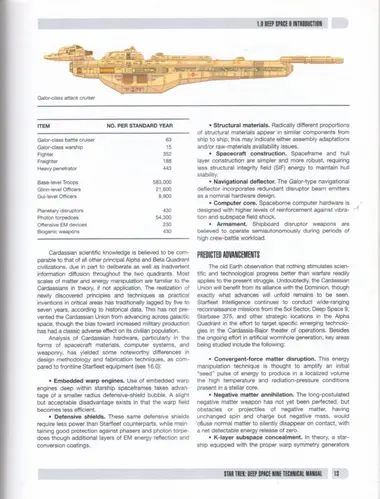
Galor-class battle cruiser: 63 per standard year. Galor-class warship: 15. Fighter: 352. Freighter: 188. Heavy penetrator: 443. Base-level Troops: 583,000. Glinn-level Officers: 21,600. Gul-level Officers: 8,900. Planetary disruptors: 430. Photon torpedoes: 54,300. Offensive EM devices: 230. Biogenic weapons: 430.
Cardassian scientific knowledge is believed to be comparable to that of all other principal Alpha and Beta Quadrant civilizations, due in part to deliberate as well as inadvertent information diffusion throughout the two quadrants. Most scales of matter and energy manipulation are familiar to the Cardassians in theory, if not application. The realization of newly discovered principles and techniques as practical inventions in critical areas has traditionally lagged by five to seven years, according to historical data. This has not prevented the Cardassian Union from advancing across galactic space, though the bias toward increased military production has had a classic adverse effect on its civilian population.
Analysis of Cardassian hardware, particularly in the forms of spacecraft materials, computer systems, and weaponry, has yielded some noteworthy differences in design methodology and fabrication techniques, as compared to frontline Starfleet equipment (see 16.0):
- Embedded warp engines. Use of embedded warp engines deep within starship spaceframes takes advantage of a smaller radius defensive-shield bubble. A slight but acceptable disadvantage exists in that the warp field becomes less efficient.
- Defensive shields. These same defensive shields require less power than Starfleet counterparts, while maintaining good protection against phasers and photon torpedoes, though additional layers of EM energy reflection and conversion coatings.
- Structural materials. Radically different proportions of structural materials appear in similar components from ship to ship; this may indicate either assembly adaptations and/or raw-materials availability issues.
- Spacecraft construction. Spaceframe and hull layer construction are simpler and more robust, requiring less structural integrity field (SIF) energy to maintain hull stability.
- Navigational deflector. The Galor-type navigational deflector incorporates redundant disruptor beam emitters as a nominal hardware design.
- Computer core. Spaceborne computer hardware is designed with higher levels of reinforcement against vibration and subspace field shock.
- Armament. Shipboard disruptor weapons are believed to operate semiautonomously during periods of high crew-battle workload.
Predicted Advancements
The old Earth observation that nothing stimulates scientific and technological progress better than warfare readily applies to the present struggle. Undoubtedly, the Cardassian Union will benefit from its alliance with the Dominion, though exactly what advances will unfold remains to be seen. Starfleet Intelligence continues to conduct wide-ranging reconnaissance missions from the Sol Sector, Deep Space 9, Starbase 375, and other strategic locations in the Alpha Quadrant in the effort to target specific emerging technologies in the Cardassia-Bajor theater of operations. Besides the ongoing effort in artificial wormhole generation, key areas being studied include the following:
- Convergent-force matter disruption. This energy manipulation technique is thought to amplify an initial "seed" pulse of energy to produce in a localized volume the high temperature and radiation-pressure conditions present in a stellar core.
- Negative matter annihilation. The long-postulated negative matter weapon has not yet been perfected, but obstacles or projectiles of negative matter, having unchanged spin and charge but negative mass, would cause normal matter to silently disappear on contact, with a net detectable energy release of zero.
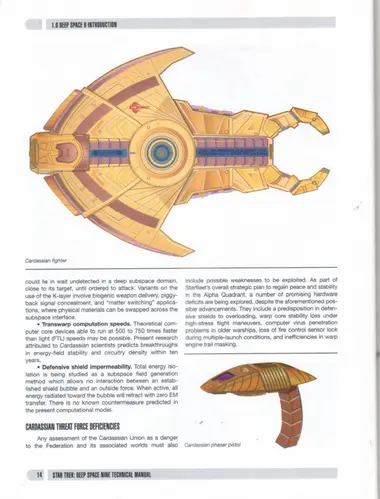
- K-layer subspace concealment. In theory, a starship equipped with the proper warp symmetry generators could lie in wait undetected in a deep subspace domain, close to its target, until ordered to attack. Variants on the use of the K-layer involve biogenic weapon delivery, piggyback signal concealment, and "matter switching" applications, where physical materials can be swapped across the subspace interface.
- Transwarp computation speeds. Theoretical computer core devices able to run at 500 to 750 times faster than light (FTL) speeds may be possible. Present research attributed to Cardassian scientists predicts breakthroughs in energy-field stability and circuitry density within ten years.
- Defensive shield impermeability. Total energy isolation is being studied as a subspace field generation method which allows no interaction between an established shield bubble and an outside force. When active, all energy radiated toward the bubble will refract with zero EM transfer. There is no known countermeasure predicted in the present computational model.
Cardassian Threat Force Deficiencies
Any assessment of the Cardassian Union as a danger to the Federation and its associated worlds must also include possible weaknesses to be exploited. As part of Starfleet's overall strategic plan to regain peace and stability in the Alpha Quadrant, a number of promising hardware deficits are being explored, despite the aforementioned possible advancements. They include a predisposition in defensive shields to overloading, warp core stability loss under high-stress flight maneuvers, computer virus penetration problems in older warships, loss of fire control sensor lock during multiple-launch conditions, and inefficiencies in warp engine trail masking.